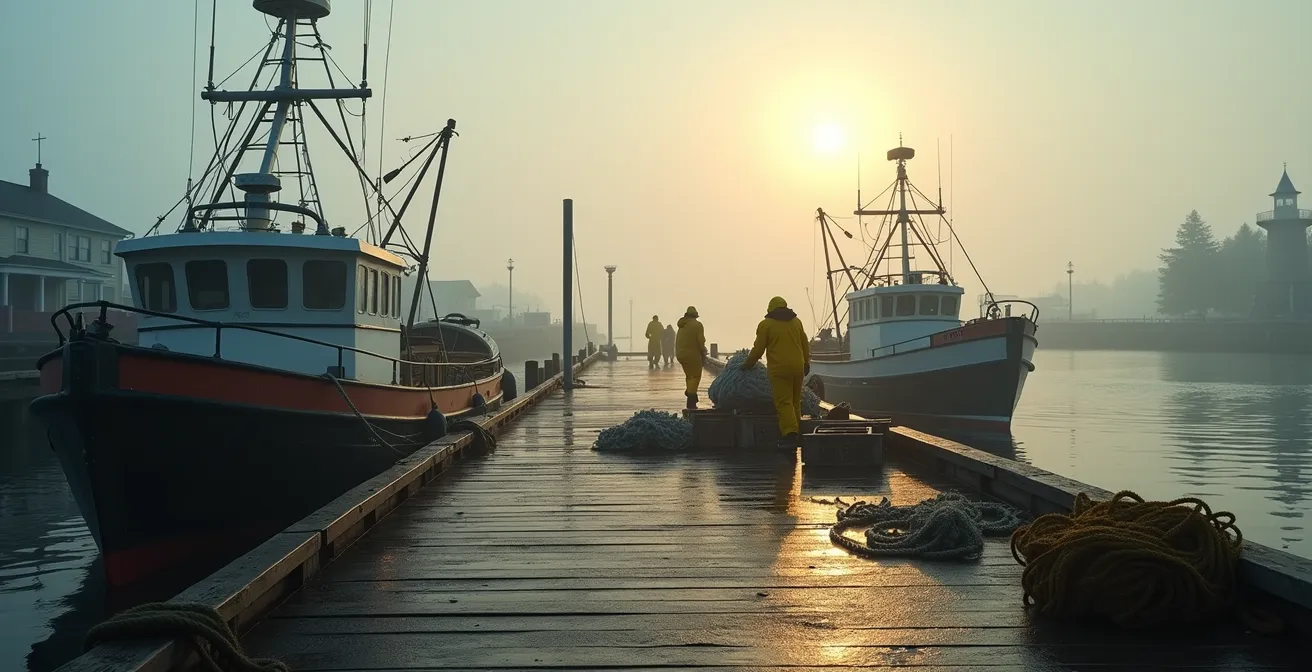
Sustainable seafood in Canada is about more than just a logo; it’s a delicious journey into the story, season, and science behind every bite.
- Seasonal cycles, not just holiday demand, are the primary driver of lobster prices in the Maritimes.
- “Farmed” doesn’t automatically mean unsustainable, especially when the salmon comes from modern, land-based systems.
Recommendation: Look for the Ocean Wise symbol, but also ask your fishmonger about the specific origin and season to make truly informed and flavourful choices.
For anyone who loves the fresh, briny taste of Canadian seafood, there’s a question that often surfaces just as you’re about to order: is this choice a good one for our oceans? The desire to enjoy a perfect lobster roll or a beautifully seared salmon fillet comes with a growing awareness of our impact on marine life. We see logos on menus and hear conflicting advice about wild versus farmed fish, often leaving us more confused than confident.
Many guides simply tell you to “look for a label” or “avoid overfished species.” While well-intentioned, this advice barely scratches the surface. It overlooks the fascinating interplay of economics, ecology, and regional culture that defines Canada’s relationship with the sea. This approach misses the deeper truth that making a sustainable choice isn’t a sacrifice; it’s an upgrade. It connects you to the source of your food in a more meaningful way.
What if the key wasn’t just avoiding the “bad” choices, but actively seeking out the “stories”? This guide adopts that very perspective. We will move beyond the logo to understand what it truly guarantees. We’ll explore why your wallet feels lighter during lobster season, decode the real differences between Pacific and Atlantic salmon, and even discover how eating an invasive crab can be a revolutionary act of conservation. We will journey from the docks to your plate, turning you from a passive consumer into a conscious, empowered seafood lover.
This article provides a comprehensive look at making sustainable and delicious seafood choices across Canada. The following summary outlines the key topics we will explore, from decoding eco-labels to embarking on a culinary journey through Canada’s historic maritime regions.
Summary: A Deep Dive into Canadian Sustainable Seafood
- What the “Ocean Wise” symbol on a menu actually guarantees?
- Why lobster is cheaper in May/June vs. December in the Maritimes?
- Pacific Wild Salmon vs. Atlantic Farmed: understanding the texture and eco-impact
- Eating Green Crab: how culinary trends are helping control invasive species?
- Frozen vs. Fresh: spotting thawed seafood sold as “fresh catch” in tourist traps
- Lunenburg vs. St. John’s: which harbor offers better history tours?
- Sweet condensed milk sauce: why asking for tzatziki gets you kicked out?
- Driving Route des Navigateurs: Exploring the St. Lawrence South Shore
What the “Ocean Wise” symbol on a menu actually guarantees?
Seeing the small, fish-shaped Ocean Wise symbol next to a menu item is the most common signpost for sustainable seafood in Canada. But what does it really mean? It’s not just a marketing sticker; it’s a commitment backed by science. When a restaurant or supplier uses this symbol, it guarantees that the seafood has been assessed by the Ocean Wise Conservation Association against rigorous criteria. These criteria ensure that the species is resilient to fishing pressure and that the fishing or farming methods cause minimal harm to marine habitats and other species.
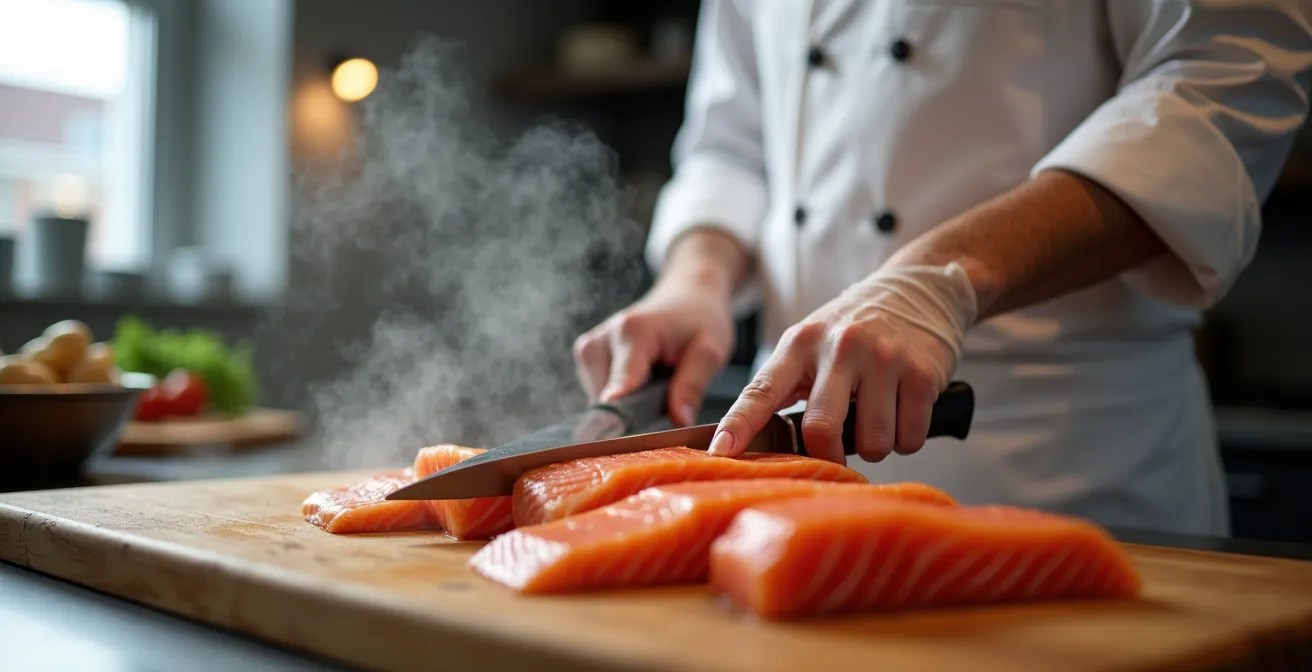
This program’s reach is significant, having grown to include over 575 partners in more than 3,000 locations across Canada. A crucial aspect many people miss is that Ocean Wise doesn’t automatically favour wild over farmed. As the Ocean Wise Program itself clarifies, their recommendations include both, provided they meet strict standards. According to their partnership literature:
Ocean Wise recommends both farmed and wild seafood as sustainable, but these options must meet our criteria to become an Ocean Wise recommended option
– Ocean Wise Program, Centennial College Partnership Description
This means a land-based farmed salmon could be a better choice than a wild fish from a depleted stock. The symbol represents a dynamic, scientific assessment, not a static rule. It assures you that an expert has already done the complex homework, verifying the traceability and sustainability of your meal.
Why lobster is cheaper in May/June vs. December in the Maritimes?
Anyone who has travelled through Canada’s Maritime provinces knows the joy of a fresh, affordable lobster roll in late spring. Yet, trying to buy lobster for a festive holiday dinner in December can feel like a luxury expense. This price swing isn’t just about holiday demand; it’s a perfect example of seasonal gastronomy, where price is directly tied to the natural cycles of the fishery. The primary reason is supply. The largest and most lucrative lobster fisheries in Canada, particularly Southwest Nova Scotia’s LFAs 33 and 34, operate from late November through May.
This fishing season creates a massive influx of lobster onto the market in the spring. With so much product available, prices naturally fall. It’s not uncommon to see Maritime lobster prices dip below $10/lb during the peak May-June season, while climbing well above $15/lb in December when the supply is lower and international demand for holidays is high. During the 2023-2024 season in LFAs 33 and 34, fishermen landed nearly 23,000 metric tons, with dock prices for top-quality lobster hovering around CAD $10-$11.50 per pound, as confirmed by an analysis of Canada’s lobster season.
Choosing to eat lobster in the Maritimes during its peak season is the ultimate sustainable act. You’re not only getting the best price and the freshest product, but you’re also eating in harmony with the region’s economic and ecological rhythms. It’s a delicious lesson in how market forces are deeply connected to the ocean’s natural abundance.
Pacific Wild Salmon vs. Atlantic Farmed: understanding the texture and eco-impact
The “salmon” on a menu can mean many different things, and the debate between wild Pacific and farmed Atlantic is often oversimplified. The truth lies in the details of their origin, which directly impacts their flavour, texture, and ecological footprint. Wild Pacific salmon, like Sockeye, Chinook, and Coho, live a varied life, resulting in a leaner, firmer flesh. Their flavour is often more complex and distinct, a direct reflection of their diverse diet in the open ocean. Farmed Atlantic salmon, on the other hand, is typically raised in a more controlled environment on a high-fat diet, resulting in a softer, more oily texture and a milder flavour.
From a sustainability perspective, the “wild is best” mantra isn’t always true. While a well-managed wild fishery is an excellent choice, some wild stocks are threatened. Conversely, while traditional open-net pen fish farms have been criticized for issues like pollution and disease transfer to wild populations, a sustainable alternative is rapidly emerging: land-based Recirculating Aquaculture Systems (RAS). These closed-loop systems have minimal impact on surrounding ecosystems and are often an Ocean Wise recommended choice. The key is knowing which questions to ask.
The following table, adapted from Ocean Wise’s educational materials, breaks down these differences, offering a clear guide to using texture as a tell for what’s on your plate.
| Type | Fat Content | Texture | Sustainability Notes |
|---|---|---|---|
| Sockeye (Wild Pacific) | Medium-High | Firm, dense | Ocean Wise recommended when caught sustainably |
| Chinook/King (Wild Pacific) | Highest | Rich, buttery | Subject to seasonal assessments |
| Coho (Wild Pacific) | Medium | Delicate | Well-managed BC/Alaska stocks |
| Atlantic Farmed | High | Soft, oily | Land-based RAS systems emerging as sustainable alternative |
Your 5-Step Audit for a Sustainable Salmon Choice
- Points of Contact: Identify all information sources available at the point of purchase: menu descriptions, packaging labels (especially the Ocean Wise logo), and the fishmonger or server.
- Collect Data: Inventory the specific claims made about the salmon. Is it “Wild Pacific,” “Farmed Atlantic,” “BC Sockeye”? Note the precise origin and production method claimed.
- Check for Coherence: Compare the collected data against core sustainability principles. If it’s “Farmed Atlantic,” does the seller know if it’s from a land-based RAS system? If “Wild Pacific,” is the species currently recommended by Ocean Wise?
- Assess the Story: Evaluate the transparency of the information. A generic label like “Fresh Salmon” is a red flag. A specific story, such as “Wild Coho caught in Haida Gwaii waters last week,” signals authenticity.
- Build Your Action Plan: Based on your audit, make your choice. If information is lacking, ask direct questions. If the answers are vague, select a different, more transparently-sourced option or consult the Ocean Wise database on your phone.
Eating Green Crab: how culinary trends are helping control invasive species?
One of the most innovative and impactful frontiers in sustainable eating is what could be called culinary ecology: turning an environmental problem into a delicious solution. A prime example in Canada is the European Green Crab. This small, aggressive crustacean is not native to our waters but is a highly successful invader, notorious for destroying vital eelgrass beds that serve as nurseries for juvenile fish and for outcompeting native species for food. These crabs have been established in Canadian waters since 1951 and are now found from Nova Scotia and the Gulf of St. Lawrence all the way to British Columbia.
For years, their impact was seen as a purely ecological disaster. But pioneering chefs and conservationists are reframing the narrative through an exciting concept: conservation by consumption. By creating a market for green crabs, we can incentivize their removal from sensitive habitats. Chefs are now experimenting with these crabs, particularly their intensely flavourful roe (often called “the ocean’s foie gras”) and soft-shell varieties, to create unique bisques, sauces, and seafood dishes. This trend creates a win-win: diners get to experience a new, exciting flavour profile while directly contributing to the restoration of marine ecosystems.
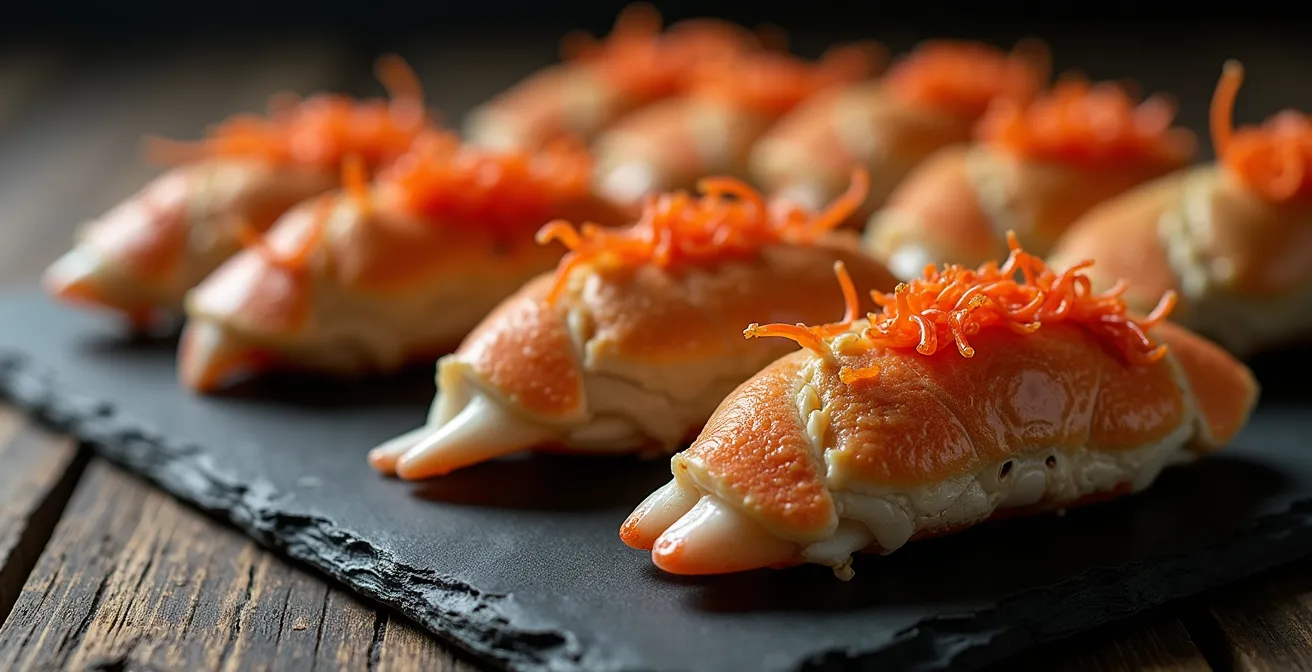
When you see green crab on a menu, it’s more than a novelty. It’s an invitation to participate in a grassroots conservation effort. Asking for it and creating demand helps support the fishermen who are working to control this invasive population. It’s a powerful and tasty way to turn the tide, proving that a thoughtful appetite can be one of our most effective environmental tools.
Frozen vs. Fresh: spotting thawed seafood sold as “fresh catch” in tourist traps
In an ideal world, all seafood would travel from the boat to our plate within hours. But the reality of supply chains means that freezing is often a necessary and excellent way to preserve quality. In fact, a properly flash-frozen-at-sea fish can be of higher quality than a “fresh” fish that has been sitting on ice for a week. The problem arises when previously frozen products are dishonestly marketed and sold as “fresh catch of the day,” especially in high-traffic tourist areas. Learning to spot the difference is crucial for any discerning seafood lover.
True freshness has clear visual indicators. A genuinely fresh fish will have bright, plump, and clear eyes that bulge slightly. Its gills should be a vibrant red or pink, not pale or brown. The most telling sign is the flesh: it should be firm and spring back immediately when you press it. The skin should be shiny and moist, with scales that are tightly adhered. Any fishy or ammonia-like smell is an immediate red flag; fresh seafood should smell clean and of the sea.
Conversely, seafood that was frozen and then thawed often betrays its history. Its eyes may be cloudy, sunken, or opaque. The gills can look faded and brownish. The flesh is often softer and may retain an indentation when pressed. Sometimes, you can even spot small signs of freezer burn or excess milky liquid pooling in the packaging. Don’t be shy at the fish counter. Asking specific questions like “When was this caught?” and “Has this been previously frozen?” can tell you a lot. A trustworthy fishmonger will have clear, confident answers.
Lunenburg vs. St. John’s: which harbor offers better history tours?
A deep appreciation for sustainable seafood is intrinsically linked to understanding the human history behind the harvest. Canada’s coastal communities were built by the fishing industry, and exploring their historic harbours provides a powerful context for the choices we make today. Two of the most iconic harbours, Lunenburg, Nova Scotia, and St. John’s, Newfoundland, offer different but equally compelling windows into this heritage. Choosing between them depends on the story you wish to uncover.
Lunenburg is a journey into a perfectly preserved past. As a UNESCO World Heritage site, its iconic, colourful waterfront is a living museum of the age of sail. A tour here is dominated by the legacy of the Grand Banks schooner fishery, epitomized by the famous Bluenose II. Walking its streets feels like stepping back in time, offering a poignant look at the craftsmanship and resilience required to build a community around fishing dories and schooners. It’s a story of artistry and a deep, often perilous, connection to the sea.
St. John’s, by contrast, offers a grittier, more vibrant, and living history. As one of North America’s oldest cities, its harbour is a bustling, working port where history and modernity collide. Tours here focus on its strategic importance, its role as a hub for centuries of transatlantic fishing, and the resilient, unique culture that has grown around it. It’s less of a museum and more of a living chronicle, where you can feel the pulse of the contemporary fishing industry alongside centuries-old stories of hardship and celebration. Lunenburg is a beautifully curated photograph; St. John’s is a dynamic, ongoing film.
Sweet condensed milk sauce: why asking for tzatziki gets you kicked out?
Embarking on a culinary tour of Canada’s fishing outports is a journey of discovery, and sometimes, the most memorable discoveries are the most unexpected. While you might be focused on the subtle differences between cod and haddock, true cultural immersion means embracing the local traditions that surround the fish itself—including the condiments. In some Newfoundland communities, you might encounter a surprising sauce served with fried fish: a simple, sweet concoction made with sweetened condensed milk.
To an outsider, this pairing might seem bizarre. One might be tempted to ask for a more familiar tartar sauce or, heaven forbid, something like tzatziki. This is where a lesson in culinary respect comes in. This sweet sauce is a part of a specific local food tradition, likely born of necessity and pantry-staple ingenuity in isolated outports. It’s a flavour profile that belongs to that place, a piece of its unique cultural identity. To dismiss it or demand an “upgrade” is to miss the entire point of the experience.
The provocative question of “getting kicked out” for asking for tzatziki is, of course, a hyperbole. But it contains a grain of truth. It’s a reminder that when we travel for food, we are guests in someone else’s kitchen. The goal should be to understand and appreciate, not to impose our own tastes. So, if you’re ever offered fried cod with a side of sweet, milky sauce during a Newfoundland “scoff,” try it. You might not love it, but you will have tasted a genuine piece of local history, which is a far more enriching experience than any generic condiment could ever provide.
Key takeaways
- The Ocean Wise symbol is a guarantee of science-based criteria, covering both sustainable wild and farmed options that meet strict standards.
- Seafood prices are a direct reflection of natural supply cycles; eating seasonally, like enjoying Maritime lobster in spring, is both more affordable and more sustainable.
- Your food choices can directly aid conservation; eating invasive species like green crab is an act of “culinary ecology” that helps restore marine balance.
Driving Route des Navigateurs: Exploring the St. Lawrence South Shore
The final piece of the sustainable seafood puzzle is understanding the vast, interconnected ecosystems where these species live. There is no better way to do this in Eastern Canada than by driving the Route des Navigateurs (Navigator’s Route). This scenic drive along the south shore of the St. Lawrence River is more than just a road trip; it’s an immersive journey along one of the world’s most important and majestic waterways.
Stretching from Baie-du-Febvre to Gaspé, the route hugs the coastline, offering breathtaking views of the river as it widens into a massive estuary and finally meets the Atlantic Ocean. Along the way, you pass through charming maritime villages, historic lighthouses, and national parks. But beyond the scenery, this drive provides a profound sense of the river’s scale and its role as a vital ecological engine. This estuary is a nursery for countless fish species, a feeding ground for whales, and a critical habitat for seabirds.
Driving this route connects all the dots of our sustainable seafood journey. You witness firsthand the environment that our choices impact. You see the fishing boats heading out from small harbours and gain a tangible sense of the communities that depend on the river’s health. It transforms the abstract idea of “marine conservation” into a concrete landscape of water, tides, and life. The health of the St. Lawrence is directly tied to the health of the seafood on our plates. This drive serves as a powerful, beautiful reminder of what we are all working to protect.
Your next delicious seafood meal is an opportunity to practice this new knowledge. Start by asking about the story behind the fish on your plate and choose an option that is as rich in flavour as it is in integrity.
Frequently Asked Questions About Choosing Seafood
What are the visual indicators of truly fresh fish?
Fresh fish has clear, plump eyes that bulge slightly, bright red or pink gills, and firm flesh that springs back when pressed. The skin should be shiny with tightly adhered scales.
How can you identify previously frozen fish being sold as fresh?
Previously frozen fish typically has cloudy, sunken eyes, pale or brownish gills, and soft flesh that retains indentations. There may be visible ice crystals or freezer burn marks on the flesh.
What questions should consumers ask at fish counters?
Ask ‘When was this caught?’ and ‘Which boat caught it?’ Also inquire if it’s been previously frozen. In tourist areas, be especially vigilant and don’t hesitate to ask these direct questions to ensure you’re getting what you pay for.