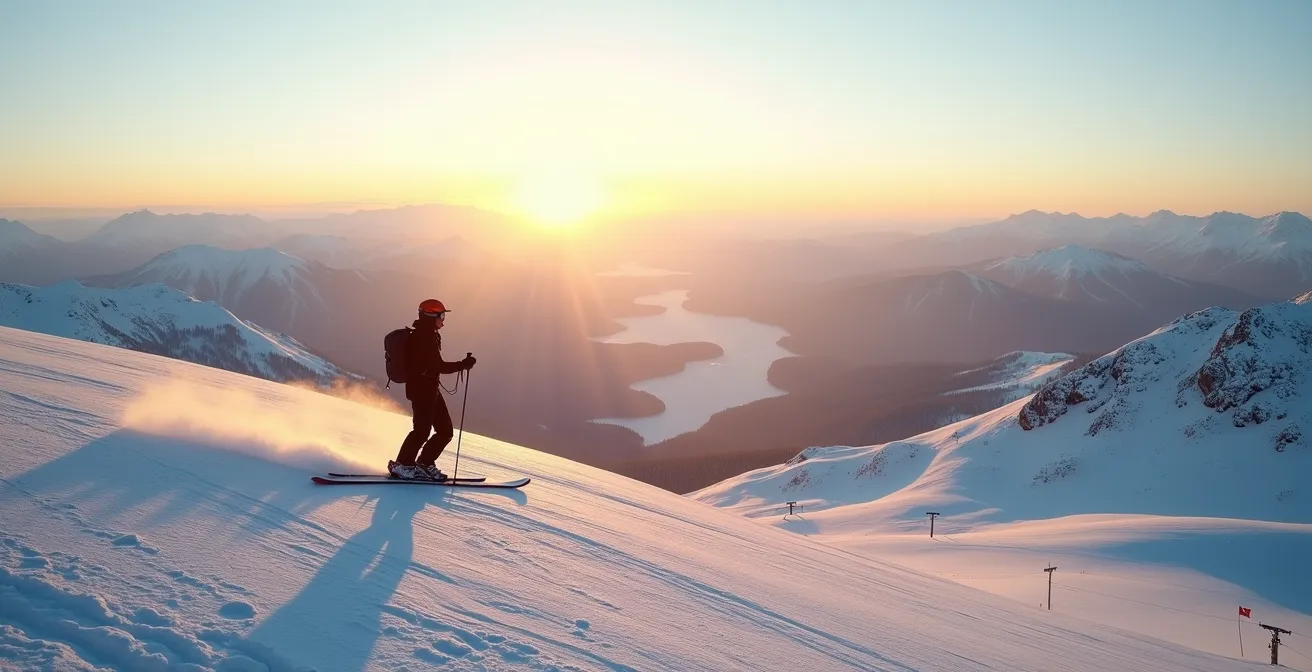
The secret to an affordable Canadian ski vacation isn’t about skipping meals; it’s about understanding the system of pricing deadlines, regional regulations, and seasonal windows that insiders use.
- Lift tickets are your biggest lever: booking passes months in advance, especially before May deadlines, can save you over 40%.
- Your timing is crucial: avoid major holidays like Christmas and March Break when prices triple, and target “dead weeks” in January or the spring season for massive savings.
- Hidden costs add up: be aware of mandatory winter tire regulations for rental cars and differing search-and-rescue policies between provinces.
Recommendation: Prioritize purchasing your lift passes and booking your main transport well in advance. These two decisions will have the largest impact on your total budget.
The vision is iconic: vast mountain landscapes, epic powder, and the crisp air of a Canadian winter. For skiers worldwide, a trip to destinations like Whistler, Banff, or Tremblant is a bucket-list dream. But that dream often comes with a dose of reality—the perceived high cost of a slope-side vacation. Many prospective visitors are daunted by the prices of lift tickets, accommodation, and transport, believing such a trip is financially out of reach.
The standard advice for budget travel—book early, cook your own meals, find a cheap place to stay—is a good starting point, but it barely scratches the surface of what’s possible. These tips are generic. The real key to unlocking an affordable Canadian ski experience lies in a deeper, more strategic approach. It’s about understanding the specific systems that govern pricing at Canadian resorts, from non-obvious pass deadlines to the logistical traps that catch uninformed travelers.
But what if the secret wasn’t about simply cutting corners, but about mastering the game? This guide moves beyond the basics to give you an insider’s playbook. We will deconstruct the core components of a ski trip budget, revealing the specific, actionable strategies for saving money on everything from lift passes to lodging. You’ll learn not just *what* to do, but *why* it works in the Canadian context.
This article provides a structured breakdown of how to budget effectively for your Canadian ski adventure. We’ll explore the critical decisions you need to make, from choosing the right pass and timing your visit to understanding local regulations that can have a significant impact on your wallet. Get ready to plan a smarter, more affordable trip.
Summary: Alpine Skiing in Canada Budgeting Guide
- How to save 40% on lift tickets at Whistler Blackcomb by booking early?
- Tremblant vs. The Rockies: comparing snow conditions and village vibe
- Why accommodation prices triple during “March Break” and Christmas?
- Skiing out of bounds: who pays for the rescue if you get lost?
- When to book for the best spring skiing conditions and lower prices?
- Why winter tires are mandatory from October to March on this highway?
- Revelstoke vs. Whistler: which offers better steep-and-deep terrain for advanced riders?
- Renting Mountain Chalets: Avoiding Scams and Managing Group Logistics
How to save 40% on lift tickets at Whistler Blackcomb by booking early?
The single most impactful way to control your ski vacation budget is by mastering the lift ticket purchase. Waiting to buy at the ticket window is a rookie mistake that can cost you dearly. The key is understanding the resort’s pass structure, which heavily rewards early commitment. At Whistler Blackcomb, for instance, the pricing model is built around products like the Epic Pass and the EDGE Card, which offer substantial savings over single-day tickets.
The golden rule is to buy before the major price increases, with the most significant deadline typically falling in late May. Planning your trip this far in advance can feel counterintuitive, but it’s where the deepest discounts of up to 65% are found. For international travelers or those planning to ski six or more days, the multi-resort Epic Pass at around $982 USD provides unlimited access and often proves to be the best value. For Canadian residents planning a shorter trip, the EDGE Card, offering 2-10 days of skiing, is the more targeted and cost-effective option.
These passes come with additional perks that contribute to your savings. Epic Pass holders, for example, often receive 20% off food, lodging, and rentals at the resort, further reducing ancillary costs. It’s a complete system designed to lock in visitors early.
Case Study: The Ultimate Budget Whistler Trip
One savvy traveler demonstrated how powerful this strategy can be by combining an early-bird Epic Season Pass purchase with credit card points to cover flights. By staying at the HI Whistler hostel for about $32 USD per night and relying on public transit, their weekly on-the-ground spending was kept to a remarkable C$250-300. This made Whistler, often perceived as one of the most expensive resorts, their cheapest ski destination of the year.
By aligning your purchase with the resort’s sales cycle, you’re not just getting a “deal”; you’re leveraging the core pricing mechanism to your advantage. A few hours of planning in the spring can save you hundreds, if not thousands, of dollars come winter.
Tremblant vs. The Rockies: comparing snow conditions and village vibe
Choosing where to ski in Canada is about more than just finding the best price; it’s about matching the destination to your desired experience. The two most iconic ski regions, Quebec’s Mont-Tremblant and the Western Canada’s Rocky Mountains (home to resorts like Banff, Lake Louise, and Jasper), offer profoundly different atmospheres, snow conditions, and logistical considerations.
Mont-Tremblant, nestled in the Laurentian Mountains, is famous for its picturesque, European-style pedestrian village. The colorful buildings, cobblestone streets, and distinctly French-Canadian “joie de vivre” create a festive and charming atmosphere. The snow here is often harder and icier due to the colder, more humid climate, leading to excellent grooming conditions and fast runs. It’s a fantastic destination for families and intermediate skiers who value a vibrant village life as much as the on-slope action.
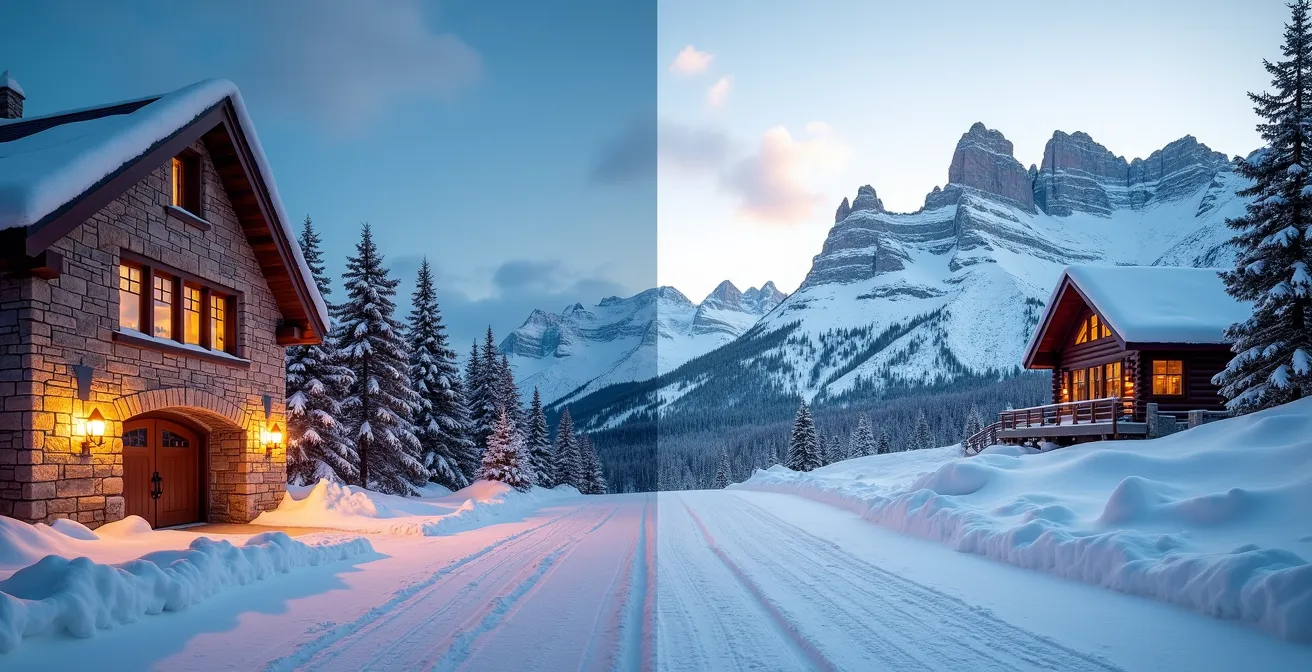
In stark contrast, the Rocky Mountains are defined by their sheer scale and wild, untamed beauty. The peaks are jagged and immense, the landscape is dramatic, and the vibe is more rugged and adventurous. The snow is legendary: the “champagne powder” of the interior is typically lighter, drier, and much deeper, offering world-class conditions for powder hounds and off-piste explorers. The towns, like Banff, have a more classic mountain-town feel, prioritizing access to the vast wilderness over a curated village experience.
Your choice has budget implications. Flights to Montreal (for Tremblant) can be cheaper from Europe, while flights to Calgary (for the Rockies) are often more accessible from Asia and the Western US. Ultimately, the decision comes down to your priorities: the cozy, curated charm of Quebec or the raw, powder-filled majesty of the West.
Why accommodation prices triple during “March Break” and Christmas?
You’ve found the perfect mountain-side condo, but the price seems astronomical. The reason is almost always timing. The cost of a Canadian ski vacation is governed by the simple laws of supply and demand, which peak ferociously during two key periods: the Christmas to New Year’s holiday (roughly Dec 20 – Jan 5) and “March Break” (a staggered two-to-three week period in March when school holidays occur across Canada and parts of the US). During these weeks, demand for flights and lodging skyrockets, and prices can easily double or triple compared to the rest of the season.
Data confirms this trend. For example, Expedia’s 2025 data shows that ski packages to Canada can start from as low as $771 during off-peak times, a figure that becomes a distant memory during holiday surges. This isn’t a hidden fee; it’s pure dynamic pricing. Resorts and rental owners know they can charge a premium when everyone wants to travel at the same time, and they do.
The insider’s strategy is to identify and target the “dead weeks”—periods of low demand nestled between the major holidays. Skiing during these windows provides the same great snow and mountain access for a fraction of the cost. The best part? The slopes are often significantly less crowded. Planning your trip around these lulls is one of the most effective ways to slash your accommodation budget.
Here are the key windows to target for maximum savings:
- First two weeks of December: You get a festive atmosphere and early-season snow without the premium Christmas pricing.
- The “January Thaw” (Jan 8-25): This post-holiday window is arguably the cheapest time of the entire winter.
- Avoid US holiday weekends: Be mindful of Martin Luther King Jr. Day (January) and Presidents’ Day (February), which cause significant price and crowd surges from American visitors.
By being flexible with your dates and consciously avoiding these peak periods, you can save 50% or more on lodging—a huge win for your overall budget.
Skiing out of bounds: who pays for the rescue if you get lost?
The allure of untracked powder just beyond the resort boundary is a powerful siren’s call for many advanced skiers. However, venturing into the backcountry, or “out of bounds,” in Canada comes with significant financial risks and responsibilities that vary dramatically by province. This is a critical piece of “regulatory arbitrage” that every skier should understand before ducking under a rope.
In British Columbia, home to resorts like Whistler and Revelstoke, the policy is remarkably forgiving. As the British Columbia Search and Rescue Association highlights, the service is provincially funded and provided free of charge to those in need. This policy is in place to ensure no one hesitates to call for help due to financial concerns.
In British Columbia, Search and Rescue (SAR) is provincially funded and free, but in other provinces, you could be billed.
– British Columbia Search and Rescue Association, Provincial SAR Funding Guidelines
This is not the case elsewhere in Canada. In other provinces, such as Alberta, you could be held financially liable for the cost of your rescue. These bills can be substantial, potentially running into thousands of dollars depending on the complexity of the operation and whether helicopters are required. Furthermore, it’s crucial to check your travel insurance policy. Most standard policies explicitly exclude off-piste or backcountry skiing. To be covered, you typically need to purchase a specific “adventure sports” add-on, which can increase your premium.
The safest and most financially prudent way to experience Canada’s legendary backcountry is to hire a certified guide from the Association of Canadian Mountain Guides (ACMG). While it’s an upfront cost, it provides expert knowledge of the terrain and snowpack, dramatically increases your safety, and is almost certainly cheaper than a potential rescue bill. It’s an investment in an unforgettable—and safe—experience.
When to book for the best spring skiing conditions and lower prices?
For many seasoned skiers, spring is the secret season. While others are packing up their gear, those in the know are enjoying sunny skies, soft “corn” snow, and significantly lower prices. Spring skiing, typically from late March through April (or even May in the Rockies), offers a fantastic combination of pleasant weather and a relaxed, fun atmosphere on the slopes.
The financial benefits are substantial. As demand drops off after March Break, accommodation prices fall sharply. In fact, Canadian ski operators report that you can find 30-40% lower accommodation rates in the spring season compared to the winter peak. This seasonal window allows you to enjoy world-class resorts without the premium price tag. The crowds thin out, lift lines disappear, and the entire experience becomes more laid-back.
The snow conditions are also a major draw. As the daily freeze-thaw cycle works its magic, the snow transforms into a forgiving, hero-making surface known as corn snow. It’s perfect for carving, learning new skills, or simply cruising in the sun. Resorts also capitalize on this period with special deals to extend their season.
Case Study: The End-of-Season Pass Advantage
Many Canadian resorts offer deeply discounted “end-of-season” passes valid for the last 3-4 weeks of operation. These passes are often cheaper than a regular 3-day lift ticket, offering incredible value. By booking accommodation just one or two weeks in advance during mid-April in Western Canada or late March in the East, skiers can secure savings of 30-40% while enjoying some of the most enjoyable conditions of the year.
Booking for spring requires less long-term planning than a mid-winter trip. You can often watch the weather forecasts and book a week or two out, capitalizing on late-season snowfalls and sunny outlooks. It’s the perfect strategy for a more spontaneous and budget-friendly Canadian ski adventure.
Why winter tires are mandatory from October to March on this highway?
One of the most overlooked “logistical traps” for out-of-province and international visitors is Canada’s strict winter tire regulations. This isn’t a friendly suggestion; it’s the law in several provinces, and non-compliance can lead to fines, voided insurance, and potentially catastrophic accidents. For example, on British Columbia’s famous Sea-to-Sky Highway (the main route to Whistler), winter tires are mandatory from October 1 to March 31.
The reason is simple: safety. All-season tires lose their elasticity and grip in cold temperatures, becoming hard and ineffective on snow and ice. Winter tires are made from a softer rubber compound and have a specific tread pattern designed to maintain flexibility and traction in cold, slick conditions. The Three-Peak Mountain Snowflake symbol on the tire’s sidewall is the legal indicator of a true winter tire.
For travelers renting a car, this presents a budget challenge. Rental companies often charge a premium of $15-25 CAD per day for a vehicle equipped with winter tires. This can add a significant, unexpected cost to your trip. Ignoring this could be even more expensive, with fines around $130 in BC and, more critically, the risk of your insurance being voided if you’re in an accident with the wrong tires.
Your Winter Tire Compliance Action Plan: Sea-to-Sky Highway & Beyond
- Verify the Symbol: Before leaving the rental lot, physically check that the tires have the official Three-Peak Mountain Snowflake symbol. Do not rely on the rental agent’s word alone.
- Budget the Fee: Factor in the $15-25 CAD daily winter tire fee from the rental company into your total transportation budget.
- Know the Fines: Be aware that fines for non-compliance are approximately $130 in British Columbia and vary by province. This is a trip-disrupting expense to avoid.
- Consider Shuttles: To bypass the tire issue entirely, research airport shuttle services like Epic Rides (to Whistler) or the Banff Airporter. The cost can be comparable to a rental car once you factor in gas, parking, and tire fees.
- Check Your Insurance: Confirm that your personal or travel insurance policy remains valid. Driving without legally required tires can void your coverage in the event of an accident.
To help you decide the best course of action, it’s useful to compare the costs directly. While a rental car offers flexibility, the added liability and cost of winter tires can sometimes make a shuttle a more stress-free and economical choice.
| Option | Daily Cost | Pros | Cons |
|---|---|---|---|
| Car Rental with Winter Tires | $50-75 CAD + gas | Flexibility, storage | Tire liability, parking fees |
| Airport Shuttle | $78-104 CAD roundtrip | No tire worry, relaxing | Fixed schedule, no flexibility |
| Public Transit | $5-10 CAD | Cheapest option | Multiple transfers, long travel time |
Ultimately, understanding and planning for winter tire requirements is a non-negotiable part of a safe and budget-conscious Canadian ski trip.
Revelstoke vs. Whistler: which offers better steep-and-deep terrain for advanced riders?
For the advanced and expert skier, the choice of resort often boils down to a single question: where can I find the best challenging terrain and the deepest powder? In Western Canada, two titans dominate this conversation: the sprawling giant of Whistler Blackcomb and the vertical behemoth of Revelstoke Mountain Resort. While both offer world-class skiing, they cater to slightly different definitions of “expert.”
Whistler Blackcomb is defined by its sheer variety and scale. With over 8,100 acres of skiable terrain across two mountains, it offers an almost endless array of bowls, glaciers, glades, and high-alpine steeps. Its lift system is unparalleled, providing quick access to a vast playground. However, its popularity means that fresh tracks in obvious areas get devoured quickly. To guarantee fresh powder, many opt for the “Fresh Tracks” breakfast ticket, adding a premium to an already expensive day.
Revelstoke, on the other hand, plays a different game. It’s all about vertical. In fact, ski resort statistics confirm that Revelstoke boasts North America’s longest vertical descent at 1,713 meters. This incredible, leg-burning vertical means longer, uninterrupted runs through its legendary glades and steep bowls. The resort’s DNA is geared towards big-mountain, powder-focused riding.
Cost-Per-Vertical-Meter: A Better Value Metric
When you analyze the value, Revelstoke presents a compelling case. While daily lift ticket prices are comparable to Whistler’s, the sheer vertical offered at Revelstoke results in a better cost-per-vertical-meter value. Furthermore, Revelstoke’s lower skier density means that fresh tracks can often be found well into the afternoon, even on a powder day, without paying a premium. For the powder purist focused on maximizing quality, deep turns, Revelstoke often delivers more bang for your buck.
The choice is a matter of philosophy. If you value endless variety, a massive lift network, and a world-renowned village, Whistler is hard to beat. If your priority is hunting for the deepest snow on the longest, most consistently steep pitches in North America, Revelstoke is your paradise.
Key Takeaways
- The single biggest budget savings come from buying lift passes months in advance to meet early-bird deadlines.
- Strategic timing is crucial; avoiding Christmas and March Break while targeting “dead weeks” in January or the spring season can cut accommodation costs by 50% or more.
- Understanding local Canadian regulations, such as mandatory winter tires and provincial differences in search-and-rescue costs, is essential for avoiding major unexpected expenses.
Renting Mountain Chalets: Avoiding Scams and Managing Group Logistics
For group trips, renting a large chalet or condo can be the most cost-effective and social lodging option. Having a shared kitchen and living space allows your group to save money by cooking meals and provides a central hub for après-ski activities. However, navigating the world of private rentals, especially on platforms like Kijiji or Craigslist, comes with risks of scams. Furthermore, managing the finances of a large group can quickly become a logistical nightmare.
The cardinal rule for booking is to never use an e-transfer or wire transfer for a deposit on an unverified listing. These methods offer no protection if the listing turns out to be fraudulent. Stick to reputable platforms like VRBO or Airbnb, which have built-in payment protection, or book directly with established local property management companies. Also, verify that the property has the required municipal short-term rental permit, as rules vary significantly between towns like Canmore, Alberta, and Mont-Tremblant, Quebec.
Once booked, effective financial management is key to a harmonious trip. Here are some proven protocols for managing group expenses:
- Designate a “CFO”: Appoint one organized person to be in charge of tracking all shared expenses.
- Use a Tracking App: Apps like Splitwise are invaluable. They allow everyone to log expenses (groceries, drinks, etc.) and automatically calculate who owes whom at the end of the trip, factoring in Canada’s 13% HST/GST.
- Budget for Hidden Fees: Be aware of common add-on charges that aren’t always obvious upfront, such as hot tub usage fees ($50-100), per-person charges above a certain group size ($25/person), and steep cleaning fees ($200-400).
We negotiated our Airbnb price by filling a gap the host had in their calendar, stayed right in Whistler village with mountain views, outdoor hot tub and heated pool. By returning our rental car after arrival and doing grocery shopping outside town first, we saved about $50/day plus avoided the 20% markup at Whistler grocery stores.
– Successful Group Traveler, Overland Exposure
By using secure booking methods and a clear system for managing shared costs, your group can enjoy the benefits of a mountain chalet without the financial stress or risk.
Now that you have the insider’s playbook on everything from lift passes to lodging, you’re equipped to bypass the common budget traps. The next logical step is to start building your own affordable Canadian ski adventure, tailored to your group’s needs and budget.
Frequently Asked Questions About Skiing in Canada
Is backcountry rescue free in all Canadian provinces?
No, only British Columbia provides free SAR services. Other provinces may charge rescue fees ranging from $500 to $10,000 depending on resources used.
Does travel insurance cover off-piste skiing accidents?
Most standard policies do NOT cover off-piste skiing unless you purchase an ‘adventure sports’ rider, which typically adds 15-25% to premium costs.
What’s the cost of hiring an ACMG-certified guide?
Daily rates range from $600-1200 CAD for a group, which is often cheaper than potential rescue costs and provides expert local knowledge.