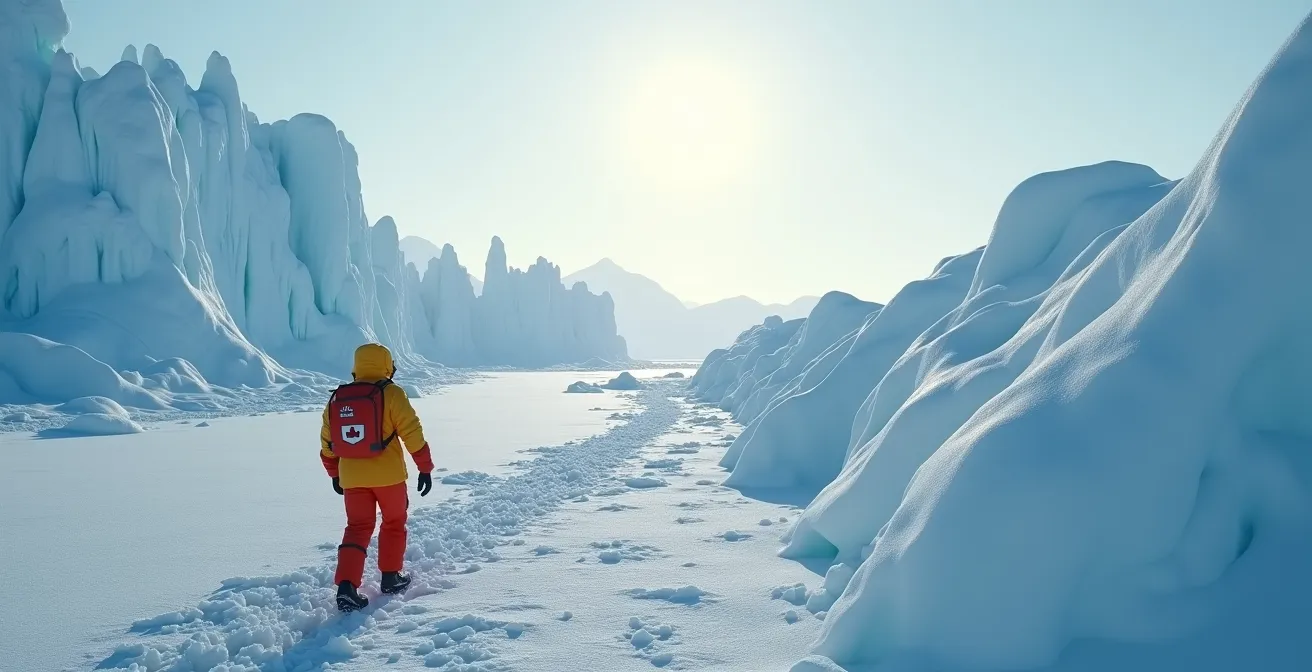
The greatest danger in the Canadian Arctic isn’t the cold; it’s the sweat you produce trying to fight it.
- High-exertion sports demand a sophisticated sweat management system, not just heavy insulation. A wet base layer at -40°C is a critical failure.
- Survival depends less on gear and more on mastering your body’s response to extreme conditions and respecting Inuit Qaujimajatuqangit (IQ)—the traditional knowledge that predicts environmental risks.
Recommendation: Prioritize training for endurance in cold weather and mastering a technical layering system before you even think about booking a flight to Canada’s North.
Forget the serene postcards of polar bears and shimmering northern lights. For the true adrenaline junkie, the Canadian Arctic is not a spectacle to be observed; it’s a physical arena to be conquered. But the rules of engagement here are written by the environment, and they are unforgiving. Many thrill-seekers arrive focused on the external gear—the best jacket, the warmest boots. They prepare for the cold. They rarely prepare for their own body’s reaction to it.
The common advice to “dress in layers” is dangerously simplistic. In the high-stakes world of Arctic dog sledding, kite-skiing, or snowmobiling, your body becomes a high-output engine. The real challenge isn’t staying warm; it’s managing the intense heat and sweat you generate during exertion. This is where most southerners fail. They over-insulate, sweat into their base layers, and the moment they stop moving, that moisture begins to freeze. In the Arctic, your own sweat can become your most immediate enemy.
This guide isn’t about sightseeing. It’s about shifting your mindset from that of a tourist to an athlete preparing for the most extreme competition of their life. We’re going to dismantle the romantic notions and focus on the brutal physics of survival and performance. We will explore how to manage your body as a high-performance machine, why ancient Inuit knowledge trumps modern technology for on-the-ground safety, and the non-negotiable logistical gauntlet you must run just to get to the starting line.
This guide provides a comprehensive breakdown of the physical realities and essential preparations for any serious adventurer heading to Canada’s North. We’ll cover everything from the raw power needed for different sports to the critical science of dressing, recognizing life-threatening conditions, and navigating the logistical challenges unique to the Canadian Arctic.
Summary: Arctic Adventures for Adrenaline Junkies: Beyond Standard Sightseeing
- Dog sledding vs. snowmobiling: physical demands compared for beginners?
- How to dress for -40°C active sports without sweating and freezing?
- Hypothermia signs that set in within 15 minutes of exposure during accidents
- Why you need a licensed guide for polar bear territory excursions?
- When the floe edge tour season begins in Nunavut for optimal safety?
- Frostbite risks: what 90% of southerners forget to cover in coastal winds
- Why satellite phones are non-negotiable for remote fly-in outposts?
- Exploring Canada’s Arctic Coasts: A Logistics Guide for the Intrepid Traveler
Dog sledding vs. snowmobiling: physical demands compared for beginners?
The choice between hearing the panting of a dog team and the roar of a two-stroke engine is more than an aesthetic one; it’s a commitment to two vastly different physical challenges. Don’t mistake either for a passive ride. In the Canadian Arctic, you are an active participant, and your body is the primary machine. Dog sledding often evokes a romantic image of standing on the runners, but the reality, as noted by operators like Arctic Chalet in Inuvik, is that you’re part of the team. When the sled bogs down in deep, soft snow, you are not a passenger; you are an engine. This means jumping off and running alongside the sled, pushing with all your might to help the dogs. It’s a cardiovascular battle fought in heavy boots and restrictive clothing.
Snowmobiling, on the other hand, is a war of attrition against a 500+ pound machine. The physical demand is less about cardio and more about brute-force wrestling. You’ll spend hours using your entire body—core, legs, and arms—to heave the machine over massive sea ice pressure ridges, fight the constant vibration that rattles your joints, and maintain control in unpredictable terrain. It’s a full-body workout that leaves you with a unique kind of exhaustion born from vibration and sustained tension. Emergency situations amplify these demands, from performing field repairs with frozen fingers to having the dexterity to fix a track at -40°C.
To choose your challenge, you must honestly assess your physical engine. Are you built for the explosive, heart-pounding sprints of a musher, or the sustained, grinding strength of a snowmobile rider? The following comparison breaks down the raw physical requirements.
| Aspect | Dog Sledding | Snowmobiling |
|---|---|---|
| Core Physical Demand | Running alongside sled in deep snow when dogs need assistance | Full-body wrestling of 500+ lb machine over pressure ridges |
| Endurance Required | Moderate to high – may run/push for 15-30 minutes in soft snow | High – constant vibration and steering resistance for hours |
| Technical Skills | Learning Inuktitut commands (Qimmiq), reading dog behavior | Navigating sea ice pressure points, mechanical troubleshooting |
| Emergency Physical Demands | Veterinary first-aid, managing injured 60-80 lb dogs | Fixing frozen tracks at -40°C requiring extreme dexterity |
| Recovery Time | 24-48 hours for muscle soreness from running | 2-3 days for vibration fatigue and joint stress |
How to dress for -40°C active sports without sweating and freezing?
This is the single most critical skill for any Arctic athlete. Getting it wrong doesn’t just mean discomfort; it means mission failure and a potential survival situation. The goal is not simply to pile on insulation. The goal is to build a dynamic sweat management system that allows you to vent massive amounts of heat and moisture during exertion, yet seal in warmth the moment you stop. The Canadian Armed Forces have perfected this for their Arctic operations, and their system is the gold standard for any serious adventurer. It’s a multi-layered approach where each component has a specific job in moving moisture away from your skin.
The system’s genius lies in its adaptability and, crucially, in components southerners rarely consider, like the Vapour Barrier Liner (VBL). During multi-day, high-exertion trips, a VBL is used between your base layer and insulation. It stops your sweat from soaking your critical insulating layers, which would otherwise lose their thermal properties and freeze. You will feel damp, but your insulation stays dry and effective. Mastering this system means constantly adjusting—zipping and unzipping, adding or removing layers—to prevent sweat buildup before it starts. You’re not just wearing clothes; you are actively managing a personal microclimate in an environment that wants to shut it down.
This image demonstrates the philosophy of a modular system, where layers are adjusted to balance insulation with ventilation.
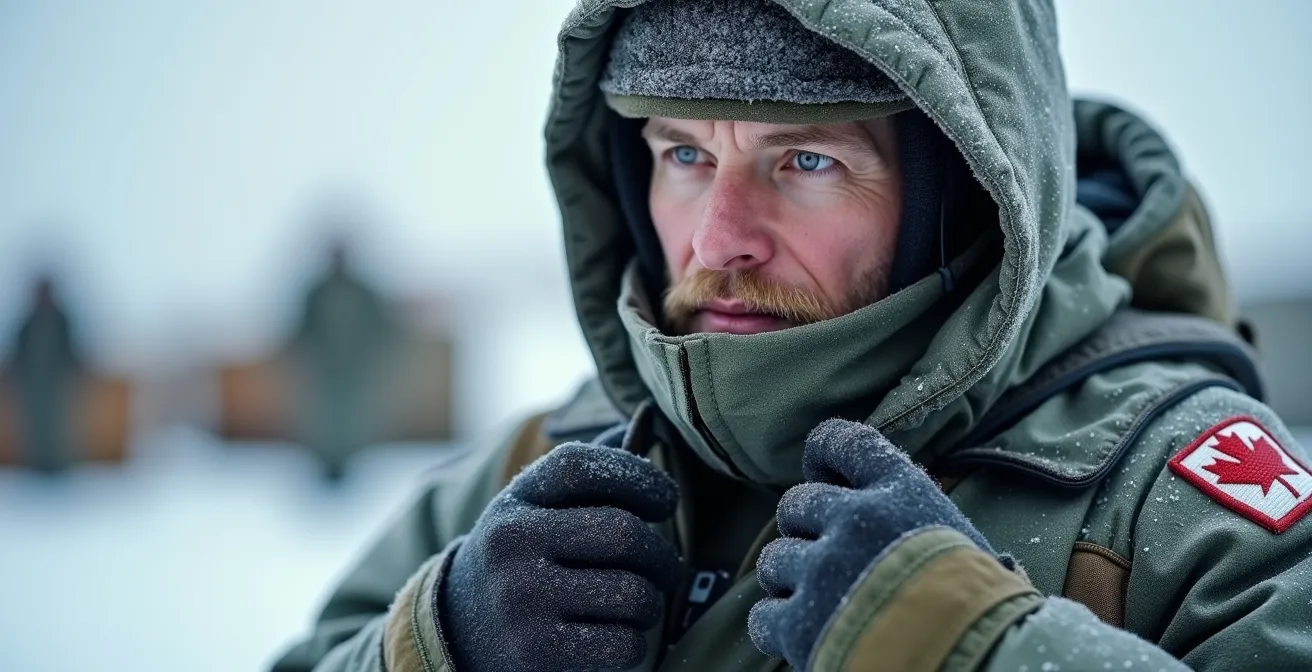
As you can see, it’s not about a single “warm jacket.” It’s about a series of technical layers working in concert. The outer shell blocks the wind, the inner layers manage moisture and trap air, and the base layer’s only job is to get sweat off your skin as fast as possible. Your life depends on this system functioning perfectly.
Your Action Plan: The 5-Layer Arctic Clothing System
- Layer 1: Moisture-Wicking Base: Select a high-quality synthetic base layer. Its sole purpose is to pull sweat away from your skin. No cotton, ever.
- Layer 2: Vapour Barrier Liner (VBL): For multi-day trips, this thin, non-breathable layer is worn over the base layer. It’s counter-intuitive but essential to keep your insulation from getting saturated with sweat.
- Layer 3: Primary Insulation: Choose high-loft Canadian Hutterite goose down for dry, cold conditions or advanced synthetics like PrimaLoft for potentially damp coastal environments. This is your main thermal engine.
- Layer 4: Active Insulation: A fleece or softshell jacket is your active-use layer. It’s what you wear when you’re moving and generating significant heat, often with your main parka strapped to your sled.
- Layer 5: Wind/Waterproof Shell: Your hardshell is your armour against the wind. In coastal areas like the Beaufort Sea, this layer is non-negotiable and is the difference between functional warmth and dangerous wind chill.
Hypothermia signs that set in within 15 minutes of exposure during accidents
In the Arctic, an accident—a snowmobile breakdown, falling through thin ice, or getting separated from your group—instantly starts a clock. Your body’s fight to maintain its core temperature is ferocious but finite. While Canadian Armed Forces studies show an untrained person might last hours before succumbing, the initial, critical signs of cognitive and physical decline can manifest with shocking speed. The first 15 minutes are a battle for control. For cold water immersion, the “1-10-1 Principle” is a stark reminder: you have 1 minute to control your breathing (the gasp reflex), 10 minutes of meaningful movement before your muscles become useless, and 1 hour before you lose consciousness.
Recognizing the early warning signs in yourself and your partners is a non-negotiable survival skill. The brain is the first organ to suffer from the cold, leading to poor judgment, confusion, and a loss of coordination. This is why Canadian Search and Rescue (SAR) teams use a simple but effective checklist known as the “Umbles.” It’s a quick field test for the subtle neurological impairments that precede catastrophic failure. If you or a teammate starts to mumble, fumble, grumble, or stumble, you are no longer just cold; you are in the initial stages of a life-threatening medical emergency. It’s a signal to stop, take immediate action, and get into shelter and dry clothes before decision-making becomes impossible.
Ignoring these signs because of pride or a desire to “push through” is a fatal mistake. The person suffering from hypothermia is often the last to recognize it due to their impaired mental state. Your responsibility as a team member is to be vigilant and act on the “Umbles” without hesitation.
- Mumbles: Slurred, slow, or incoherent speech is a primary red flag.
- Fumbles: A loss of dexterity. Ask the person to perform a simple task, like zipping their jacket or touching their thumb to each finger. Inability to do so is a major warning.
- Grumbles: Uncharacteristic irritability, apathy, or a sudden change in personality. A normally cheerful partner becoming withdrawn or aggressive is a sign of cognitive decline.
- Stumbles: Loss of coordination, a clumsy gait, or repeated tripping indicates the cold is affecting motor control.
Why you need a licensed guide for polar bear territory excursions?
Venturing into polar bear country is not an “excursion”; it’s an entry into the territory of a perfect apex predator. Thinking a high-calibre rifle is your primary safety tool is a rookie mistake that can get you killed. True safety is not about firepower; it’s about avoidance. As the Parks Canada guidelines for Nunavut state, the paramount skill of an elite Canadian guide is not their marksmanship, but their ability to read bear behaviour and the environment to prevent an encounter from ever happening.
This is where local, licensed Inuit guides are indispensable. Their knowledge, part of a continuum known as Inuit Qaujimajatuqangit (IQ), is a sophisticated science passed down through generations. They can read the subtle cues a southerner would never see: the way the snow is drifted, the behaviour of seals, the distant posture of a bear. They understand what a bear is thinking—is it curious, hunting, or stressed? Outfitters in communities like Resolute, Nunavut, which have maintained near-perfect safety records for decades, rely on this deep, inherited expertise. Their guides are required by the Government of Nunavut to be masters of non-lethal deterrence first, using everything from voice commands to bear bangers to de-escalate a situation. The firearm is the absolute last resort, not the first line of defense.
A licensed guide is not a tour operator; they are a risk manager whose primary qualification is a lifetime spent on the land. They are your interpreter of a language you do not speak, in a place where a misinterpretation is fatal. To travel without one is not adventurous; it is reckless.
The primary skill of a top Canadian guide is reading bear behaviour to avoid encounters
– Parks Canada Wildlife Safety Guidelines, Polar Bear Safety in Nunavut National Parks
When the floe edge tour season begins in Nunavut for optimal safety?
Forget your wall calendar. In the Canadian Arctic, the “floe edge season” is not a date you can circle in red ink. It is a dynamic, fluid state of being declared not by a tourism board, but by the land itself, and interpreted by those who know it best. As the outfitters at Arctic Bay Adventures make clear, this critical knowledge is held by the community’s most experienced hunters and elders. They are the ones who determine when the ice is stable enough for safe travel. This is a core tenet of Inuit Qaujimajatuqangit (IQ): a holistic understanding that combines ice thickness, current patterns, wind history, and animal behaviour into a complex, predictive model.
Even with modern technology, the ice remains dangerously unpredictable. While the Canadian Ice Service provides daily satellite imagery, these tools are a supplement to, not a replacement for, on-the-ground knowledge. As case studies from companies like Arctic Kingdom show, conditions at the floe edge near communities like Pond Inlet can shift in a matter of hours. A sudden change in wind direction can break off a vast expanse of seemingly solid ice, turning a tour into a life-or-death rescue mission. This is precisely why the Canadian Rangers are often called upon to rescue groups stranded on breakaway floes, even during “peak season.”
Your safety hinges on respecting this reality. The season begins when the local experts say it begins, and it can end just as abruptly. Choosing a licensed, local operator who defers to this traditional knowledge is the only way to mitigate the immense risk of the floe edge—the dynamic, living line where the land ice meets the open sea.
The ‘season’ is declared by Inuit elders and hunters in communities like Arctic Bay, based on ice thickness, current patterns, and traditional knowledge (Inuit Qaujimajatuqangit), not a fixed date
– Arctic Bay Adventures, Nunavut Floe Edge Safety Protocols
Frostbite risks: what 90% of southerners forget to cover in coastal winds
You’ve got the best parka money can buy and boots rated for -100°C. You feel invincible. But frostbite is an insidious predator, and it doesn’t target your core; it attacks the exposed, the forgotten, and the poorly protected extremities. In the relentless coastal winds of Nunavut or the Northwest Territories, the ambient temperature is a lie. The real enemy is the wind chill, which can drop the effective temperature on exposed skin into the danger zone with terrifying speed. Southerners, used to still, cold air, consistently make critical errors in armoring themselves against this specific threat.
The most vulnerable area is the “Wind-Chill Triangle”—the exposed flesh of the nose and cheekbones. This area is often left unprotected and is the first to show the waxy, white signs of frostbite. A simple balaclava is not enough; you need a neoprene face mask specifically designed for high-wind, low-temperature environments. Another common and dangerous oversight is metal. Metal-framed glasses can conduct cold directly to the skin around your eyes, causing localized frostbite. The same goes for earrings, nose rings, or any metal jewelry. In extreme cold, they become dangerous thermal conductors and must be removed.
Even your eyes are at risk. During high-speed activities like snowmobiling, the wind can freeze your corneas. Dual-lens, anti-fog goggles are not a luxury; they are essential protective equipment. Your strategy must be absolute: no skin exposed to the wind, and no metal in contact with your skin.
To ensure complete protection, follow this checklist based on Health Canada’s cold weather safety advice, adapted for high-risk coastal conditions:
- Cover the ‘Wind-Chill Triangle’: Use a neoprene face mask rated for -40°C to protect your nose and cheekbones.
- Remove All Metal: Take off all jewelry, especially earrings. Metal conducts cold with extreme efficiency.
- Switch Your Glasses: Replace metal-framed eyeglasses with plastic alternatives or wear contacts.
- Protect Your Corneas: Always use dual-lens, anti-fog goggles during any high-speed activity to prevent wind from freezing your eyes.
- Create a Barrier: Apply a protective balm or zinc oxide to any small areas of exposed skin every two hours to shield them from the wind.
Why satellite phones are non-negotiable for remote fly-in outposts?
Out on the land, hundreds of kilometers from the nearest community, your cell phone is a useless brick. In the Canadian Arctic, there is no “service.” There is only the vast, silent landscape. Your lifeline is not a cell tower; it is a satellite. Believing a Personal Locator Beacon (PLB) is sufficient is a dangerous misconception. A PLB is an “oh-no” button. It sends a one-way distress signal to the Joint Rescue Coordination Centre (JRCC) in Trenton, Ontario, but it doesn’t allow you to speak, to explain the nature of your emergency, or to confirm help is coming. It’s a distress flare, not a conversation.
Given that Canadian SAR response studies indicate a minimum exposure time of 13-38 hours while awaiting rescue in the Arctic, the ability to communicate is critical. A satellite phone or a two-way messenger like a Garmin inReach allows you to have that conversation. You can report your exact situation: “Broken leg, stable, need medevac” versus “Sleds through the ice, multiple hypothermic individuals, need immediate air rescue.” This information is vital for SAR teams to dispatch the right assets and for your own psychological endurance during the long wait.
Device reliability is also paramount. Not all satellite networks are created equal. In the High Arctic, above 70°N latitude, only the Iridium satellite network provides true pole-to-pole coverage. Other networks have spotty or non-existent service. Your safety net must be redundant: a PLB for a worst-case scenario, plus a two-way device for communication. This is not optional. It’s a fundamental component of your survival system.
The table below, based on extensive field testing, shows why specific device choices are critical for Canadian Arctic expeditions.
| Device Type | Coverage | Function | Canadian Arctic Reliability |
|---|---|---|---|
| Iridium Satellite Network | 100% global including poles | Voice + Data | Only reliable choice above 70°N latitude |
| PLB (Personal Locator Beacon) | Global via COSPAS-SARSAT | One-way SOS to JRCC Trenton | No subscription required, 5W transmission power |
| Garmin inReach | 100% via Iridium | Two-way text + SOS | 28-day battery life, works at all latitudes |
| Other satellite networks | Limited above 60°N | Varies | Poor or no service in High Arctic |
Key Takeaways
- In active Arctic sports, effective sweat management through technical layering is more critical for survival than the absolute thickness of your insulation.
- Local Inuit Knowledge (IQ) is a predictive environmental science, not folklore. Relying on it for ice safety and wildlife encounters is a non-negotiable risk mitigation strategy.
- Your expedition’s success is determined before you leave the south. Mastering the logistical gauntlet and ensuring communication redundancy are as vital as physical training.
Exploring Canada’s Arctic Coasts: A Logistics Guide for the Intrepid Traveler
The real first challenge of your Arctic expedition is not on the ice; it’s on a balance sheet and a flight schedule. Reaching the remote communities of Nunavut or the Northwest Territories is a logistical gauntlet that weeds out the unprepared. You can’t just book a flight to Pond Inlet. As operators like 10Adventures highlight, travel to Canada’s North operates on a hub-and-spoke aviation system. Your journey will involve multiple legs: first to a southern hub like Ottawa or Edmonton, then a connection to an Arctic hub (Iqaluit, Yellowknife) on a specialized airline like Canadian North, and finally a smaller plane to your destination community.
Each leg of this journey comes with its own set of challenges, particularly concerning gear. Airlines serving the north have notoriously restrictive baggage allowances. The heavy, bulky equipment required for extreme sports—sleds, skis, extensive safety gear—will inevitably incur extreme overweight baggage fees. These fees aren’t trivial; they can exceed $10 per kilogram, quickly adding thousands of dollars to your budget. Pre-shipping gear via cargo is an option, but it requires weeks of advance planning and adds another layer of complexity. You must plan your gear with military precision, weighing every item and accounting for every dollar.
Beyond flights and baggage, there are permits, insurance, and the staggering cost of living. A Parks Canada permit for a national park like Sirmilik must be secured months in advance. Mandatory medical evacuation insurance with specific coverage for activities above 70°N latitude is required by every reputable outfitter and can cost over a thousand dollars. Once you arrive, the price of basic goods will be a shock. Expect to pay three times what you would in the south for groceries, a direct result of everything being flown in. The Arctic demands not only physical and mental fortitude but also meticulous financial planning.
To truly prepare, you must shift from a tourist’s mindset to that of an expedition planner. This means embracing the challenge of logistics with the same rigor you apply to your physical training. Start planning months, if not a year, in advance, and build a detailed, resilient budget that accounts for the harsh financial realities of Canada’s North.
Frequently Asked Questions About Arctic Adventures for Adrenaline Junkies: Beyond Standard Sightseeing
What permits are required for Arctic National Parks?
Parks Canada permits are mandatory for parks like Sirmilik, obtained through their online reservation system 3-6 months in advance.
How much does food cost in remote Nunavut communities?
Expect to pay $15+ for milk, $10 for bread, and up to 3x southern prices for fresh produce due to air freight costs.
What insurance is required for Arctic expeditions?
Mandatory evacuation insurance costs approximately $1,000 CAD and must include coverage above 70°N latitude with minimum $250,000 medical evacuation limits.