The “Fairmont premium” is only worth the cost if you value historic ambiance and grand public spaces over modern room efficiencies and predictable layouts.
- Mandatory destination fees and municipal taxes can inflate your bill by up to 24.5% in cities like Toronto, eroding perceived value.
- Upgrades like Club Level access often require spending over $150/night on top of the base rate, a cost that isn’t always offset by the included amenities.
Recommendation: Conduct a value audit before booking. Deconstruct the total price, compare it to modern alternatives, and decide if the intangible “return on experience” from a historic property justifies the tangible cost.
You’re planning a trip to Canada and the choice presents itself: a gleaming, modern luxury tower or an iconic, castle-like Fairmont railway hotel. The Fairmont commands a premium, often $300 or more per night. The question every discerning traveler asks is: what am I actually paying for? Is it genuine luxury and superior service, or is it the upkeep of a national landmark and a legacy brand name?
Most travel advice focuses on chasing loyalty status or finding package deals. This approach misses the point. The real key to determining value isn’t about finding a discount; it’s about conducting a rigorous audit of the price itself. You must deconstruct the final bill—from the base rate to the myriad of taxes and fees—to understand where your money is truly going. Many travelers are surprised to learn about the non-negotiable Destination Marketing Fees (DMFs) and Municipal Accommodation Taxes (MAT) that can significantly bloat the final cost, regardless of the hotel’s brand.
But what if the secret wasn’t just in avoiding costs, but in understanding the value proposition of what’s included? The true art of luxury booking lies in critically evaluating the bundled benefits. Is the “free” breakfast and evening canapés in the Club Lounge a savvy saving, or an expensive illusion? Does the romance of a historic lobby compensate for a surprisingly small room? This guide moves beyond the glossy brochures to provide a financial auditor’s framework. We will dissect the hidden costs, calculate the real-world value of upgrades, and analyze the trade-offs between historic charm and modern convenience.
By following this analytical path, you will be equipped to look past the brand name and make a decision based not on marketing, but on a clear-eyed assessment of value. This article provides the tools to determine whether that “Fairmont premium” is a worthwhile investment in an unforgettable experience or an unnecessary expense.
Summary: An Auditor’s Guide to Canadian Luxury Hotels
- Why destination marketing fees add 3-5% to your bill in Toronto and Vancouver?
- Club Level access: calculating if free breakfast and cocktails offset the upgrade cost
- Downtown vs. Yorkville: choosing the right luxury base for your Toronto trip style
- The quirks of historic hotels: small rooms vs. grand lobbies in Victorian buildings
- How to get room upgrades without status at independent luxury boutique hotels?
- Upper vs. Lower Berth: the comfort difference for seniors in semi-private sections
- Center Block vs. West Block: where are tours currently operating during renovation?
- Staying in Historic Lighthouses: Booking Unique Heritage Accommodation
Why destination marketing fees add 3-5% to your bill in Toronto and Vancouver?
The first step in any value audit is to look beyond the advertised room rate. In major Canadian tourism hubs like Toronto and Vancouver, your final bill will be substantially higher due to a layered system of taxes and fees. A key one to scrutinize is the Destination Marketing Fee (DMF), sometimes called a “destination marketing program fee” (DMPF). While often presented as a mandatory charge, its nature can be ambiguous. It’s a fee levied by a consortium of hoteliers to fund local tourism marketing, but its application can feel a lot like the controversial “resort fees” seen in other markets. As one traveler on a TripAdvisor forum bluntly put it, “DMF’s are here to stay… whether you like them or not… just like resort fees.”
This fee is just one piece of a complex tax puzzle that varies by city and province. On top of the federal Goods and Services Tax (GST) or provincial Harmonized Sales Tax (HST), cities layer on their own Municipal Accommodation Tax (MAT) or Major Events Municipal and Regional District Tax (MRDT). In Toronto, for instance, the situation is set to become even more expensive; to help fund the 2026 FIFA World Cup, the city’s total hotel tax rate will reach 21.5% starting in June 2025. This makes understanding the full, “all-in” cost essential when comparing properties.
The table below breaks down the typical tax and fee structure in major Canadian cities. Note that some DMFs are technically voluntary, but often automatically added to the bill, requiring the guest to actively request their removal—a step many are uncomfortable taking.
| City | PST/HST | Municipal Tax | DMF | Total |
|---|---|---|---|---|
| Vancouver | 8% PST + 5% GST | 3% MRDT + 2.5% Event | 1.5% | Up to 20% |
| Toronto | 13% HST | 6% MAT (8.5% from June 2025) | Optional 3% | 19-24.5% |
| Calgary | 5% GST only | 4% Tourism Levy | 3% (voluntary) | 12-15% |
| Montreal | 5% GST + 9.975% QST | 3.5% QLT | Varies | 18.5%+ |
These non-negotiable costs mean a $500 room is actually a $600+ room before you even step inside. This baseline reality is crucial when evaluating if a premium-priced hotel is truly worth the extra expense.
Club Level access: calculating if free breakfast and cocktails offset the upgrade cost
Once you’ve accounted for taxes, the next line item to audit is the allure of the “hotel within a hotel”: the Club or Gold Level. Brands like Fairmont heavily market their “Fairmont Gold” floors as an exclusive enclave offering complimentary breakfast, evening hors d’oeuvres, an honour bar, and dedicated concierge services. The pitch is one of convenience and elevated luxury. But from a value-auditor’s perspective, the critical question is: does it make financial sense?
The upgrade is never free. A review of pricing shows that Fairmont Gold Floor rooms typically start at $450+, representing a premium of $150 to $250 per night over a standard room. To determine the value, you must deconstruct the benefits. A luxury hotel breakfast can easily cost $40-$50 per person ($80-$100 for a couple). Evening cocktails and canapés might substitute for a light dinner, potentially saving another $60-$80 per person. For a couple, the tangible value could therefore be around $200-$260 per day.

On paper, this can look like a break-even or even a slight win. However, the calculation depends entirely on your travel style. Will you be at the hotel during the specific, and often narrow, service hours for breakfast (e.g., 7-10 AM) and cocktails (e.g., 5-7 PM)? Or will your schedule of meetings or sightseeing make it impossible to take full advantage? If you only use the lounge for a quick coffee in the morning, you are effectively subsidizing the meals of other guests. The intangible benefits—a quieter space, personalized service—are harder to price but must be factored into your personal value equation.
Ultimately, Club Level access is a bet on your own behaviour. If you plan to fully utilize the lounge as a daily hub for meals and relaxation, it can offer reasonable value. If not, you’re better off saving the premium and paying for your meals à la carte.
Downtown vs. Yorkville: choosing the right luxury base for your Toronto trip style
Location is a classic pillar of real estate value, and it’s no different for luxury hotels. In Toronto, the choice often boils down to two prime districts: the bustling Financial District (Downtown) or the chic, upscale neighbourhood of Yorkville. An audit of guest experiences and pricing reveals a distinct trade-off. Yorkville properties like the Hazelton or Four Seasons often have base rates 15-20% higher than comparable Downtown options like the St. Regis or Shangri-La. While hotels in both districts are subject to the same tax structure, some Yorkville hotels may absorb certain voluntary fees to stay competitive, though this is not guaranteed.
The “right” choice depends on a granular analysis of your trip’s purpose and ancillary costs. A business traveler may prioritize the underground PATH access and proximity to Bay Street offered by Downtown hotels, especially during Toronto’s harsh winters. In contrast, a leisure traveler focused on high-end shopping and gallery hopping will find Yorkville’s walkability more appealing. Transportation is another key variable. Arriving from Pearson Airport via the UP Express is a cost-effective $12.40 to Union Station (Downtown), while a taxi or Uber to Yorkville can easily run $60-$80.
Your lifestyle preferences are the final piece of the puzzle. Downtown offers a 24/7 energy with an abundance of late-night dining and entertainment options. Yorkville, while home to some of the city’s best restaurants, becomes much quieter and more residential after 10 PM. This can be a pro or a con depending on your desired ambiance.
Your Action Plan: Choosing Your Toronto Luxury District
- Define primary purpose: Are you there for business meetings on Bay Street (favouring Downtown) or for upscale leisure and boutique shopping (favouring Yorkville)?
- Calculate total transportation costs: Factor in the UP Express ($12.40) to Downtown versus a taxi/Uber ($60-$80) to Yorkville from the airport.
- Assess walkability needs: Consider the value of Downtown’s underground PATH system in winter versus Yorkville’s surface-level, pedestrian-friendly streets.
- Evaluate evening preferences: Do you prefer the 24/7 energy of Downtown or the quieter, more residential ambiance of Yorkville after dark?
- Factor in future tax hikes: Remember that the 2025-2026 World Cup tax increase to 8.5% MAT will affect all Toronto hotels equally, making base rate differences even more significant.
Choosing incorrectly can lead to daily frustrations and unforeseen costs in time and transportation, undermining the entire purpose of a luxury stay. A thorough pre-trip audit prevents this common mistake.
The quirks of historic hotels: small rooms vs. grand lobbies in Victorian buildings
The core of the “Fairmont premium” often lies in the building itself. Canada’s grand railway hotels, like the Fairmont Banff Springs, Le Château Frontenac, or the Royal York, are architectural marvels. Their grand lobbies, soaring ceilings, and ornate details offer a sense of history and occasion that modern hotels cannot replicate. This is a powerful, intangible benefit. However, the trade-off for this public grandeur is often found behind the private door of your room. Victorian and Edwardian architectural standards mean that standard rooms can be notoriously small, hallways can be labyrinthine, and layouts can be awkward.
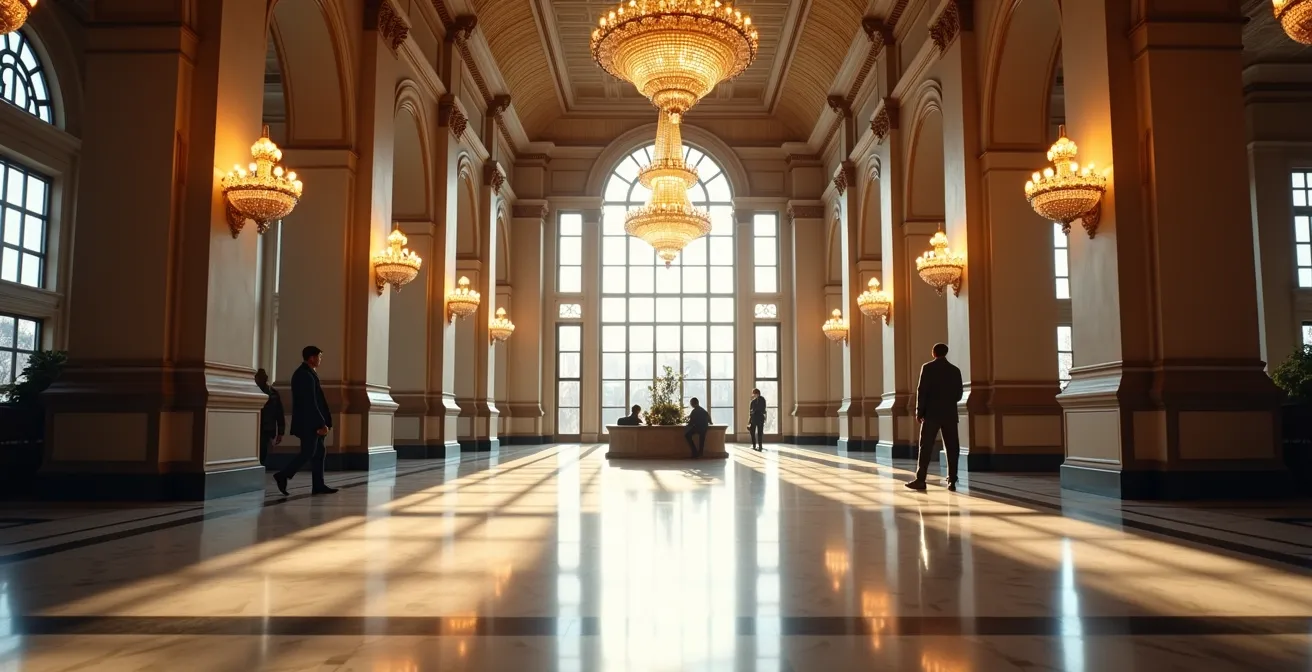
This contrast is a fundamental part of the value audit for historic properties. You are often paying for the experience of being in a landmark building, which includes the spectacular common areas. If you plan to spend significant time enjoying the lobby, bars, and restaurants, the premium may be justified. If you view your room as a private sanctuary and prioritize square footage and modern amenities, a new-build luxury hotel will almost always offer better value on a per-square-foot basis.
Case Study: The Fairmont Banff Springs Room Size Reality Check
The iconic Fairmont Banff Springs, opened in 1888, perfectly illustrates this historic trade-off. Over the years, the Fairmont Banff Springs has expanded to 770 rooms, but the legacy of its original structure remains. Standard rooms in the oldest sections of the hotel can be as compact as 160 square feet—significantly smaller than a standard room in a modern luxury build. Guests often report maze-like corridors and charming but sometimes impractical features, like decorative, non-functional fireplaces. To mitigate this, experienced guests recommend booking specific room types, like the “Original Building River View” rooms, which are noted to offer a better balance of historic character and updated comfort. This highlights the need for deep research beyond just the basic room category when booking a historic hotel.
The key is to honestly assess how you will use the hotel. If the grand lobby is your temporary living room and the history is part of the destination, the small room is a minor compromise. If the room is your castle, look elsewhere.
How to get room upgrades without status at independent luxury boutique hotels?
For travelers without top-tier elite status in a major hotel loyalty program, securing a room upgrade can feel like an impossible goal, especially at independent properties that don’t have a formal loyalty scheme. However, strategic booking is a powerful tool that can significantly increase your chances. The key is to leverage preferred partner programs and consortia, which act as a stand-in for elite status. As the experts at TravelSort note in their analysis, these programs hold significant weight with hotel management.
Preferred partner programs prioritize their own bookings ahead of all other programs, such as AMEX Fine Hotels & Resorts, Virtuoso, Andrew Harper
– TravelSort, Hotel Upgrade Strategy Analysis
Booking through a program like Virtuoso or American Express Fine Hotels & Resorts (FHR) signals to the hotel that you are a premium customer. These bookings often come with a suite of automatic benefits, such as daily breakfast for two, a $100 property credit, and, crucially, an upgrade upon arrival (subject to availability). While not guaranteed, a booking made through one of these channels is immediately flagged for preferential treatment over a direct booking or one made through a generic online travel agency.
Beyond booking channels, a few tactical approaches can further improve your odds, even during busy periods at sought-after Canadian properties:
- Book through a preferred program: Use a Virtuoso-affiliated travel advisor to book properties like the Auberge Saint-Antoine in Quebec City or The Hazelton in Toronto. This automatically places you on the upgrade list.
- Leverage credit card benefits: The Amex FHR program offers a guaranteed 4 PM late checkout, a highly valuable perk in itself, in addition to upgrade potential.
- Make a personal connection: Email the General Manager or Front Office Manager a week before your arrival. Politely mention your excitement for the stay and any special occasion you might be celebrating.
- Book one category up: It is often easier for a hotel to upgrade a guest from a mid-tier room to a junior suite than from the absolute base-level room to a slightly better view. This small initial investment can yield a large return.
- Avoid peak compression: Your chances of an upgrade during the Toronto International Film Festival (TIFF) or the Montreal Grand Prix are virtually zero. Travel during shoulder seasons for the best results.
In the world of independent luxury, how you book is as important as what you book. It’s a strategic move that communicates your value to the hotel before you even arrive.
Upper vs. Lower Berth: the comfort difference for seniors in semi-private sections
While the romance of train travel has its own specific trade-offs, a similar “level-based” comfort calculation applies within the hotel itself, particularly for seniors or guests with mobility concerns. The choice of floor level—low, mid, or high—is not merely about the view; it’s a strategic decision that impacts accessibility, noise, and peace of mind. High floors (10+) promise the best vistas and insulation from street noise, but they also mean longer waits for elevators and potential anxiety in an emergency evacuation scenario. This is a critical consideration for any traveler, but especially for seniors.
Conversely, a low floor (1-3) offers the ultimate in convenience: quick access to the lobby, restaurants, and exits. This can be a significant advantage for guests who make frequent trips in and out of the hotel or for whom navigating a large, crowded property is a challenge. The trade-off, of course, is a greater potential for street noise and a compromised view. The mid-level floors often represent a compromise, balancing decent views with moderate elevator wait times and a comfortable distance from the street-level hustle.
The following table provides a clear framework for auditing the trade-offs of floor level, allowing travelers to align their room placement with their personal comfort and mobility priorities.
| Floor Level | Advantages | Disadvantages | Best For |
|---|---|---|---|
| High Floor (10+) | Best views, quieter, less street noise | Long elevator waits, evacuation concerns | Mobile guests prioritizing views |
| Mid Floor (4-9) | Good views, moderate wait times | Potential noise from floors above/below | Balanced comfort seekers |
| Low Floor (1-3) | Quick access, easy evacuation, less motion | Street noise, limited views, less privacy | Seniors, mobility-impaired guests |
For many senior travelers, the real luxury isn’t a panoramic city view, but the ease and security of a well-placed room on a lower floor. It’s a prime example of personal value trumping conventional notions of “the best.”
Center Block vs. West Block: where are tours currently operating during renovation?
The concept of navigating a property undergoing significant renovation isn’t limited to national landmarks like Parliament Hill. It’s a frequent reality in the luxury hotel world, where properties must constantly reinvest to maintain their competitive edge. A hotel’s “Center Block” versus “West Block” can be seen as a metaphor for its historic wing versus its newly renovated section. A massive overhaul, such as when the Fairmont Queen Elizabeth underwent a $140 million renovation, creates two distinct experiences under one roof.
Staying in or near a renovated section offers the benefit of brand-new rooms, cutting-edge technology, and modern design. However, it can also come with the risk of construction noise, closed-off amenities, and a general sense of disruption. Conversely, staying in an older, un-renovated wing provides a more traditional, perhaps dated, experience but one that is free from the immediate inconveniences of construction. A savvy traveler must audit the hotel’s renovation status before booking.
Often, these large-scale renovations are undertaken to add significant new features that enhance the hotel’s value proposition. The goal is to create destination amenities that justify the room rates. As noted in a review of the Fairmont Banff Springs, a major refurbishment of its spa resulted in “a watery wonderland complete with Hungarian Mineral Pool kept at 98.6 degrees.” This type of capital-intensive upgrade is precisely what the “Fairmont premium” is supposed to fund. When booking, it’s wise to inquire specifically about the status of renovations and request a room far from any active construction, while also asking which new facilities are currently open and available for use.
A renovation can signal a hotel’s commitment to excellence, but it can also signal a period of disruption. Your job as an auditor is to determine which phase the hotel is in during your planned stay.
Key Takeaways
- The true cost of a luxury hotel room in Canada includes up to 25% in taxes and fees on top of the advertised rate.
- The value of bundled perks like Club Level access is entirely dependent on your travel style and ability to use the amenities during their fixed hours.
- Historic hotels trade larger, modern rooms for unparalleled ambiance and grand public spaces—a value proposition you must consciously accept.
Staying in Historic Lighthouses: Booking Unique Heritage Accommodation
The final stage of a value audit involves questioning the very definition of “luxury.” Is it the standardized, high-touch service of an urban hotel chain, or is it the unrepeatable, story-driven experience of a unique heritage property? In Canada, this choice is exemplified by the rise of extraordinary accommodations that compete directly with five-star city hotels on price, but offer a completely different form of value. These are properties that offer a profound Return on Experience (ROE), a metric that values memorable stories and personal connection over conventional amenities.
This is a trade-off between predictable excellence and unique immersion. An urban Fairmont delivers a consistent, high-quality product. A property like the Fogo Island Inn in Newfoundland or a converted historic lighthouse keeper’s cottage offers something else: a deep connection to place, culture, and landscape. You might sacrifice 24-hour room service or a sprawling spa, but you gain an experience that becomes a cornerstone of your travel memories.
Case Study: Fogo Island Inn and the Michelin Key Standard
The recent introduction of the MICHELIN Guide to Canada, including its “Key” awards for hotels, has legitimized this new paradigm of luxury. Properties like Fogo Island Inn and Clayoquot Wilderness Lodge, both awarded the highest honour of Three MICHELIN Keys, are officially recognized as being among “the most unique luxury experiences” in the country. A stay at these remote properties can exceed $1,000 per night, placing them in direct competition with top-tier urban suites. However, as the MICHELIN Guide’s recognition implies, the value proposition is entirely different. It’s not about the thread count of the sheets, but about the intimate, story-driven service and the exclusive access to a dramatic, wild landscape.
Evaluating these properties requires a different kind of audit. You must factor in the accessibility challenges—remote locations often require additional flights or transfers that can add hundreds of dollars to the total cost. You must also embrace a different service philosophy, one that is more personalized and less protocol-driven than a large hotel chain. This is about calculating your potential Return on Experience: will the unique story and social capital generated by the stay outweigh the predictable comforts of a traditional luxury hotel?
For some travelers, the ultimate luxury is not a service, but a story. The final step of your value audit is to decide if you are one of them and whether you are willing to invest in an experience that prioritizes memory over marble.