
Contrary to what it looks like, the Halifax Donair is not a free-for-all; it’s a culinary ritual with unwritten laws that define its authenticity.
- The sweet, condensed milk sauce is non-negotiable; asking for tzatziki is a grave error and a sign of an outsider.
- There’s a specific “Halifax Lean” eating technique required to eat it without covering yourself in its glorious, messy sauce.
Recommendation: To experience it properly, you must embrace the mess, respect the history from its Greek origins to its Lebanese stewardship, and never, ever treat it like a simple gyro.
You see it in the wild, usually after 10 p.m. A tightly wrapped foil cylinder, suspiciously heavy, leaking a mysterious white sauce. This is the Halifax Donair, a culinary icon of Nova Scotia and a beacon for the hungry, the late-night revellers, and the culturally curious. To the uninitiated, it might look like a gyro, or perhaps some regional cousin of the shawarma. They might think they can approach it with the same casual indifference, maybe even ask for a different sauce. This is a profound mistake.
The Halifax Donair is not just a sandwich; it’s a civic emblem, an edible piece of social history, and a testament to immigrant ingenuity. In fact, the city of Halifax was so serious about it that in 2015, it officially declared the donair its official food. This isn’t just fast food; it’s a cultural institution governed by a strict, unwritten rulebook. To truly understand and appreciate the donair is to perform a delicious, messy ritual, one that begins with its most controversial and sacred component: the sauce.
This guide is your initiation into the donair cult. We will dissect the culinary dogma behind the sweet sauce, master the physics of eating it without ruining your clothes, and trace its journey from Greek inspiration to Lebanese-Canadian icon. We’ll explore its late-night temple, Pizza Corner, and uncover why its authentic taste is so hard to find outside its Nova Scotian homeland. Prepare to get your hands dirty.
Summary: A Deep Dive into the Halifax Donair Phenomenon
- Sweet condensed milk sauce: why asking for tzatziki gets you kicked out?
- The tarp technique: how to eat a donair without ruining your clothes?
- Greek vs. Lebanese influence: how the donair evolved specifically in Halifax?
- Pizza Corner history: why this intersection is the holy grail of late-night eats?
- Why donair meat tastes different outside Nova Scotia (the spice blend secret)?
- How to navigate Halifax’s waterfront history in one afternoon?
- How to distinguish authentic food tours from commission-based tourist traps?
- West Coast IPA vs. East Coast Hazy: knowing what to expect in BC vs. NS?
Sweet condensed milk sauce: why asking for tzatziki gets you kicked out?
Let’s be unequivocally clear: the soul of the Halifax Donair is its sauce. It is not tzatziki. It is not garlic sauce. It is a sweet, tangy, and utterly unique concoction made from evaporated or condensed milk, sugar, vinegar, and garlic powder. As Chef Alain Bossé once noted, “The sweet sauce is what makes a difference between a donair and a gyro.” Walking into a Halifax donair shop and asking for tzatziki is the culinary equivalent of walking into a Scottish pub and ordering a piña colada. You might not literally be kicked out, but you will be met with a look of pity, confusion, and deep, deep disappointment. You will have committed the ultimate sweet heresy.
This sauce is not an accident; it’s a brilliant piece of culinary adaptation. It represents a specific moment in Halifax’s food history where an immigrant entrepreneur met the local palate head-on and invented something new. The story is now legend, a foundational myth for any true Haligonian foodie.
Case Study: Peter Gamoulakos’s Sweet Revolution
In the early 1970s, Greek immigrant Peter Gamoulakos tried to sell traditional gyros—spit-roasted lamb with tzatziki sauce wrapped in pita—to the people of Halifax. The problem? As an in-depth history of the donair explains, the Maritime palate was not accustomed to lamb or yogurt-based sauces. Sales were poor. Instead of giving up, Gamoulakos pivoted. He swapped the lamb for spiced ground beef, shaving it from a vertical broiler. More importantly, he invented a new sauce that would appeal to local tastes. This sweet, creamy sauce became the signature of his new creation, the “donair,” and it was an instant success, perfectly tailored to a city that loved its sweet and savoury flavours.
This sauce is the first and most important rule in the donair’s culinary dogma. It’s the sweet, sticky glue that holds the entire cultural experience together. To reject the sauce is to reject the donair itself. It’s what separates the insiders from the tourists, the believers from the skeptics. Accept no substitutes.
The tarp technique: how to eat a donair without ruining your clothes?
Once you’ve accepted the sauce, you face your next challenge: consumption. A properly made Halifax Donair is an exercise in controlled chaos. It’s overstuffed with spiced meat, diced tomatoes, and raw onions, then drenched in that famously drippy sweet sauce, all precariously housed in a thin, steamed pita. The structural integrity is, to be charitable, compromised from the start. A novice will end up with more sauce on their shirt and shoes than in their mouth. But for the seasoned veteran, there is a method to the madness. It’s known as the “Halifax Lean” or, more graphically, the “tarp technique.”
This isn’t just a casual suggestion; it’s a codified posture, a piece of physical knowledge passed down through generations of late-night eaters. You stand, you lean forward from the hips at a roughly 45-degree angle, and you let gravity be your friend, directing any and all drips onto the foil wrapper or the pavement below, but never, ever onto your person. This is not a food you eat in your car. This is not a food you eat sitting down elegantly. It demands respect and a specific physical commitment.
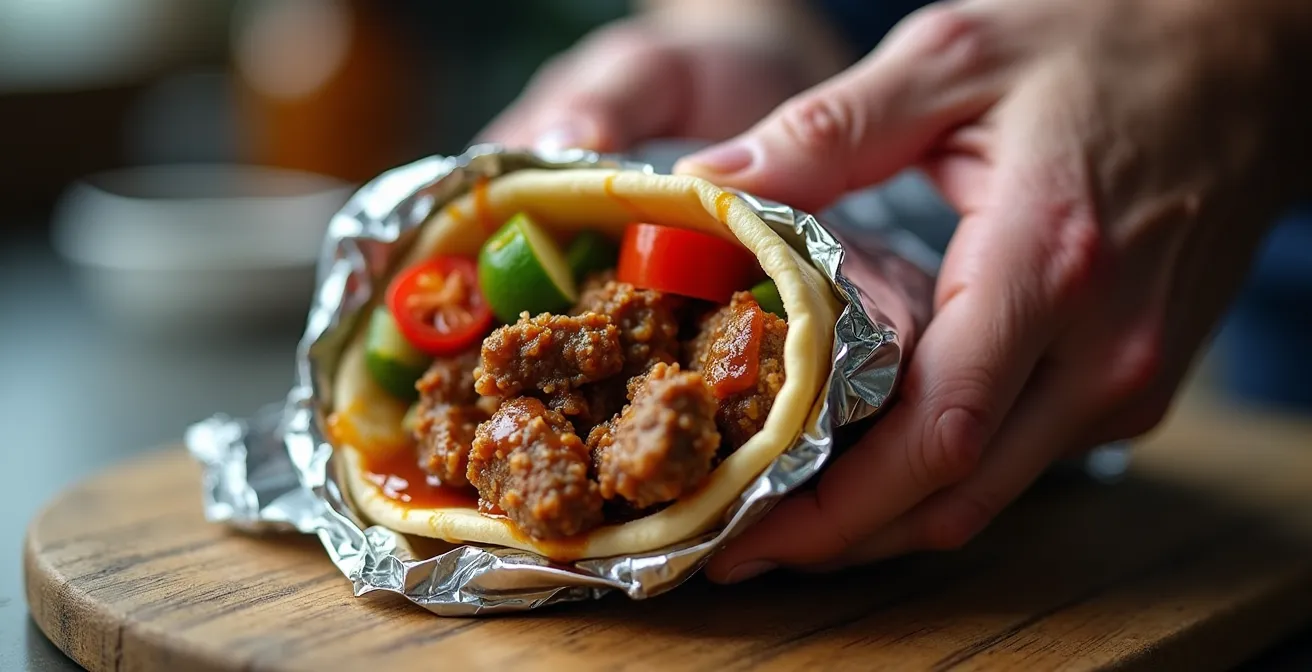
The foil itself is your primary tool. It’s not just a wrapper; it’s your shield, your plate, and your safety net. Mastering the foil is as important as mastering the lean, creating a protective barrier that you gradually peel back as you eat. But don’t expect to stay perfectly clean. A certain amount of mess is not just expected; it’s a sign of authenticity. If you finish a donair with pristine hands, you did it wrong.
Action Plan: The Halifax Lean and Foil Mastery
- Structural Reinforcement: Before the first bite, fold the donair in half lengthwise and wrap the aluminum foil tightly around the bottom half to create a strong base.
- Assume the Position: Stand with your feet apart and lean forward from the waist. This is the Halifax Lean. Your clothes are now out of the drip zone.
- The Gradual Peel: As you eat from the top, slowly and methodically fold the aluminum foil down, creating a “bib” that catches the inevitable sauce drips.
- Embrace the Puddle: A key sign of a good donair is the pool of sauce that collects in the bottom of the foil. This is a feature, not a bug. Use it for a final, glorious dip.
- Napkin Readiness: Even with perfect technique, you will need napkins. Have them at the ready. This is a battle you can manage, but never fully win.
Greek vs. Lebanese influence: how the donair evolved specifically in Halifax?
While a Greek immigrant, Peter Gamoulakos, is rightly credited as the father of the donair, the story of its proliferation and cultural cementing in Halifax belongs significantly to the Lebanese community. This isn’t a story of one culture, but a fascinating hand-off from a Greek innovator to Lebanese custodians who made the donair a city-wide staple. This transition is key to understanding why the donair feels so deeply embedded in the fabric of Halifax.
After Gamoulakos’s King of Donair proved the concept, many of the earliest and most iconic donair shops that followed were opened by Lebanese families. These entrepreneurs understood the business of spit-roasted meats and flatbreads, and they saw the immense potential in this new, localized creation. They became the donair’s most ardent champions, spreading the gospel of sweet sauce across the city and beyond. Many of Halifax’s most beloved shops, like Tony’s Donair, are a testament to this legacy. In fact, the corner of Robie and Cunard is affectionately known by locals as “Tony’s Corner,” a nod to the shop that a Lebanese family has run since 1976.
Case Study: The Lebanese Custodianship
The evolution from a single Greek invention to a city-wide Lebanese-run phenomenon is perfectly illustrated by the story of the El-Homeira family. As documented in a detailed history of Halifax food, Chawki El-Homeira’s Venus Pizza was one of the early adopters. Over time, the business evolved into Mezza Lebanese Cuisine, a chain that became synonymous with both traditional Lebanese food and the Halifax donair. This shows how the donair was not just copied, but integrated into the Lebanese-Canadian culinary identity, sitting proudly on menus next to shawarma, falafel, and tabbouleh. They didn’t just sell the donair; they adopted it as one of their own.
This dual heritage is crucial. The donair has Greek roots but a Lebanese soul. It’s a product of cultural adaptation and community stewardship, representing the best of what happens when immigrant traditions meet, merge, and create something entirely new and perfectly suited to its adopted home. It’s a Canadian story, told through spiced beef and sweet sauce.
Pizza Corner history: why this intersection is the holy grail of late-night eats?
Every city has a late-night culinary nexus, a magnetic point where all paths converge after the bars close. In Halifax, that legendary ground zero is Pizza Corner. For decades, the intersection of Grafton and Blowers Streets was the undisputed epi-centre of post-midnight sustenance, a chaotic and glorious hub fueled by pizza slices and, of course, donairs. To understand Halifax’s late-night culture is to understand the gravitational pull of this single downtown corner.
It can seem like all late-night paths lead to Pizza Corner
– The Coast Halifax, The life and times of Pizza Corner
At its peak, Pizza Corner was a triumvirate of carb-loading options: King of Donair, Sicilian Pizza, and the European Food Shop. It was more than just a place to eat; it was a social stage, a final stop, a place of democratic communion where students, sailors, and politicians could all be found performing the Halifax Lean. The corner’s fame was so great that during the G7 Summit in 1995, world leaders reportedly made a detour to experience the phenomenon. But like all great empires, Pizza Corner’s classic era has seen significant change.
The original King of Donair location on the corner closed, as did the European Food Shop, marking the end of an era. While new establishments have moved in, attempting to carry the torch, the “classic” Pizza Corner of Haligonian lore now lives on mostly in memory and story. Below is a brief timeline of its transformation.
| Year | Event | Impact |
|---|---|---|
| Pre-2012 | Three pizzerias at corners | King of Donair, Sicilian Pizza, European Food Shop form the classic trio |
| 2012 | King of Donair closes | A rental dispute forces the iconic corner’s most famous tenant to relocate |
| 2015 | European Food Shop closes | Only one of the original three pizzerias remains on the corner |
| 2017 | Pizza Girls opens | New blood attempts to restore the corner’s pizza-focused legacy |
| 2024 | Indian restaurant arrives | New flavors join the mix, honoring the late-night tradition while diversifying it |
Why donair meat tastes different outside Nova Scotia (the spice blend secret)?
The donair has spread. Expat Nova Scotians, desperate for a taste of home, have opened donair shops across Canada, particularly in Alberta, where Edmonton has embraced the donair with nearly 120 shops. But ask any Haligonian, and they’ll tell you the same thing: it’s just not the same. This isn’t simple regional pride; there are tangible reasons why the authentic Halifax donair taste is so difficult to replicate. The secret lies not in one single ingredient, but in a trinity of factors: the spice blend, the meat texture, and the seasoned equipment.
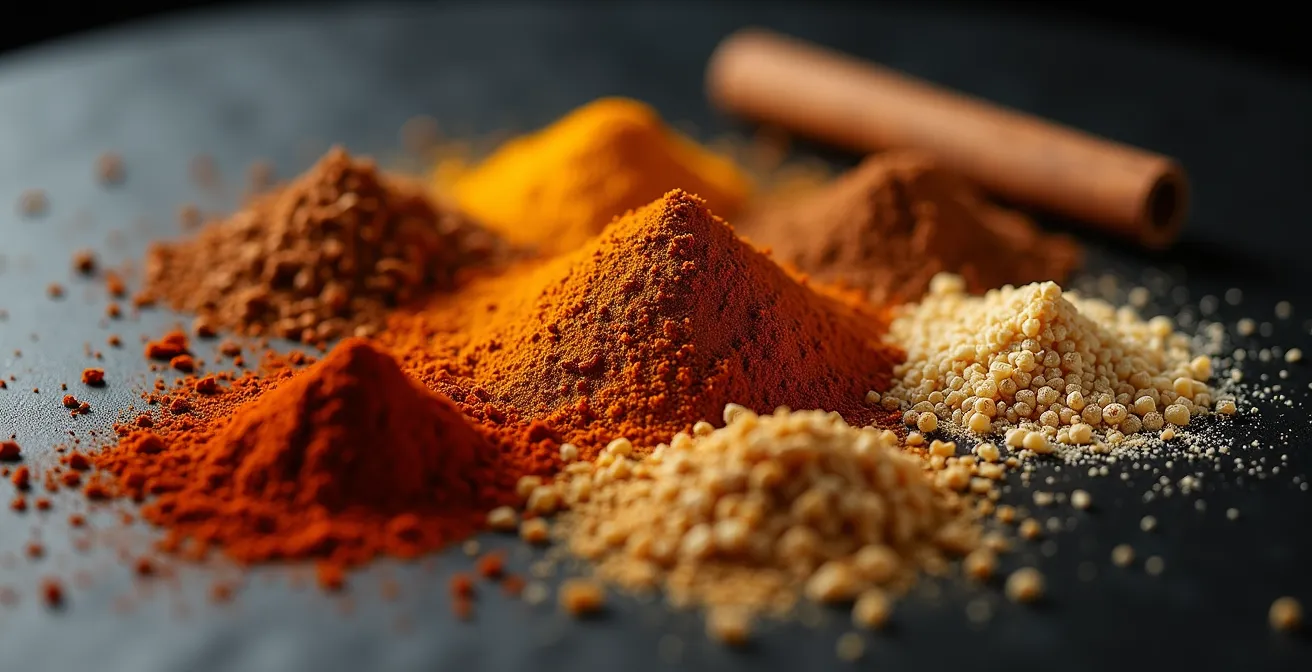
First, the spice blend. While recipes are closely guarded, the profile of a Halifax donair is distinct. It’s not just salt, pepper, and garlic. True Halifax donair meat contains a subtle but crucial warmth from spices like cinnamon, nutmeg, or allspice. These “baking spices” are unusual in a savoury meat dish for many, but they are essential to the authentic flavour, providing a complex backdrop to the sweetness of the sauce. Many replicas outside the Maritimes miss this crucial, warming nuance.
Second is the texture. Authentic donair meat isn’t chunky or coarse. It is finely ground, almost to a pâté-like consistency, before being packed onto the vertical spit. This fine grind ensures that when shaved off, the meat is tender and delicate, not chewy. It’s a texture that melts in your mouth, designed to absorb the maximum amount of sauce. Achieving this exact texture requires specific grinding and packing techniques that are often overlooked.
The Challenge of Authenticity Abroad
As a travel guide for foodies points out, the struggle for authenticity is real for donair entrepreneurs outside Nova Scotia. Beyond just the spices and meat texture, there’s an almost mystical element at play. Factors like the local water used in the pita, and more importantly, the decades of seasoning built up on the original vertical broilers in Halifax’s legacy shops, contribute to a unique flavour profile. A brand-new broiler in Calgary simply doesn’t have the “ghosts” of a thousand donairs past seasoning the meat as it cooks.
How to navigate Halifax’s waterfront history in one afternoon?
To truly understand the donair, you have to understand Halifax. And to understand Halifax, you must start at its heart: the historic waterfront. This isn’t a detour from our culinary journey; it’s a necessary pilgrimage to the city’s soul. The waterfront is a living museum of immigration, adaptation, and survival—the very same forces that gave birth to the donair. Walking along the boardwalk, you’re tracing the steps of countless immigrants who arrived by sea, bringing their traditions and dreams to a new land.
The Maritime Museum of the Atlantic tells stories of shipwrecks and sailor culture, while the Canadian Museum of Immigration at Pier 21 stands as a monument to the millions who began their Canadian lives right here. This is a city built by outsiders who became insiders, a place where cultural exchange wasn’t an academic concept but a daily reality. The port brought people, and people brought food. From the rum-runners of the past to the donair-slingers of today, the waterfront has always been about the flow of goods and culture.
The donair is a perfect example of how an immigrant adapted his culture to create a new Halifax icon
– Local Halifax food historian, Halifax waterfront and donair culture connection
The donair is the edible embodiment of this waterfront spirit. It is the story of Peter Gamoulakos arriving from Greece, finding his traditional food didn’t quite fit, and instead of leaving, creating something new that belonged entirely to Halifax. A tour of the waterfront, followed by a short walk up to the original donair territory on Quinpool Road or Pizza Corner, connects the dots. You see the grand narrative of immigration in the museums and then taste its delicious, tangible result wrapped in foil.
How to distinguish authentic food tours from commission-based tourist traps?
As a food tourist in Halifax, your mission is clear: experience an authentic donair. The city’s official food status has, predictably, given rise to countless “food tours” and guides, some more legitimate than others. The danger is falling for a commission-based tourist trap that leads you to a generic, modernized shop instead of a place with real history. As a donair historian, I must arm you with the knowledge to perform your own Donair Authenticity Litmus Test.
Forget the glossy brochures. A true donair experience is about heritage, not hype. An authentic tour—or a self-guided one—should prioritize the places that are part of the story. This means seeking out family-run institutions, especially those with roots stretching back to the 1970s and 80s. You must ask the hard questions: Is the meat made in-house, or is it a pre-made log from a supplier? Does your guide explain the cultural significance, or just hand you a sample? Do they teach you the Halifax Lean? If not, you are likely in a tourist trap.
To guarantee authenticity, the best food tour is often the one you create yourself. A “DIY Donair Crawl” is the purist’s choice, allowing you to sample the nuances between the city’s foundational pillars of the donair world.
The Purist’s DIY Donair Crawl
For an unassailable, authentic experience that bypasses all tourist traps, a pilgrimage to these three legendary shops is mandatory. As recommended by donair purists, including the original brand itself, King of Donair, this route covers the essential history:
- King of Donair (Quinpool Road): This is Mecca. While the original Pizza Corner location is gone, the Quinpool Road shop is the direct descendant of Peter Gamoulakos’s 1973 invention. You must start at the source.
- Tony’s Donair (Robie Street): Representing the crucial Lebanese chapter of the donair story, Tony’s has been a beloved institution since 1976. This is where you taste the legacy of the community that made the donair a Halifax staple.
- Johnny K’s (Blowers Street): Located near the historic Pizza Corner, Johnny K’s represents the continuation of the donair tradition in the heart of Halifax’s nightlife district, holding the line for authentic flavour in the modern era.
Visiting these three provides a complete education in donair history and flavour.
Key takeaways
- The donair is defined by its sweet, condensed milk-based sauce; asking for an alternative is the primary mistake of a novice.
- Proper consumption requires the “Halifax Lean,” a specific forward-leaning posture to manage the inevitable mess.
- Authenticity is found in historic, family-run shops, not generic tourist spots; a DIY crawl to King of Donair, Tony’s, and Johnny K’s is the ultimate test.
West Coast IPA vs. East Coast Hazy: knowing what to expect in BC vs. NS?
You have your donair. You’ve assumed the position. Now, what do you drink? This is not a trivial question. The right beverage pairing can elevate your donair experience from a simple meal to a transcendent flavour event. And in a city with a brewing history as rich as Halifax’s—its oldest brewery, Alexander Keith’s, has been brewing since 1820—the local craft beer scene offers the perfect companion.
The intense, unique flavour profile of a donair—spicy, savoury beef, sharp raw onions, and a profoundly sweet sauce—requires a beer that can either cut through the richness or complement the complexity. This is where the great North American IPA debate comes into play. A bitter, piney West Coast IPA (popular in BC) can be too aggressive, clashing with the sweet sauce. The superior choice, as any Halifax beer aficionado will tell you, is an East Coast Hazy IPA.
An East Coast Hazy IPA is a superior pairing to a West Coast IPA for a donair. The lower bitterness and juicy character of the Hazy complements the sweet sauce and spices
– Halifax craft beer expert, Halifax Craft Breweries Guide
The soft, fruity, and less bitter profile of a Hazy IPA works in harmony with the donair’s flavours rather than fighting them. However, Halifax’s diverse craft scene offers many excellent pairing options, from crisp lagers that cleanse the palate to tart sours that contrast the fatty meat. The ultimate pairing, of course, is the meta-experience of a beer brewed specifically for the donair.
| Beer Style | Brewery | Pairing Notes with Donair |
|---|---|---|
| Crisp Lager | Propeller Brewing Co. | Cleanses the palate between rich, saucy bites, resetting your taste buds. |
| Hazy IPA | 2 Crows Brewing Co. | Juicy, tropical notes complement the sweet sauce without adding bitterness. |
| Sour Ale | North Brewing Co. | High acidity cuts through the richness of the spiced beef and fatty sauce. |
| Traditional IPA | Alexander Keith’s | The classic, hoppy choice to stand up to the donair’s bold flavours. |
| Donair Beer | Keith’s & KOD Collab | A spiced beer designed by the originators specifically to be drunk with a donair. |
You have the knowledge. You know the rules, the history, the posture, and the proper beverage. The only thing left to do is to put this education into practice. Go forth, find an authentic Halifax donair, assume the position, and embrace the glorious, sweet, and sticky mess. It’s the only way to truly earn your stripes.