High flight prices in Canada aren’t just about taxes or a simple duopoly; they’re a symptom of a fragmented, infrastructure-dependent system.
- True savings come from exploiting this system’s “seams,” such as choosing secondary airports over major hubs to drastically cut base fares.
- Understanding the specific aircraft on your route (like a Dash-8) and its limitations can prevent unexpected fees and travel headaches.
Recommendation: Stop hunting for elusive airline sales and start making strategic choices about your departure airport, ground transport alternatives, and even your luggage to genuinely reduce your travel costs.
Every Canadian traveller has felt the familiar sting of disbelief: seeing a round-trip ticket to Paris or Lisbon priced lower than a flight from Toronto to Calgary. It’s a national paradox that defies simple explanation. For years, the conversation has been dominated by the usual suspects—high federal taxes, the vast geography, and the market dominance of Air Canada and WestJet. While these factors certainly play a role, they form an incomplete picture that leaves travellers feeling powerless against exorbitant fares.
The common advice to “book in advance” or “fly with a budget carrier” only scratches the surface. These tips fail to address the fundamental, structural reasons that make flying within Canada so uniquely expensive. The reality is that the high cost is baked into the very infrastructure of Canadian aviation, from the financing of our airports to the specific types of aircraft used on regional routes. This system, however, is not without its cracks.
This guide moves beyond the platitudes to offer a new perspective. The key to affordable domestic travel isn’t just about finding a cheaper airline; it’s about understanding and navigating the inefficiencies and ‘seams’ of this complex system. It requires a shift in thinking from being a passive ticket-buyer to an active strategist who leverages knowledge of secondary airports, alternative modes of transport, and even passenger rights regulations.
We will deconstruct the core issues driving up prices, from monopolies in the North to the operational realities of smaller aircraft. More importantly, we will provide actionable strategies and data-driven comparisons that empower you to make smarter choices, proving that while flying in Canada is expensive, it doesn’t always have to be.
Summary: Navigating the High Cost of Domestic Canadian Air Travel
- Why limited competition on regional routes keeps prices high in the North?
- Abbotsford vs. YVR: saving $200 by choosing secondary airports near major hubs
- Carry-on restrictions on Dash-8 prop planes: preventing gate-check surprises
- Booking “open-jaw” tickets to avoid backtracking and save time on cross-country trips
- Claiming compensation for delays under Canada’s Air Passenger Protection Regulations
- How to access remote coastal communities without chartering a private plane?
- How to find fast chargers in rural Saskatchewan using aggregator apps?
- Riding “The Canadian”: Why Delays Are Common on the Toronto-Vancouver Route?
Why limited competition on regional routes keeps prices high in the North?
While the Air Canada-WestJet duopoly defines the national market, a far more acute issue exists on smaller, essential routes in Canada’s North. Here, the problem isn’t just limited competition; it’s often a complete monopoly. On many routes serving remote and Indigenous communities, a single carrier dictates pricing, scheduling, and service levels, creating a captive market where residents and workers have no alternative for essential travel.
This lack of competition leads to some of the highest per-kilometre airfares in the world. These routes are not just for tourism; they are lifelines for medical appointments, family connections, and the movement of essential goods. The high operational costs of serving remote airfields with specialized aircraft are real, but without competitive pressure, there is little incentive for carriers to optimize pricing for consumers.
Case Study: The Canadian North Merger and its Impact on Arctic Fares
The economic reality of these route monopolies was starkly illustrated by the 2019 merger of First Air and Canadian North. The transaction was characterized by the Competition Bureau as a ‘merger to monopoly’ on several key northern corridors, including those serving the Kitikmeot and Qikiqtaaluk regions. The consequences on pricing have been significant. Post-merger, a return flight from Ottawa to Iqaluit can frequently cost between $2,000 and $3,000. For more remote communities like Resolute Bay, that same trip to the nation’s capital can exceed an astonishing $7,000, highlighting the extreme financial burden placed on residents of the North.
For travellers needing to access these regions, strategies must shift from simple price comparison to leveraging any available program. This can include booking through medical travel authorities which often have negotiated rates, maximizing the value of loyalty points on partner airlines, or breaking up a journey into segments to fly on a more competitive southern leg before transferring to the northern monopoly carrier. These are not simple hacks, but necessary workarounds in a market defined by a lack of choice.
Abbotsford vs. YVR: saving $200 by choosing secondary airports near major hubs
One of the most effective strategies for combating high domestic fares is what can be called infrastructural arbitrage: deliberately choosing a smaller, secondary airport instead of a major hub. The price difference between flying out of Toronto Pearson (YYZ) versus Hamilton (YHM), or Vancouver International (YVR) versus Abbotsford (YXX), can be substantial. These smaller airports attract ultra-low-cost carriers (ULCCs) like Flair by offering lower landing fees and operational costs, savings that are passed directly to the consumer.
This strategy directly attacks the base fare, which is crucial given that a significant portion of a ticket’s cost is fixed. In Canada, government fees and taxes represent roughly 35.8% of a typical domestic ticket price. Since you cannot avoid these taxes, the only way to achieve meaningful savings is by reducing the underlying fare charged by the airline. A $50 base fare from a ULCC at a secondary airport will always result in a cheaper final price than a $250 base fare from a legacy carrier at a major hub, even after adding baggage fees.
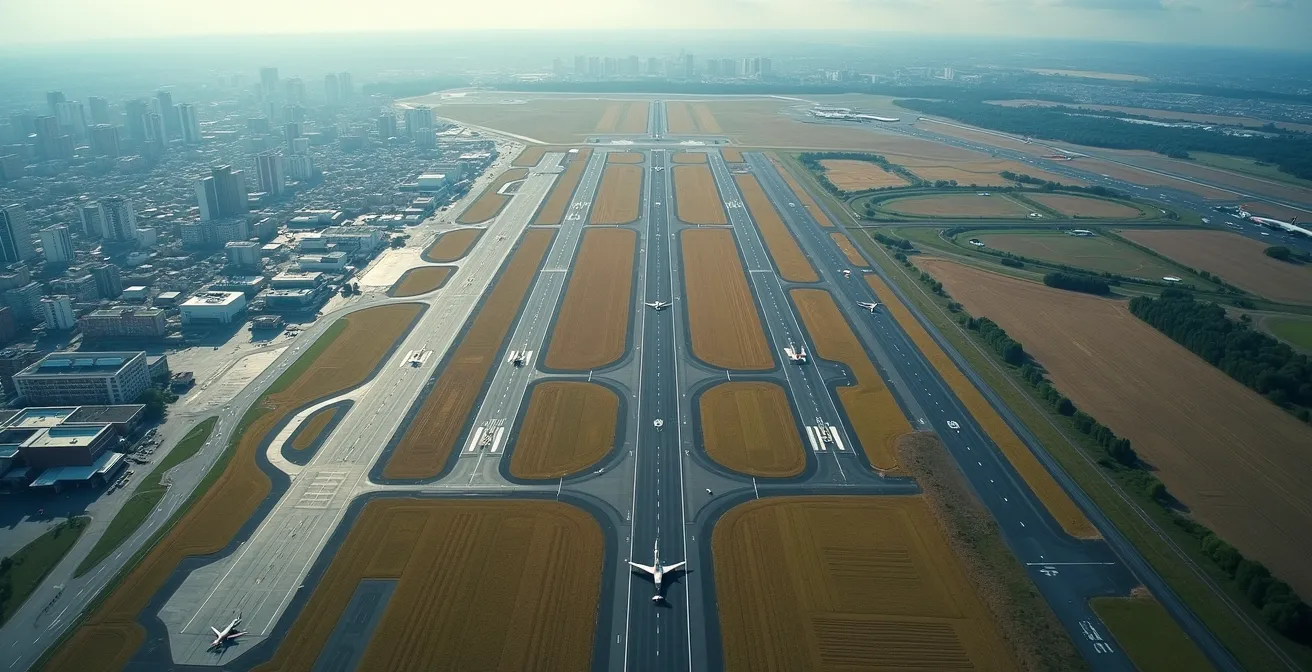
Of course, this approach requires a cost-benefit analysis. The savings on the flight must outweigh the added cost and time of ground transportation to the secondary airport. For travellers without a car, this can involve buses or regional transit. However, as the following comparison shows, the net savings are often significant.
| Route | Primary Airport | Secondary Airport | Flight Savings | Ground Transport Cost | Total Savings |
|---|---|---|---|---|---|
| Vancouver | YVR | YXX (Abbotsford) | $200-300 | $45 (Ebus) | $155-255 |
| Toronto | YYZ | YHM (Hamilton) | $150-250 | $20 (GO Transit) | $130-230 |
| Montreal | YUL | YHU (St-Hubert) | $100-180 | $25 (Transit) | $75-155 |
Carry-on restrictions on Dash-8 prop planes: preventing gate-check surprises
In Canada’s vast regional network, the type of aircraft you fly on can have a bigger impact on your travel experience—and budget—than the airline itself. Many shorter, less dense routes, particularly in Eastern Canada and between smaller Western cities, are served not by jets but by turboprop aircraft like the De Havilland Dash 8. This is a crucial detail that many travellers overlook, leading to frustrating and costly “gate-check” surprises.
Dash 8s have significantly smaller overhead bins and a narrower aisle than standard Boeing 737 or Airbus A320 aircraft. This means that a standard, regulation-sized roll-aboard carry-on bag that fits perfectly on a mainline flight will not fit in the cabin of a Dash 8. Airlines enforce this strictly, forcing passengers to gate-check their bags. While this is often free, it negates the primary benefit of carry-on: keeping your belongings with you and avoiding the wait at the baggage carousel. For those with tight connections, this can be a major issue.
I wish I had known that the Air Canada flight I was taking was so small inside that you can barely fit your carryon bag down the aisle. Also that there are some planes who’s seats don’t recline.
– Anonymous Traveller, Kayak Reviews
A savvy domestic traveller anticipates this. Before booking, check the flight details to see the aircraft type. If it’s a Dash 8 (often listed as DH8, DHC-8, or Q400), you must adapt your packing strategy. The key is to embrace the “personal item” as your main bag for short trips or invest in a soft-sided duffel bag specifically designed to comply with the smaller dimensions of turboprop planes. This aircraft-dictated travel approach prevents surprises at the gate and ensures a smoother journey.
- Be aware that Dash 8 planes have severely limited overhead bin space for standard roll-aboard luggage.
- The maximum carry-on dimensions for a Dash 8-300/400 are often around 40cm x 23cm x 35cm, much smaller than the standard jet allowance.
- Consider purchasing soft-sided bags from Canadian retailers like MEC or Herschel, which often have models designed for this type of commuter travel.
- Employ the “Personal Item as Main Bag” strategy: pack essentials for 2-3 days in a bag that fits under the seat to completely avoid any chance of gate-checking.
- Know the difference between “valet gate-check” (like on Porter), where your bag is returned to you at the jet bridge, versus a standard gate-check where you must retrieve it at baggage claim.
Booking “open-jaw” tickets to avoid backtracking and save time on cross-country trips
A classic flight booking is a simple round-trip: Toronto to Vancouver and back. However, for trips that involve exploring a region, this model is highly inefficient, forcing you to waste time and money backtracking to your arrival airport. The solution is an “open-jaw” ticket, a powerful but underutilized tool for domestic Canadian travel. An open-jaw itinerary allows you to fly into one city and depart from another.
This is particularly valuable in a country as large as Canada. Imagine a trip to explore the Rocky Mountains. A standard booking would be a return flight to Calgary. An open-jaw booking, however, would allow you to fly into Calgary, rent a car, drive through Banff and Jasper, and then fly home from Edmonton or even Vancouver. This eliminates a long, redundant drive back to your starting point, saving a full day of travel and the associated costs of fuel and an extra night’s accommodation.
Most airline booking websites support this through a “multi-city” or “multiple destinations” search option. Instead of selecting “round-trip,” you input your flights as two one-way segments:
- Flight 1: Your Home City -> Destination A
- Flight 2: Destination B -> Your Home City
Contrary to a common misconception, booking an open-jaw ticket with a major carrier is often priced similarly to a standard round-trip, as airlines price routes segment by segment. It is not the same as booking two expensive one-way tickets. This strategy maximizes your vacation time and allows for a more logical, linear journey, whether you’re touring the Maritimes (fly into Halifax, out of Charlottetown) or exploring British Columbia’s interior.
Claiming compensation for delays under Canada’s Air Passenger Protection Regulations
While strategies to find cheaper fares are proactive, it’s equally important to know your rights when things go wrong. Canada’s Air Passenger Protection Regulations (APPR) provide a powerful framework for holding airlines accountable for delays and cancellations. This isn’t just about getting a meal voucher; it’s about significant monetary compensation for your lost time, provided the disruption was within the airline’s control and not related to safety.
Understanding your right to compensation is a form of regulatory leverage. If a flight is delayed for over three hours for a reason like staffing issues, mechanical problems discovered outside of regular maintenance, or scheduling consolidation, you are likely entitled to compensation. For large airlines, the APPR mandates that carriers must pay between $400 and $1,000 CAD per passenger depending on the length of the arrival delay. Specifically, large carriers like Air Canada and WestJet owe $400 for delays of 3-6 hours, $700 for 6-9 hours, and a full $1,000 for delays of 9 hours or more.
Recent updates to the regulations have shifted the burden of proof onto the airlines. They must now provide compensation for a disruption unless they can prove it was caused by exceptional circumstances. This strengthens the passenger’s position significantly. Filing a claim is a straightforward process that should be a standard part of any traveller’s post-trip routine if they’ve experienced a significant delay.
Action Plan: Filing an APPR Claim for Flight Delays
- Documentation is key: Keep all boarding passes, receipts for expenses (food, hotel), and records of communication with the airline.
- Submit your claim: You have one year from the date of the flight disruption to file a claim for compensation directly with the airline, usually via an online form on their website.
- Escalate if necessary: If the airline denies your claim or fails to respond within 30 days, you can escalate the complaint to the Canadian Transportation Agency (CTA) through their online portal.
- Understand the airline’s risk: Be aware that as of 2024, the maximum penalties for airlines not complying with APPR have increased tenfold, from $25,000 to $250,000 per incident.
- Claim additional damages: For international itineraries, remember that the Montreal Convention may allow you to claim additional proven damages on top of standard APPR compensation.
How to access remote coastal communities without chartering a private plane?
For many of Canada’s stunning but remote coastal communities, particularly on the Pacific and Atlantic coasts, air travel seems like the only option. However, flights into smaller towns like Tofino, Prince Rupert, or Fogo Island can be infrequent and prohibitively expensive. Chartering a private plane is out of reach for most. The solution often lies on the water, by leveraging Canada’s extensive and scenic ferry networks as a form of “marine highway.”
These are not simple commuter ferries; they are large, vehicle-carrying vessels that serve as a critical piece of transportation infrastructure. They offer a reliable and often far more affordable alternative to flying, while also providing a travel experience in itself. While domestic flights are typically short-haul journeys of 2-4 hours, these ferry routes transform the travel into a scenic, relaxing voyage.
The most iconic example is BC Ferries’ Inside Passage route. This 15-hour journey connects Port Hardy on Vancouver Island with Prince Rupert on the northern mainland, stopping at communities like Bella Bella along the way. It effectively replaces a series of expensive, multi-leg flights. Similar essential ferry services exist across the country, connecting Newfoundland to Labrador, the mainland to Fogo Island, and serving Quebec’s Lower North Shore. For the savvy traveller, combining a walk-on ferry ticket with a pre-booked taxi or a local car rental at the destination can be a fraction of the cost of flying.
To successfully use this strategy, planning is essential:
- BC Ferries (Inside Passage): For peak summer season, vehicle space should be booked at least 2-3 months in advance. Foot passenger space is more readily available.
- Newfoundland (Fogo Island/Labrador): Check Marine Atlantic schedules meticulously, as they are highly seasonal and weather-dependent.
- Quebec (Lower North Shore): The Relais Nordik is a unique cargo/passenger hybrid ship that runs a weekly service. It’s an adventure, not an express trip, and booking is essential.
- Smaller Airlines: For the final leg, don’t forget smaller carriers. Companies like Pacific Coastal Airlines serve dozens of small B.C. destinations and can be combined with a ferry trip for an optimal cost/time balance.
How to find fast chargers in rural Saskatchewan using aggregator apps?
The question of EV charging in a vast province like Saskatchewan may seem unrelated to air travel, but it directly addresses a core dilemma for many Canadians: for short-haul trips, is it cheaper to drive or to fly? On routes like Regina to Saskatoon, the flight is less than an hour but can cost hundreds of dollars, making the 2.5-hour drive an attractive alternative. With the rise of electric vehicles, the calculation now includes charging costs and infrastructure availability.
The key to making an EV road trip viable, especially on the prairies, is relying on robust charging aggregator apps. Services like PlugShare are indispensable, providing a real-time map of all charging stations from various networks, including user-generated reviews on reliability. For a trip across Saskatchewan, it’s also wise to have the specific app for the Petro-Canada network, which has established an “Electric Highway” along the Trans-Canada Highway, providing critical DC fast chargers in towns like Davidson, right between Regina and Saskatoon.
When comparing the costs, the advantage of driving an EV becomes immediately apparent. The cost to charge a Tesla Model 3 for the 260km trip is a fraction of the airfare, even when accounting for reduced battery efficiency in the harsh prairie winter. This makes the “drive vs. fly” decision a clear win for driving, provided the traveller is not severely time-constrained.
| Travel Method | Distance | Time | Cost | Notes |
|---|---|---|---|---|
| Air Canada Flight | 260km | 45 min flight + 2hr airport | $350-450 | YQR to YXE including taxes |
| EV (Tesla Model 3) | 260km | 2.5 hours | $8-12 charging | Petro-Canada stations at Davidson |
| EV (Winter conditions) | 260km | 3 hours | $12-18 charging | 20-30% range reduction in cold |
For those undertaking such a trip, a few strategic considerations are vital. Pre-conditioning the battery while still plugged in during winter can save significant range, and planning to keep the battery’s charge between 20% and 80% on long drives maximizes both charging speed and long-term battery health.
Key Takeaways
- The most powerful strategy to lower flight costs is “infrastructural arbitrage”—choosing secondary airports like Abbotsford (YXX) or Hamilton (YHM) can save hundreds of dollars on the base fare.
- Don’t overlook “marine highways.” For remote coastal destinations, extensive ferry networks in B.C., Newfoundland, and Quebec offer a scenic and far more affordable alternative to expensive regional flights.
- Master your rights. Understanding the Air Passenger Protection Regulations (APPR) and the specific luggage limitations of smaller aircraft like the Dash-8 can save you from unexpected fees and help you claim significant compensation for delays.
Riding “The Canadian”: Why Delays Are Common on the Toronto-Vancouver Route?
For the ultimate act of infrastructural arbitrage, some travellers opt to bypass the aviation system entirely for cross-country travel by riding VIA Rail’s “The Canadian.” This iconic journey from Toronto to Vancouver is less about speed and more about embracing the vastness of the country. However, travellers must set their expectations accordingly, as significant delays are not an exception but a common feature of the journey. This is because VIA Rail does not own most of the track it operates on.
West of Winnipeg, the passenger train runs on tracks owned by CN Rail, a freight company. Under long-standing agreements, freight trains have priority over passenger rail. If a long, slow-moving freight train is occupying the track, “The Canadian” must pull over onto a siding and wait, sometimes for hours. These delays can accumulate, turning the scheduled 86-hour journey into one that lasts 96 hours or more. This reality is a structural constraint that VIA Rail can do little about, and it’s a critical piece of information for anyone considering this mode of transport.
Despite the potential for delays, the train offers a compelling value proposition compared to flying, particularly when looking beyond a simple seat. The cost of a sleeper cabin, which includes all meals in the dining car, access to panoramic dome cars, and a private room, can be comparable to or even cheaper than a premium or business class flight, while offering a far richer social and scenic experience.
The federal government used to own Canada’s national system of airports until they were transferred to private not-for-profit corporations in the early 1990s. However, these airports must still pay rent to the federal government—nearly half a billion dollars annually.
– Alex Whalen, Fraser Institute
This final point on airport rents brings the issue full circle. The high fixed costs of the Canadian aviation system, from airport fees to track access for rail, are structural. The intelligent traveller doesn’t just look for a sale; they look for a different system to play in, whether that’s a secondary airport, a ferry, or a train.
To effectively lower your travel costs, the next step is to apply these strategies to your upcoming trip planning. Start by comparing your main hub with its secondary alternative for your next flight search; the savings may surprise you.