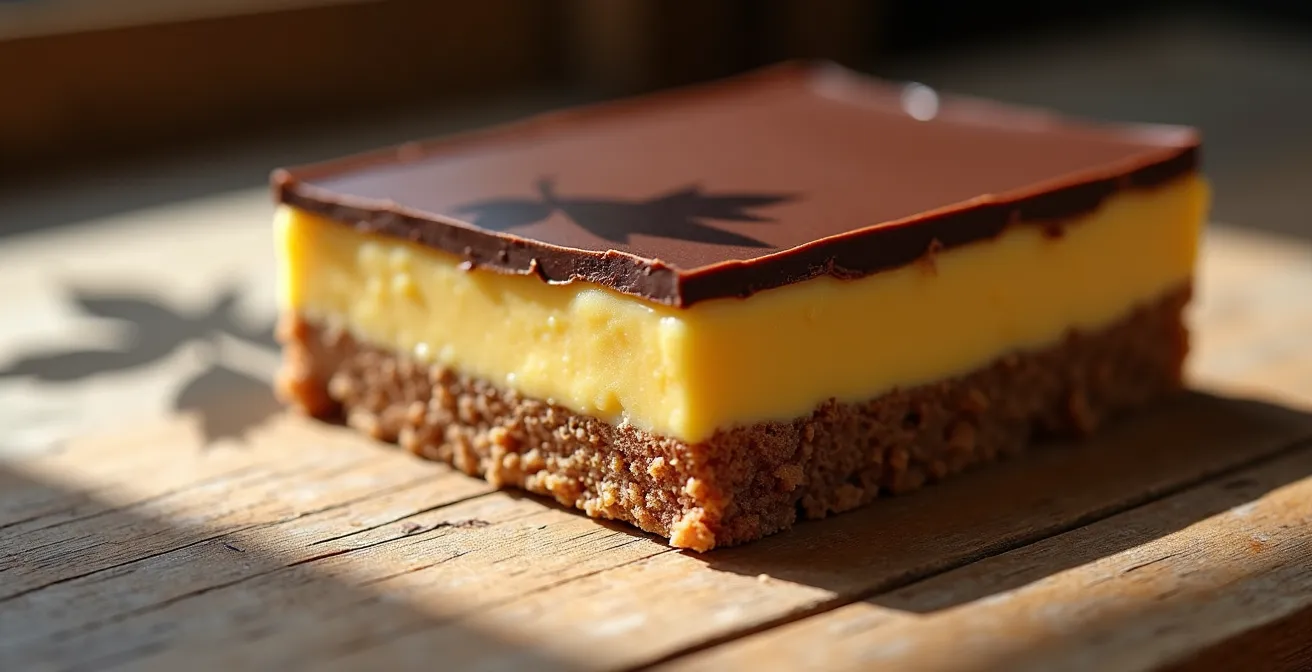
The perfect Nanaimo Bar isn’t about creative flavours; it’s a strict science of texture and a testament to Canadian culinary identity.
- Deviations from the official 1950s recipe, especially those involving mint, are considered flavour heresy by purists.
- The key is non-negotiable ingredients like Bird’s Custard Powder and precise temperature control to achieve the signature three-layer textural triad.
Recommendation: Follow the City of Nanaimo’s official recipe to the letter to understand its heritage, or explore the Nanaimo Bar Trail with a newfound appreciation for the original.
The first bite of a true Nanaimo Bar is a lesson in structural engineering. It’s a journey through three distinct textures: a firm, crumbly base of chocolate, coconut, and graham cracker; a soft, smooth, sweet custard middle; and a crisp, thin layer of chocolate that snaps cleanly under pressure. It is not just a dessert; it is a Canadian icon, born in the city of Nanaimo, British Columbia, and perfected in the mid-20th century. For any dessert lover visiting BC, or any ambitious baker at home, understanding this bar is paramount.
Many will tell you about endless variations—peanut butter, salted caramel, or the ever-controversial mint. These are presented as fun, modern twists. But what if the true magic of the Nanaimo Bar isn’t in its adaptability, but in its very rigidity? What if its perfection lies not in flavour experimentation, but in the precise, unchanging science of its original form? This is the perspective of the purist, the pastry chef who sees the bar as an “Icon by Preservation,” a piece of culinary history to be protected, not altered.
This guide defends that original vision. We will not be exploring a dozen trendy flavours. Instead, we will dissect the official recipe, revealing why its components are non-negotiable. We’ll explore the science behind achieving that perfect custard layer and snappy top, delve into its status as a Canadian cultural artifact alongside Montreal bagels and Halifax donairs, and finally, provide the etiquette for appreciating its subtle complexities. This is your guide to mastering the one, true Nanaimo Bar.
This article will guide you through the sacred rules of the authentic Nanaimo Bar, from its official recipe to its place in Canada’s culinary heart. The following sections break down everything you need to know to become a true connoisseur.
Summary: The Nanaimo Bar: Finding the Perfect Crumb-to-Custard Ratio
- The City of Nanaimo Official Recipe: why deviations with mint are considered heresy?
- The Nanaimo Bar Trail: mapping out the best stops for variations in Nanaimo
- Why your custard layer separates and how to get that perfect yellow snap?
- Transporting Nanaimo bars: keeping them cold so they don’t melt in luggage
- Vegan/Gluten-Free options: do they hold up to the butter-heavy original?
- Why the bagel war in Montreal is cultural, not just culinary?
- Greek vs. Lebanese influence: how the donair evolved specifically in Halifax?
- Ordering tasting flights: the etiquette of sharing and tasting order
The City of Nanaimo Official Recipe: why deviations with mint are considered heresy?
Let us be perfectly clear: there is only one Nanaimo Bar recipe. It is the one officially endorsed by the City of Nanaimo, a version submitted by Joyce Hardcastle in the 1980s that codified the local tradition. This isn’t a friendly suggestion; it is the culinary canon. Any deviation is not a “variation,” but a different dessert entirely. The most egregious of these is the mint Nanaimo Bar, a creation that fundamentally misunderstands the bar’s delicate balance. The original is a symphony of chocolate, coconut, graham, and a distinct vanilla-custard note. Introducing a powerful flavour like mint is not an enhancement; it’s a hostile takeover that bulldozes the subtlety of the original.
The integrity of the bar rests on a few non-negotiable ingredients. The base requires graham wafer crumbs, finely chopped almonds, and shredded coconut. The topping is simple semi-sweet chocolate melted with butter. But the heart, the soul of the bar, is the filling. This is where the true heresy often occurs. As one B.C. resident and purist maker noted in a community forum:
Custard powder is an essential part of the traditional bar, it is what creates the yellow filling. If the recipe says to make a vanilla custard from scratch, it is not a Nanaimo Bar.
– BC resident and Nanaimo bar maker, Group Recipes Community Forum
She is absolutely correct. The specific flavour and setting properties of Bird’s Custard Powder are essential. It provides that signature pale yellow colour and a flavour that is distinct from pure vanilla pudding. To use anything else is to create a fraud. The recipe is a formula, a piece of history preserved in specific ratios of butter, sugar, and cocoa. To meddle with it is to disrespect its legacy.
The Nanaimo Bar Trail: mapping out the best stops for variations in Nanaimo
Now that we have established the sanctity of the original recipe, we can approach the Nanaimo Bar Trail with the proper mindset: as a form of delicious research. It allows you to benchmark the authentic version against the many creative (and sometimes questionable) interpretations found across its homeland. This trail is not just a random collection of bakeries; it is a calculated and successful piece of marketing.
Tourism Nanaimo’s Sweet Success
The Nanaimo Bar Trail was created in 2010 by Chelsea Barr of Tourism Nanaimo as a brilliant marketing move. It has since grown to include over 40 stops across the region, from Lantzville to Cedar and even on Gabriola Island. This initiative brilliantly transformed a local dessert into a major tourist attraction, encouraging visitors to explore the entire area. Participants offer everything from traditional bars to wildly creative versions like the deep-fried Nanaimo bar at Pirate Chips, cocktails, and even non-edible items like themed soaps and pedicures, proving the bar’s deep cultural penetration.
Exploring the trail is a must-do for any visitor to Vancouver Island. It offers a tangible connection to the region’s identity. While you’ll find countless variations, the best stops are often those that either perfect the traditional form or offer a variation so unique it becomes its own experience. The goal is to taste the difference, to understand what makes the classic work by seeing how others deconstruct or reimagine it.

For those planning a trip, a little guidance can help navigate the dozens of options. The following table, based on a recent comparative analysis of trail stops, highlights some of the most notable destinations for both traditionalists and adventurers.
| Location | Specialty | Unique Feature | Price Range |
|---|---|---|---|
| Hearthstone Artisan Bakery | Traditional & Monthly Specials | Featured on Food Network, thicker bars | $3-4 |
| Bocca Café | Salted Caramel, Maple Bacon | Creative variations in Old City Quarter | $3.50-4.50 |
| Pirate Chips | Deep Fried Nanaimo Bar | Hot & gooey with ice cream center | $6-8 |
| Modern Café | Deconstructed Version | Espresso cream with sea salt | $5-6 |
| Red’s Bakery | Classic Recipe | Local favorite since 1946 | $3-3.50 |
Why your custard layer separates and how to get that perfect yellow snap?
Achieving the perfect Nanaimo Bar is a science of temperature. More specifically, it’s about managing temperature differentials between the three layers. The most common failure—a weeping, separated, or overly soft custard layer—is almost always a result of improper chilling. The textural triad of crumbly, smooth, and snappy is not a happy accident; it’s a deliberate construction. When you pour warm chocolate over a room-temperature custard layer, the butter in the custard melts, creating a greasy, unstable interface. The layers will slide, and the chocolate will never achieve that satisfying snap.
The secret is patience and a cold environment. Each layer must be a distinct temperature stage before the next is applied. The base must be fully chilled and firm. The custard layer must be even colder before the melted chocolate is introduced. In fact, food science experts recommend chilling the custard layer to below 4°C (39°F) to ensure a stable, perfect interface with the chocolate topping. This extreme cold prevents the butter in the custard from melting on contact with the slightly warm chocolate, ensuring a clean, defined line and the ideal final texture.
Cutting the bars presents the final temperature challenge. If you cut them straight from the refrigerator, the cold, brittle chocolate top will shatter into a thousand pieces, ruining your perfect surface. The trick is to let the slab sit at room temperature for about 10 minutes to take the intense chill off the chocolate, making it just pliable enough to slice cleanly without cracking. Mastering these temperature stages is the true mark of a skilled Nanaimo Bar maker.
Your Action Plan: The Temperature Staging Guide for Perfect Layers
- Ingredient Prep: Ensure butter for the middle (custard) layer is at room temperature (20-22°C) for smooth creaming.
- Base Chilling: Chill the bottom graham crumb layer completely in the refrigerator for a minimum of 30 minutes until firm.
- Custard Freezing: Freeze the applied custard layer for at least 20 minutes before adding the chocolate topping. It should be very cold to the touch.
- Chocolate Cooling: Let the melted chocolate and butter topping cool to a lukewarm 30-35°C before spreading to prevent melting the custard.
- Scoring the Top: Once the chocolate is about 75% set (firm but not rock-hard), score it with a sharp knife where you plan to make your final cuts. This prevents cracking.
Transporting Nanaimo bars: keeping them cold so they don’t melt in luggage
Once you’ve acquired or baked the perfect Nanaimo Bar, you face the final challenge: getting it home intact. This is a dessert with a fragile temperament, highly susceptible to heat. The butter-heavy custard and chocolate layers demand cold temperatures to maintain their structural integrity. Letting them sit at room temperature for too long is a recipe for disaster; the custard will soften, the chocolate will develop a “fat bloom” (a harmless but unattractive white film), and the whole bar can become a gooey mess.
Canadian bakers and travelers have this down to a science. The gold standard for long-distance transport is freezing. The bars should be frozen solid, then individually wrapped in plastic wrap or placed in a single layer in Ziploc bags. Packed in a cooler with ice packs, they can survive a long flight or car ride. For shorter trips, a temperature of 10-12°C is ideal to keep the bar firm without making the chocolate too brittle. The enemy is warmth and time; after a couple of days at room temperature, the custard can begin to separate as it dries out. Proper temperature control isn’t just a suggestion; it’s essential for preserving the bar’s integrity.
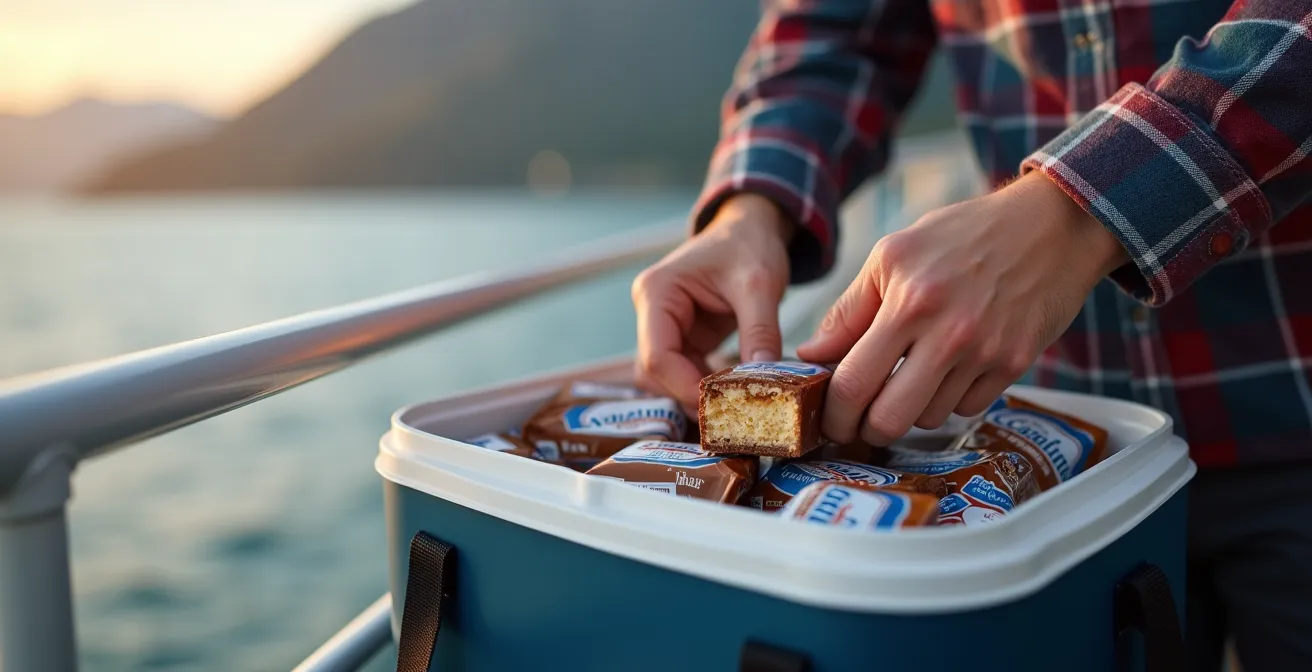
The image of carefully packing these treats into a cooler on a BC Ferry captures the essence of this ritual. It’s a distinctly Canadian act of culinary care, ensuring a precious taste of British Columbia can be shared with friends and family far away. This isn’t just about transporting a snack; it’s about being a custodian of a beloved regional treasure and delivering it in the pristine condition it deserves.
Vegan/Gluten-Free options: do they hold up to the butter-heavy original?
In our modern culinary landscape, the question of dietary alternatives is inevitable. Can the Nanaimo Bar, a dessert so fundamentally reliant on butter, eggs, and graham crackers, be successfully translated into a vegan or gluten-free version? The honest answer from a purist’s perspective is: not without compromise. While it is possible to create a delicious three-layered bar using alternative ingredients, it is impossible to perfectly replicate the texture and flavour profile of the original.
Recipe developer Sonia Wong has made significant strides in this area, creating stable vegan and gluten-free versions. Her work shows that using a high-quality vegan butter like Earth Balance at a 1:1 ratio and specific gluten-free graham crackers can yield a structurally sound bar. However, the experience is different. The mouthfeel of vegan butter or coconut oil is not identical to dairy butter, often resulting in a base that is slightly less firm and requires more aggressive chilling. The custard layer, often made with cornstarch and a nut milk, can achieve smoothness but rarely the same rich, pale yellow hue of a Bird’s Custard Powder base.
For a side-by-side comparison, an analysis of ingredient performance clearly shows where the trade-offs occur. The most successful gluten-free versions, for instance, often require adding extra cocoa powder to the base to balance the different taste of GF crumbs.
| Component | Traditional | Vegan Alternative | Texture Impact |
|---|---|---|---|
| Butter (base) | Dairy butter | Earth Balance or coconut oil | Slightly less firm, needs extra chilling |
| Custard Layer | Bird’s Custard + dairy | Cornstarch + oat milk | Similar smoothness, less yellow color |
| Graham Base | Regular graham crackers | Pamela’s GF crackers | Add 1-2 tbsp cocoa for taste balance |
| Chocolate Top | Semi-sweet + butter | Dark chocolate + coconut oil | Identical snap when properly tempered |
Ultimately, these versions should be appreciated for what they are: admirable adaptations that allow more people to enjoy a similar experience. But they are not, in the truest sense, Nanaimo Bars. They are a different, related dessert, and acknowledging that distinction is key to honouring the original’s specific, butter-laden perfection.
Why the bagel war in Montreal is cultural, not just culinary?
To understand the fierce defensiveness surrounding the Nanaimo Bar recipe, one must look to other Canadian culinary battlegrounds. There is no better example than the bagel war in Montreal. This isn’t a simple debate over which bakery—St-Viateur or Fairmount—makes a better product. It is a deeply cultural conflict about identity, tradition, and authenticity. A true Montreal bagel is defined by a strict, non-negotiable process: it must be boiled in honey-sweetened water and baked in a wood-fired oven. A bagel that is steamed, machine-made, or baked in a gas oven is, to a Montrealer, not a bagel. It’s just round bread.
This is the exact same principle that applies to the Nanaimo Bar. As food historian Margaret French notes, “The Nanaimo Bar is to Nanaimo what the Bagel is to Montreal.” The “heresy” of a non-traditional Nanaimo bar is the cultural equivalent of a Montrealer’s disdain for a factory-produced bagel. In both cases, the specific ingredients and methods are not just about taste; they are a link to a specific history and place. The wood-fired oven for the bagel and the Bird’s Custard Powder for the Nanaimo Bar are tangible pieces of that heritage.
This protective stance is a hallmark of foods that have transcended from mere recipes to become symbols of civic or national pride. It’s a pride that is entirely justified. This was officially confirmed in a 2006 national survey that crowned Nanaimo Bars as Canada’s Favourite Confection. This isn’t just Nanaimo’s dessert; it’s a treasure that belongs to all of Canada, and its integrity is worth defending with the same passion a Montrealer defends their bagel.
Greek vs. Lebanese influence: how the donair evolved specifically in Halifax?
If the Nanaimo Bar and Montreal Bagel represent “Icon by Preservation,” the Halifax Donair is a perfect example of an “Icon by Fusion.” This comparison further clarifies why the Nanaimo Bar’s recipe is so fiercely protected. The donair, another of Canada’s definitive city-branded foods, did not arrive in Halifax fully formed. It evolved. It was adapted from the Greek gyros and Lebanese shawarma traditions by immigrants trying to appeal to the local palate. The key innovation was the uniquely sweet donair sauce, a mixture of evaporated milk, sugar, vinegar, and garlic powder created specifically in Halifax to suit local tastes.
Icon by Preservation vs. Icon by Fusion
The Halifax donair became an icon through adaptation and fusion. It took an existing culinary concept and transformed it into something uniquely Haligonian. The Nanaimo Bar, in contrast, is an icon because it has been preserved. Its identity is tied to maintaining its original 1950s form, resisting change rather than embracing it. Both are defined by a singular, non-negotiable flavour component—the sweet sauce for the donair and the specific graham-coconut-custard powder combination for the Nanaimo Bar—but their paths to iconic status were opposites. This distinction is crucial to understanding Canadian food culture.
The donair’s history is one of creative merging, resulting in a beloved food that is a product of cultural exchange and local taste. The Nanaimo Bar’s story, however, is one of conservation. Its value lies in its consistency, a direct, unbroken line to a specific time and place. It does not bend to trends or palates. You either accept it on its own terms, or you are eating something else entirely. Both are valid paths to becoming a culinary landmark, but they represent two fundamentally different philosophies of what makes a food iconic.
Key Takeaways
- The authentic Nanaimo Bar is defined by the City of Nanaimo’s official recipe; deviations are considered different desserts, not variations.
- Perfect texture relies on a science of temperature control, requiring each of the three layers to be chilled at specific stages.
- The Nanaimo Bar is a Canadian “Icon by Preservation,” valued for its unchanging 1950s formula, unlike other icons like the Halifax Donair which evolved through fusion.
Ordering tasting flights: the etiquette of sharing and tasting order
Now, armed with a deep understanding of the Nanaimo Bar’s science, culture, and history, you are ready to approach a tasting flight with the palate of a true expert. Whether you are sampling different versions along the Nanaimo Bar Trail or sharing a few homemade varieties, there is an etiquette that can elevate the experience from simple consumption to a genuine analytical tasting. The goal is to appreciate the nuances, not just to ingest sugar. When sharing, a warm knife will produce the cleanest slices, and cutting bars into small, 2cm squares is perfect for flight-sized portions.
The most important rule is the order of tasting. Just like a wine or cheese flight, you must progress from the most subtle to the most intense flavours to avoid overwhelming your palate early on. A proper tasting flight follows a clear protocol:
- Start with the Traditional: Always begin with a classic, official-recipe Nanaimo Bar. This is your baseline, your control group. It re-calibrates your palate to the foundational flavours and textures.
- Progress to Subtle Variations: Next, move to bars with closely related flavour profiles, such as those with peanut butter or extra coconut. These flavours complement the original without overpowering it.
- Move to Bold Flavours: Now you can venture into stronger territories like maple bacon or the infamous mint. Your palate, having been primed, can now better isolate and analyze these dominant notes against the memory of the original.
- Finish with the Extreme: Conclude your tasting with the most radical interpretations, such as a deep-fried bar or a deconstructed version served in a glass. These are desserts in their own right and should be treated as the grand, experimental finale.
Between each sample, cleansing your palate with a sip of black coffee or plain water is essential. This tasting protocol transforms a simple dessert crawl into a structured, educational experience, deepening your appreciation for the complexity and perfection of the original.
With this knowledge, you are now more than just a dessert lover; you are a custodian of Canadian culinary heritage. The next step is to put this theory into practice. Bake a batch, following the official recipe with the precision of a pastry chef, or plan your pilgrimage to the Nanaimo Bar Trail, ready to taste with an educated palate.