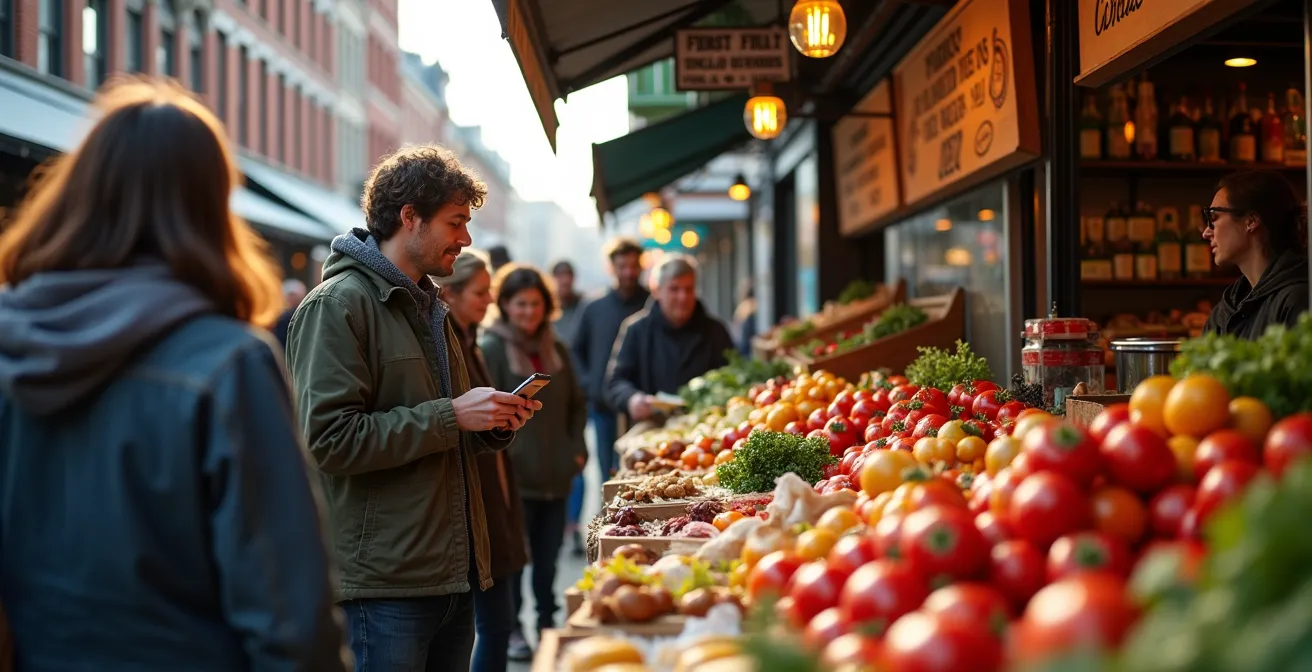
The real value of a Canadian food tour isn’t what’s on your plate, but the cultural and logistical puzzles it solves.
- It decodes local rivalries and stories, like Montreal’s infamous bagel war or Halifax’s donair-fueled Pizza Corner.
- It navigates complex provincial quirks, such as why some Ontario brewpubs can serve full meals and others only snacks.
Recommendation: Look beyond the menu; choose a tour based on the story it tells and the specific problems it solves for you as a traveler.
The question hangs in the air for any foodie exploring a new Canadian city: is a walking food tour a savvy investment in cultural discovery, or just an expensive, curated snack run? You see the happy groups navigating Vancouver’s Granville Island or Toronto’s historic districts, and you wonder if you could do it better, and cheaper, on your own. The common wisdom suggests a good tour introduces you to hidden gems and local specialties you might otherwise miss. You’ll hear about poutine, peameal bacon, or even the curious history of the Nanaimo bar.
But this thinking barely scratches the surface. To focus only on the food is to miss the point entirely. A truly great food tour doesn’t just feed you; it equips you with cultural fluency. It provides a narrative framework that turns a simple meal into a memorable story. The real value isn’t measured in the cost of the samples, but in the return on your cultural and logistical investment. What if the key wasn’t simply tasting the bagel, but understanding *why* Montrealers will defend their style to the bitter end?
This guide offers an analytical look at the worth of a food tour ticket in Canada. We’ll deconstruct the experience, moving beyond the plate to evaluate the storytelling, logistical leverage, and cultural insight you’re actually paying for. We’ll explore how to spot an authentic experience, navigate practicalities like allergies, and understand the deep-rooted local quirks that define Canada’s most vibrant food scenes. By the end, you’ll have a clear framework for deciding if a tour is the right choice for your specific travel style.
Summary: Urban Food Tours: Is the “Walking Tasting” Worth the Ticket Price?
- How to Distinguish Authentic Food Tours From Commission-Based Tourist Traps?
- Navigating Food Tours With Gluten or Nut Allergies: What Can Be Accommodated?
- Why the Bagel War in Montreal Is Cultural, Not Just Culinary?
- Kensington Market vs. St. Lawrence Market: Which Toronto Food Tour Fits Your Vibe?
- Tipping Etiquette on Food Tours: Do You Tip the Guide and the Restaurants?
- Brewpub Food Laws: Why Some Tasting Rooms Only Serve Popcorn and Others Full Meals?
- Pizza Corner History: Why This Intersection Is the Holy Grail of Late-Night Eats?
- Touring Okanagan Vineyards: Logistics of the Wine Route
How to Distinguish Authentic Food Tours From Commission-Based Tourist Traps?
In a booming market, telling a genuine culinary experience from a glorified shopping trip is the first step in getting your money’s worth. Canada’s culinary tourism sector is growing rapidly, with one market analysis projecting a 21% compound annual growth rate from 2024 to 2030. This popularity inevitably attracts operators focused more on commissions than culture. An authentic tour invests its value in storytelling and quality vendors, while a tourist trap funnels you toward businesses that pay the guide a kickback.
The key difference lies in the financial structure and the narrative depth. A legitimate guide is a storyteller and a curator, not a salesperson. They have pre-arranged agreements and often pay vendors directly for samples, ensuring the focus remains on the experience. Look for tours that provide cultural context beyond the food itself, touching on things like immigration history, urban planning, or local art scenes. These are strong authenticity signals, proving the tour is about understanding the city’s fabric, not just its flavours.
Another powerful indicator of authenticity is endorsement from local, neutral bodies. In Toronto, for example, a tour affiliated with a Business Improvement Area (BIA) or Destination Toronto is more likely to be vetted and community-focused. Similarly, a tour that actively includes and highlights Indigenous-owned businesses and traditional foods like bannock or Saskatoon berries demonstrates a commitment to deep, authentic Canadian culture. The goal is to find a tour that acts as a cultural bridge, not just a consumption channel.
Navigating Food Tours With Gluten or Nut Allergies: What Can Be Accommodated?
For travelers with dietary restrictions, a food tour can seem like a culinary minefield rather than a delight. The fear of cross-contamination or a lack of suitable options is a significant barrier. However, the ability to navigate these challenges is a hallmark of a high-quality, professional tour operator. It’s a clear demonstration of their logistical prowess and strong relationships with vendors. A good tour company will have done the hard work for you, vetting each stop for its ability to accommodate specific needs.
The key is clear and early communication. When booking, you must declare any and all allergies or restrictions. Reputable tours will have a clear policy outlined on their website. They won’t make vague promises; instead, they will provide specific information on what they can and cannot handle. For instance, while a tour might be able to offer gluten-free or vegetarian options at every stop, guaranteeing a completely nut-free environment in a bustling market kitchen is often impossible. They will be transparent about the potential for trace amounts.
This is where the tour’s value becomes tangible. Instead of you having to awkwardly interrogate every vendor, the guide acts as your advocate, ensuring your pre-arranged, safe options are ready for you. This logistical support transforms a potentially stressful experience into a seamless and enjoyable one.
Case Study: Kensington Market Allergy Accommodations
A prime Canadian example is the food tour in Toronto’s diverse Kensington Market. According to their booking information, the experience can be made fully vegetarian, vegan, and gluten-free. For nut allergies, they clarify that while nut-free samples are available at all locations, they cannot guarantee against trace amounts due to shared kitchen spaces. This level of specific, upfront information is exactly what to look for, as it allows you to make an informed decision about your safety and enjoyment.

As you can see, the preparation of separate, clearly-defined options is a sign of a well-organized tour. This pre-planning is a service in itself, freeing you to focus on the flavours and stories without anxiety.
Why the Bagel War in Montreal Is Cultural, Not Just Culinary?
To an outsider, the fierce debate between the St-Viateur and Fairmount bagel shops in Montreal’s Mile End might seem like a trivial foodie squabble. But to understand this “bagel war” is to understand Montreal itself. This isn’t just about a ring of boiled-and-baked dough; it’s about history, identity, and community pride. A good food tour doesn’t just let you taste the bagel; it gives you the “narrative currency” to understand why that bite is so significant to a Montrealer.
The rivalry is rooted in the city’s Jewish immigrant history. Both iconic shops were founded by immigrants who brought their traditions with them, shaping the culinary landscape of the Mile End neighbourhood. The slight differences in style—one slightly sweeter, the other denser—are points of almost tribal loyalty. A tour guide will explain how the 24/7, wood-fired ovens became pillars of the community, symbols of resilience and continuity. This context elevates the food from a snack to a piece of living history.
This is where a tour’s value truly shines. As one tour operator describes the neighbourhood:
Mile End is a thriving community of musicians, artists, and young entrepreneurs. Our tour allows you to discover exactly what makes this special neighbourhood tick! We explore its back alleys, acclaimed shops, and exhilarating culture.
– Alberta Food Tours, Canada Tours – Mile End Montreal Description
The bagel is a gateway to that culture. The fierce loyalty is a testament to this deep-seated identity, a fact perfectly captured by the experience of visitors who dare to mention an out-of-province version.
Montreal-style bagels in Ontario? Say it isn’t so! Really, though…you should have seen the eye-roll our tour guide in Montreal gave us when we said we had a Montreal-style bagel in Toronto.
– A visitor’s experience
That eye-roll is the entire point. It’s a moment of pure, undiluted local culture that you can’t get from a blog post. You’re not just buying a bagel; you’re buying access to the story and the emotion behind it.
Kensington Market vs. St. Lawrence Market: Which Toronto Food Tour Fits Your Vibe?
In Toronto, the choice between a food tour of Kensington Market and one of St. Lawrence Market is not just about different foods; it’s about choosing a different version of the city itself. Each market offers a unique “vibe,” and a good tour acts as a personality matchmaker, ensuring the experience aligns with your travel style. This is a form of value that goes beyond a simple tasting menu—it’s about maximizing your enjoyment by placing you in an environment where you feel you belong.
Kensington Market is a bohemian tapestry of smells, sights, and sounds. It’s a counter-culture hub defined by its vibrant street art, independent spirit, and a dizzying array of international street food stalls. A tour here is less structured, more of a grassroots exploration that feels like being shown around by a knowledgeable local friend. It’s perfect for the adventurous, artistic traveler who thrives on organized chaos and wants to taste the world in a few city blocks.
St. Lawrence Market, by contrast, is a pillar of Toronto’s history. Housed in a grand Victorian building, it’s organized, traditional, and steeped in over 200 years of heritage. A tour here is more curated and educational, focusing on Canadian classics like the iconic peameal bacon sandwich and the stories of multi-generational vendors. It’s the ideal fit for the traveler who appreciates history, order, and a more classic, focused culinary experience. The following comparison breaks down the essential differences.
This table, based on information from local operators, highlights how two tours in the same city can offer fundamentally different experiences. A tour’s value here is in helping you make the right choice for you.
| Aspect | Kensington Market | St. Lawrence Market |
|---|---|---|
| Vibe | Bohemian, counter-culture, artistic | Historic, traditional, established |
| Food Focus | International street food, diverse ethnicities | Canadian classics, peameal bacon, local produce |
| Best Day to Visit | Pedestrian Sundays for car-free experience | Saturdays for farmers’ market |
| Tour Style | Less structured, grassroots exploration | More curated, heritage-focused |
| Vendor Relationships | Personal, multi-generational family stalls | Formal, tied to 200-year market history |
Tipping Etiquette on Food Tours: Do You Tip the Guide and the Restaurants?
Navigating tipping culture is one of the most common anxieties for travelers in Canada, and food tours are no exception. Understanding the etiquette is part of the “cultural ROI” an article like this provides. The short answer is yes, you should tip your tour guide. The rationale is simple: tour guiding is a service industry, and in Canada, the culture of tipping for good service is deeply ingrained.
Think of your guide in the same way you would a server in a restaurant. They are curating your experience, managing logistics, providing entertainment, and sharing expert knowledge for several hours. The standard practice is to tip 15-20% of the tour’s pre-tax price, mirroring what is customary in Canadian restaurants. This is reinforced by dining trends; a recent report on Canadian diners revealed that an overwhelming 84% of Canadians prefer traditional service models where tipping is the norm. Your tip is a direct acknowledgment of the personal service and expertise your guide provided.
However, it’s crucial to know who *not* to tip. You do not need to tip the individual food vendors or staff at each stop. The tour company handles all financial arrangements with its partners as part of the ticket price. Your tip is for the guide alone. Some Canadian operators, especially those catering to international visitors, may now include a gratuity in the price. It’s always wise to check the booking confirmation or FAQ on the company’s website to see if gratuity is included. If it’s not mentioned, assume it is not.
Your 5-Point Food Tour Value Audit
- Price Breakdown: Mentally subtract the likely retail cost of the food samples from the ticket price. Is the remaining amount a fair price for 2-3 hours of a local expert’s time, storytelling, and logistical planning?
- Narrative Value: Does the tour promise to explain the “why” behind the food (e.g., history, cultural significance, local legends)? Are you buying a story or just a sequence of snacks?
- Logistical Leverage: Does the tour solve a problem for you? (e.g., navigating a complex market, handling dietary needs, providing transportation like in wine regions).
- Exclusivity Check: Does the tour offer something you couldn’t easily do yourself? (e.g., behind-the-scenes access, conversations with chefs, tasting items not on the public menu).
- Post-Tour Utility: Will you leave with a list of vetted restaurants and a better understanding of the city’s layout and culture that will benefit the rest of your trip?
Brewpub Food Laws: Why Some Tasting Rooms Only Serve Popcorn and Others Full Meals?
You’re on a craft beer tour in Ontario and notice something odd. One brewery has a bustling, full-service restaurant, while the next one is legally only allowed to serve you a small bowl of pretzels with your flight. This isn’t an arbitrary choice by the owners; it’s a direct consequence of a complex web of provincial liquor laws. Understanding this “provincial nuance” is a fascinating piece of cultural insight that a good food or beer tour will illuminate.
The discrepancy in Ontario, for example, comes down to the type of license a brewery holds from the Alcohol and Gaming Commission of Ontario (AGCO). A “Tied House” license allows a manufacturer to operate a full restaurant on-site. In contrast, a “By the Glass” license, which is often simpler and cheaper to obtain, comes with minimal food requirements. The law often stipulates that some form of snack must be available, a legal echo of old temperance-era rules designed to prevent people from drinking on an empty stomach.
This legal framework varies dramatically from province to province. British Columbia, for instance, generally has more liberal laws, making full-scale brewery restaurants more common. This directly impacts the type of tour you might experience. In BC, you can expect sophisticated beer-and-food pairings as a standard offering. In other provinces, the tour might be more beer-focused, with food playing a minor, legally-mandated role. A knowledgeable guide can explain these differences, adding a layer of legislative history to your tasting experience that you’d never discover on your own. It’s a perfect example of a tour providing answers to questions you didn’t even know you should be asking.
Pizza Corner History: Why This Intersection Is the Holy Grail of Late-Night Eats?
At the corner of Blowers and Grafton Streets in Halifax lies a simple, unassuming intersection that holds a sacred place in the city’s identity: Pizza Corner. For generations of students, night-shift workers, and bar-hoppers, this spot has been the traditional final stop of the night. But why here? Why did this specific corner become the undisputed holy grail of late-night eats in Halifax? The answer is a story of urban geography, immigration, and the birth of a uniquely Canadian food: the Halifax donair.
A good food tour will unpack this local legend. The corner’s strategic location, at the heart of the downtown entertainment district, made it the perfect oasis for the late-night crowds pouring out of bars and music venues. In the 1970s, a Greek immigrant, Peter Gamoulakos, tried to introduce the traditional gyro to Haligonians. When it didn’t catch on, he adapted the recipe, swapping lamb for spiced ground beef and creating a sweet, tangy garlic sauce. The Halifax donair was born, and its popularity exploded.
The donair shops, alongside classic pizza joints, congregated at this corner, creating a critical mass of cheap, delicious, and satisfying late-night food. “Grabbing a slice” or “a donair” at Pizza Corner became a shared ritual, a cultural touchstone passed down through decades. It’s more than just a place to eat; it’s a living museum of Halifax’s social history. A guide can share tales of its heyday, its recent changes with urban development, and its unwavering place in the city’s heart. This is the narrative currency you’re paying for—the story that transforms a greasy, delicious slice of pizza or a messy donair into a meaningful cultural experience.
Key Takeaways
- The true value of a food tour is its “Cultural ROI”—the stories, context, and logistical help you receive.
- Authentic Canadian tours often have ties to local BIAs, feature Indigenous foods, and focus on storytelling over sales.
- Tipping your guide 15-20% is standard in Canada, but you don’t need to tip the individual vendors.
Touring Okanagan Vineyards: Logistics of the Wine Route
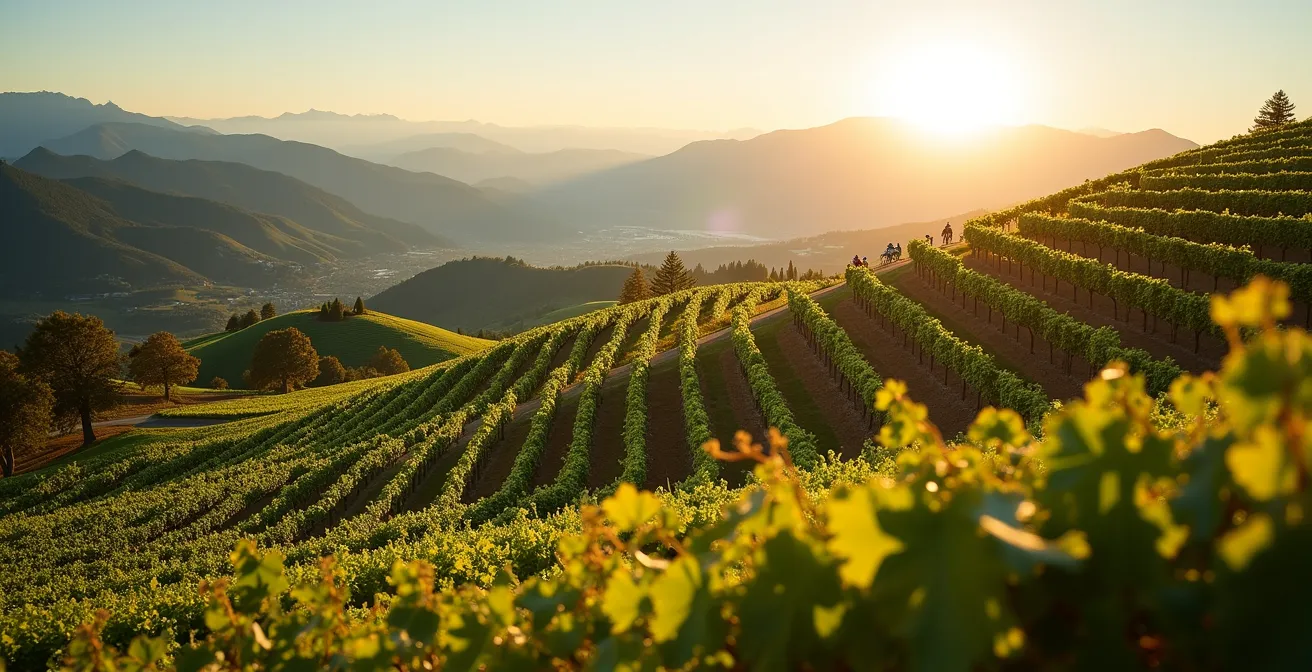
The sun-drenched hills of British Columbia’s Okanagan Valley are a paradise for wine lovers. But with over 200 wineries scattered across sub-regions like the Naramata Bench, the Golden Mile, and Lake Country, the logistics of touring the wine route can be daunting. This is where a tour’s value shifts from “narrative currency” to pure, unadulterated logistical leverage. The price of the ticket buys you a solution to a complex planning problem.
The primary challenge is transportation. Self-driving is an option, but it requires a designated driver who can’t fully participate in the tastings, which defeats much of the purpose. A tour eliminates this issue entirely. Whether you choose a larger, cost-effective tour bus or a more flexible private driver, everyone in your group can indulge without worrying about getting behind the wheel. A tour company also handles the intricate scheduling, securing reservations that can be difficult to get during the busy summer season.
Furthermore, experienced operators bring crucial strategic knowledge. They can design an itinerary that minimizes travel time and maximizes tasting opportunities, often planning a route through a specific sub-region known for a particular style of wine. They know which wineries offer the best tours, which have the most scenic patios, and which hidden gems are worth a visit. This insider knowledge saves you hours of research and prevents the disappointment of a poorly planned route.
Here are the common transportation options to consider:
- Self-driving: Offers flexibility but requires a designated driver, limiting participation.
- Tour buses: A social and budget-friendly choice, but schedules are rigid.
- Private drivers: The most flexible and customizable option, but also the most expensive.
- Strategic Planning: A good tour will plan sub-regions effectively, like focusing on the condensed Naramata Bench for efficient touring or the Golden Mile for its famous bold red wines.
In a region as vast and popular as the Okanagan, a tour is less of a luxury and more of a practical tool for optimizing your time and enjoyment.
Ultimately, a Canadian food tour’s worth is a function of what you value as a traveler. If your goal is simply to eat, you might be better served by doing your own research. But if your goal is to understand, to connect, and to experience a city’s culture through its food, then the right tour is an invaluable investment. Use the value audit and insights from this guide to find an experience that doesn’t just fill your stomach, but also enriches your entire trip.
Frequently Asked Questions About Urban Food Tours
Why do Ontario brewpubs have different food requirements than BC?
The difference lies in provincial licensing. In Ontario, the AGCO’s “Tied House” license permits full restaurants in breweries, while the more common “By the Glass” license only requires minimal snacks. British Columbia’s regulations are generally more permissive, making full-service food offerings more standard in their tasting rooms.
Are these food requirements related to temperance-era laws?
Yes, many of the “snack requirements” in Canadian liquor laws are modern remnants of older temperance-era legislation. These laws were originally designed to ensure alcohol was not consumed on an empty stomach, and that legal framework continues to shape the operations of tasting rooms today.
How does this affect brewery tours in different provinces?
It significantly changes the experience. In a province with liberal laws like British Columbia, you can expect brewery tours to feature sophisticated beer-and-food pairings. In provinces with stricter or more complex rules, tours may be more focused on the beer itself, with food serving as a secondary, legally required component.