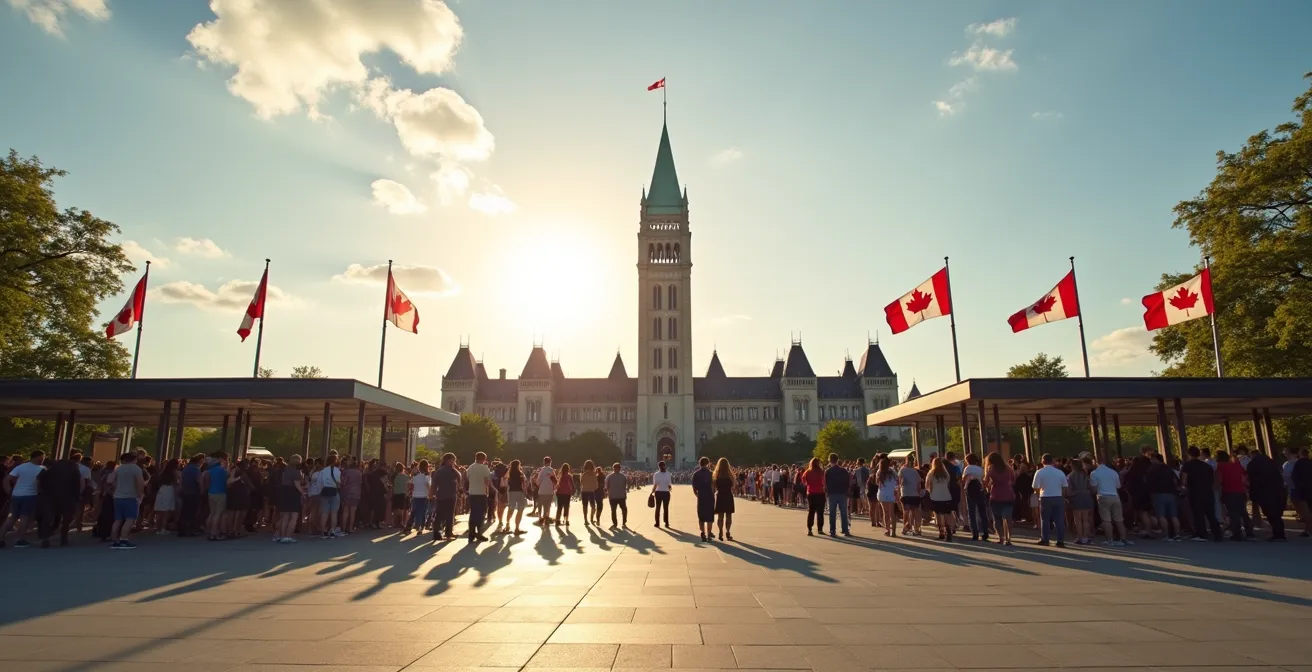
The ongoing renovation of Parliament Hill’s Centre Block has significantly altered the visitor experience. For tourists confused by the changes, this guide provides the official, up-to-date procedures for visiting. Understanding the new operational logic for booking free tours, navigating security checkpoints, and knowing which buildings are open is the key to a smooth and successful visit to Canada’s seat of government.
The iconic Peace Tower stands tall over Ottawa, a symbol of Canadian democracy. Yet, for many visitors, the view is now framed by construction hoarding and the hum of machinery. The historic Centre Block is undergoing a monumental, decade-long rehabilitation, leading to widespread confusion: Are tours still available? Where do they happen? What are the new rules? While many guides offer generic advice, they often fail to address the core operational shifts that now define a visit.
The reality is that access to Parliament Hill has not stopped; it has been procedurally redesigned. Success is no longer about simply showing up. It is about understanding the new visitor flow, from online reservations to a reconfigured security apparatus. This is not merely an inconvenience but a reflection of enhanced security protocols and the logistical demands of the largest heritage restoration project in Canadian history. The key is to move beyond the simple fact of renovation and grasp the new procedural logic.
This guide will provide that clarity. We will detail the precise steps for securing your free tour, explain the security screening process, clarify which buildings now host the proceedings of the House of Commons and the Senate, and provide operational guidance for navigating the site. By understanding these new systems, you can plan your visit with confidence, ensuring a rewarding experience at the heart of Canada’s capital.
This article provides a comprehensive overview of the current protocols and logistics for visiting Parliament Hill. Explore the detailed sections below to plan each aspect of your trip.
Summary: A Guide to Parliament Hill’s New Visitor Protocols
- How to reserve free tickets for the House of Commons gallery online?
- Why are large bags prohibited inside federal buildings and where to store them?
- Center Block vs. West Block: where are tours currently operating during renovation?
- Delays caused by official state visits or protests: how to check status?
- When to arrive to see the Changing of the Guard ceremony for the best view?
- Why you should buy art directly from Indigenous creators rather than souvenir shops?
- Navigating the Place des Festivals: moving through 100,000 people safely
- Navigating Francophone Heritage: Bilingualism Beyond Quebec’s Borders
How to reserve free tickets for the House of Commons gallery online?
Accessing the proceedings of the House of Commons or the Senate is a unique opportunity, and contrary to what some may believe, tickets remain entirely free of charge. However, the era of spontaneous walk-up visits is over. The current system requires all visitors to reserve timed-entry tickets online in advance. This procedural shift ensures better crowd management and security predictability. The booking process is centralized through the official Parliament of Canada website, which serves as the sole, official access point for reservations.
You can book your tour for the House of Commons (located in the West Block) or the Senate (in the Senate of Canada Building) up to 60 days in advance. It is highly recommended to book as early as possible, especially during peak tourist seasons like summer and school holidays, as time slots fill up quickly. The process is straightforward and ensures you receive a digital ticket for presentation upon arrival. For those requiring assistance, a dedicated phone line is available.
Your Action Plan: Booking Your Parliament Tour
- Visit the official Parliament of Canada tours website at rts.parl.ca to begin the reservation process.
- Click on “Reserve Tickets” and select your preferred guided tour: the House of Commons in the West Block or the Senate of Canada Building.
- Choose your desired visit date and time slot from the available calendar, which shows availability up to 60 days in advance.
- Enter the required visitor information, including the names of all guests and an email address for confirmation.
- Review all booking details for accuracy and submit your request; your free tickets will be sent to your email immediately.
This structured booking system is fundamental to the new visitor flow. It provides the Parliamentary Protective Service with a clear manifest of expected guests, streamlining the security process for everyone. Securing your tickets online is the mandatory first step to your visit.
Why are large bags are prohibited inside federal buildings and where to store them?
Upon arrival, visitors will find that security protocols on Parliament Hill are rigorous and non-negotiable. A key regulation that often surprises tourists is the strict limitation on personal items. As per official guidelines, only one small bag per visitor is permitted inside the buildings, with specific dimension limits. This rule is not for convenience; it is a direct result of enhanced security postures implemented across the Parliamentary Precinct.
This procedural logic is rooted in safety. Following the 2014 attack on Parliament Hill, the Parliamentary Protective Service (PPS) fundamentally redesigned its security framework. As detailed in their mandate, this overhaul instituted an airport-style screening process for every person and item entering the buildings. Large bags, backpacks, and luggage dramatically slow down this essential screening, creating bottlenecks and increasing security risks. Prohibiting them ensures a faster, more efficient, and safer visitor flow for everyone.
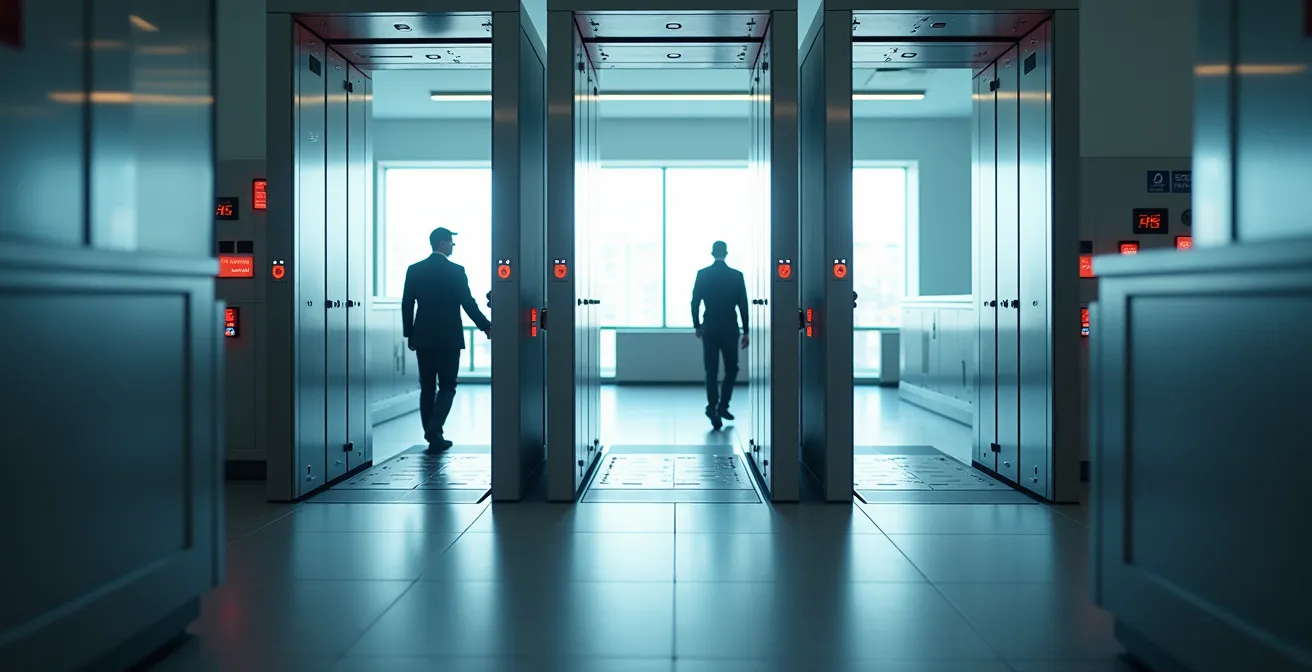
As the image above illustrates, the screening process involves metal detectors and X-ray scanners. There is no on-site storage or locker facility for oversized bags on Parliament Hill. Visitors arriving with luggage will be denied entry to the tour. It is imperative to leave large items at your hotel or in a secure off-site location before you arrive for your scheduled tour time. All visitors must also present a valid government-issued photo ID. This integrated system of identification and limited personal items is the cornerstone of the precinct’s protective measures.
Center Block vs. West Block: where are tours currently operating during renovation?
For generations of Canadians and international visitors, a tour of Parliament meant walking the grand halls of the Centre Block, culminating in a visit to the iconic Library of Parliament. However, with the Centre Block now closed for a massive heritage restoration, this is no longer the case. All legislative functions and guided tours have been relocated to other buildings within the Parliamentary Precinct. This has created significant confusion, but the new locations offer their own unique and modern perspective on Canada’s democracy.
The House of Commons has been moved to a stunning, state-of-the-art chamber built within the open courtyard of the newly restored West Block. This building, with its magnificent glass roof, now hosts a new guided tour that showcases Canadian politics in a contemporary setting. Meanwhile, the Senate of Canada has been relocated to Ottawa’s original train station, the historic Government Conference Centre, now renamed the Senate of Canada Building. Separate tours are offered for this equally impressive location. It’s crucial for visitors to know which tour they have booked, as they take place in two distinct, non-connected buildings.
The scale of the Centre Block project underscores why this move was necessary. It is not a simple facelift but a complete overhaul of structure, mechanics, and heritage elements, a monumental undertaking with projected costs between $4.5 and $5 billion. This site transformation ensures the preservation of the building for another century, but for the foreseeable future, your parliamentary experience will be in the modern marvel of the West Block or the historic elegance of the Senate Building.
Delays caused by official state visits or protests: how to check status?
Parliament Hill is not a museum; it is a living, working environment. The grounds and buildings are the backdrop for official government business, state ceremonies, and public demonstrations. These activities can, and often do, lead to unexpected changes in public access, including tour cancellations or delays. Official visits from foreign dignitaries, major government announcements, or large-scale protests can result in temporary closures of certain areas with little advance notice.
This operational reality means that flexibility is key to any visit. While your ticket is for a specific time, access to the grounds or buildings can be restricted at any moment by the Parliamentary Protective Service for security reasons. There is no single, guaranteed way to predict all disruptions, but there are procedural checks you can perform. The most reliable source of information is the official Parliament of Canada website. An alert banner is typically displayed on the homepage of the tour-booking section if there are any known, large-scale disruptions planned for the day.
For day-of, last-minute changes, monitoring the official social media channels of the Parliament of Canada and the RCMP’s Parliamentary Protective Service can provide real-time updates. Local Ottawa news outlets also report on major planned protests or road closures. Acknowledging that the Hill is a dynamic environment and performing a quick status check before you depart for your tour is a wise procedural step to avoid potential disappointment and manage expectations.
When to arrive to see the Changing of the Guard ceremony for the best view?
Beyond the architectural tours, Parliament Hill hosts one of Ottawa’s most beloved summer traditions: the Changing of the Guard. This impressive display of military pageantry, complete with regimental bands and soldiers in scarlet tunics and bearskin hats, is a major draw for visitors. The ceremony is a summer-only event, typically running from late June to late August each year, and it is crucial to check the official schedule for exact dates and times, which are usually at 10:00 a.m. daily, weather permitting.
Securing a good vantage point requires planning. The key is to arrive well before the ceremony begins. For an unobstructed, front-and-centre view of the main proceedings on the lawn, you should aim to be in place at least 45 minutes early. This prime viewing area fills up very quickly. For those more interested in photography, standing along the ceremonial path that the guards use to march onto the lawn can offer excellent angles, often with the Peace Tower in the background. Arriving 30 minutes early is sufficient for these spots.
On hot, sunny days, the side areas of the lawn near the trees offer welcome shade, though the view may be partially obstructed. An arrival of 20 minutes early is usually fine for these less-crowded zones. The most important procedural check is the weather. The ceremony is often cancelled during heavy rain or periods of extreme heat. Always verify same-day announcements on the Canadian Army’s official website or social media channels before heading to the Hill to avoid disappointment. This simple check can save you a significant amount of time.
p>
Why you should buy art directly from Indigenous creators rather than souvenir shops?
A visit to Ottawa offers a profound opportunity to engage with the rich cultures of the First Nations, Inuit, and Métis peoples. While many souvenir shops around Parliament Hill sell items with “Indigenous-style” designs, making a purchase directly from Indigenous artists or through designated galleries ensures cultural respect, authenticity, and direct economic support for the creators and their communities. This act of “ethical purchasing” moves beyond tourism to become a meaningful act of reconciliation.
This approach is particularly significant in the context of Canadian institutions, which have been on a long journey of reform. As a striking example of this historical context, the National Gallery of Canada provides a telling perspective.
The Gallery’s mandate did not include collecting art by Indigenous peoples until the 1980s
– National Gallery of Canada, Wikipedia – National Gallery of Canada
This historical exclusion has been actively addressed. Today, the National Gallery of Canada’s permanent galleries display Indigenous and Canadian art side-by-side, in chronological order, weaving Indigenous stories into the national narrative. Similarly, the Ottawa Art Gallery features rotating exhibitions of contemporary and historical Indigenous art. Visiting these galleries or official markets like the Indigenous Arts Market at the Canadian Museum of History is the best way to appreciate and purchase authentic work, where the artist’s story and heritage are an integral part of the piece.

Buying directly honours the skill, tradition, and intellectual property of the artists. It ensures your money supports the artists themselves, rather than mass-producers. Look for artist signatures, “Made in Canada” labels, or the “Igloo Tag” on Inuit art, which guarantees authenticity. This mindful approach to souvenir shopping transforms a simple purchase into a respectful cultural exchange.
Key Takeaways
- All tour tickets for Parliament Hill are free but must be reserved online in advance via the official Parliament website.
- Only one small bag per person is permitted; there is no on-site storage for luggage, and airport-style security screening is mandatory.
- Tours are not in the Centre Block. The House of Commons is in the West Block, and the Senate is in a separate, historic building.
- Always check the official Parliament website or social media for same-day disruptions due to official business or protests.
Navigating the Place des Festivals: moving through 100,000 people safely
While Montreal’s Place des Festivals is renowned for its massive festival crowds, similar principles of crowd management are essential for navigating Parliament Hill during its own peak events, such as Canada Day. On July 1st, the front lawn of Parliament transforms into a dense sea of red and white, presenting a significant navigational challenge. The key to a safe and enjoyable experience lies in understanding the operational logic of visitor flow management.
p>
The Parliamentary Protective Service, in partnership with over 20 other agencies including the RCMP and Ottawa Police, undertakes a year of planning for this single day. This case study in crowd control demonstrates that the grounds are a highly managed environment. It’s not a chaotic free-for-all; there are designated security checkpoints, established circulation paths, and a heavy presence of officers and first-aid personnel. According to RCMP planning documents, the Parliament Hill grounds can hold approximately 30,000 people, and managing this capacity is a science.
For visitors, the safest strategy is to move with the established flow of traffic, not against it. Identify exit routes and landmarks upon arrival, before the crowd density peaks. Pre-arrange a meeting spot with your group in a less-congested area (e.g., by the Valiants Memorial or a specific statue) in case you get separated. Staying hydrated and being patient are critical. Trying to force your way through a dense crowd is ineffective and unsafe. Instead, it is better to wait for natural clearings in the crowd to move. Following the directions of police and security staff is not optional; it is a mandatory component of the day’s safety protocol.
Navigating Francophone Heritage: Bilingualism Beyond Quebec’s Borders
A visit to Parliament Hill is an immersion in Canada’s policy of official bilingualism. While Ottawa is in the English-majority province of Ontario, its unique position directly across the river from Gatineau, Quebec, makes the National Capital Region a vibrant hub of French and English culture. This duality is not just a demographic curiosity; it is a legally enshrined principle woven into the fabric of all federal institutions.
The Official Languages Act mandates that federal services be available in both English and French. On Parliament Hill, this is seen in action everywhere. All signage, from building directories to historical plaques, is presented in both languages. Parliamentary documents and debates are published and interpreted simultaneously. For visitors, this has a direct and beneficial impact: all guided tours of the House of Commons and the Senate are offered in both English and French. When booking your tickets online, you can select your preferred language, ensuring a tour experience that is clear, engaging, and accessible.
This commitment to language demonstrates a core aspect of the Canadian identity. The tours themselves are a case study in functional bilingualism, with guides seamlessly explaining the functions of government in the language of the group’s choice. This is not a token gesture but a fundamental operational standard. The presence of both languages is a constant reminder that the visitor is standing at a place that represents all Canadians, from coast to coast to coast, reflecting a heritage that extends far beyond the borders of Quebec.
As you explore the capital, this bilingual character is a unique cultural feature. Now that you have a complete picture of the visit, it is helpful to reconsider the starting point of your journey. Mastering the entire process, from booking to departure, ensures a fulfilling experience.
Frequently Asked Questions About Visiting Parliament Hill
Can I bring a drone to film Parliament Hill events?
No. The use of recreational and micro drones is strictly prohibited. Parliament Hill is located within restricted airspace (CYR537), which covers a radius of 0.75 miles. Unauthorized drone operation in this area is illegal and will result in enforcement action.
Where can I park when visiting Parliament Hill?
There is absolutely no public or visitor parking available directly on Parliament Hill or at the Senate of Canada Building. Visitors must use one of the numerous nearby municipal parking lots or private parking garages. Using Ottawa’s public transit system is also a highly recommended alternative.
What items are prohibited on Parliament Hill grounds?
In addition to the ban on large bags, several other items are strictly prohibited for safety and security. These include any type of weapon, explosives or fireworks, and alcoholic beverages. Furthermore, while peaceful demonstrations are permitted on the grounds, any form of political demonstration is not allowed inside the buildings.