Your safety on a Canadian river isn’t determined by the rapid’s class number, but by your brutally honest answer to the real-world risks involved.
- Glacial water isn’t just cold; it’s a critical survival factor that can incapacitate you in minutes, regardless of the season.
- You are not a passenger, you are active crew. Your ability to follow commands like “High-Side” directly prevents capsizing.
- That liability waiver is a legally binding document in Canada, often releasing the company from responsibility even in cases of their own negligence.
Recommendation: Before you even look at trip options, use this guide to conduct an honest self-assessment of your physical and mental limits against the unique challenges of Canadian whitewater.
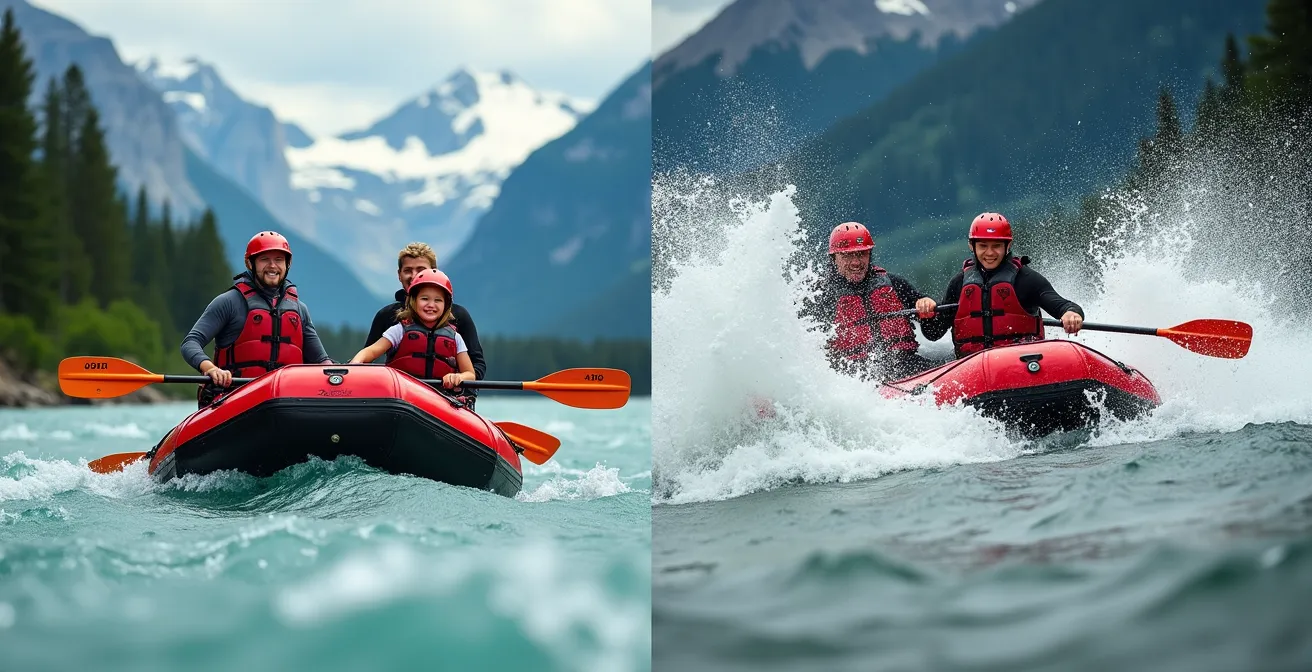
Listen up, team. You’re staring at two rafting brochures for your Canadian adventure. One shows a smiling family gently splashing through sunny rapids. The other shows a helmeted crew digging paddles into a monstrous, churning wave. The choice seems simple: fun float or adrenaline rush. But that’s the first mistake. In Canada, choosing your whitewater trip isn’t about picking your preferred level of ‘fun.’ It’s about conducting a frank, honest self-assessment of your abilities against the non-negotiable realities of our rivers: immense seasonal power, glacially cold water, and your own physical limits when things go wrong.
Many articles will just list the international scale of river difficulty, from Class I to VI. That’s the ‘what’. It tells you nothing about the ‘why’ or ‘how’ of staying safe on a river like the Kicking Horse or the Ottawa. This isn’t about scaring you off; it’s about equipping you with the mindset of a river guide. My job isn’t just to get you down the river; it’s to make sure you understand the forces at play and your role in managing them. The true key to an amazing day isn’t the class of the rapid, but the perfect match between the river’s challenge and your proven capabilities.
This guide will break down that decision-making process. We won’t just talk about rapid classes; we’ll talk about your real-world swimming ability in cold water. We’ll cover why the same river in May is a different beast than in August, what gear is non-negotiable, and what that liability waiver you’re signing actually means in a Canadian legal context. Forget the brochure photos for a minute. Let’s talk about what it really takes to paddle safely in Canada.
To navigate this decision properly, we’ll break down the critical factors you must consider, from understanding the raw power of the river to your responsibilities as part of the crew. This structure will help you build a complete picture of the risks and choose an adventure that’s both thrilling and appropriate for your level.
Summary: A Guide to Canadian Whitewater Rafting Levels
- Class III vs. Class V: knowing your swimming ability limits on the Ottawa River
- Spring runoff vs. Summer flows: when is the water level most extreme?
- Wetsuit essentials: why the glacial water requires neoprene even in August?
- The ” T-Grip” rule: how to not knock out your raft-mates teeth?
- Adventure waivers: understanding what rights you sign away before getting in the boat
- Trim and balance: avoiding capsizing by packing your gear correctly
- Hypothermia signs that set in within 15 minutes of exposure during accidents
- Planning a Fly-In Fishing Trip: Logistics for Remote Northern Ontario Lodges
Class III vs. Class V: knowing your swimming ability limits on the Ottawa River
Alright, let’s talk numbers. The biggest misconception is that a Class III rapid is “safe” and a Class V is “dangerous.” The truth is, any swim in moving water is a serious situation. The real difference isn’t the rapid; it’s the consequence of a mistake and the level of self-rescue skill required. A Class III might have a clear channel and a calm pool at the bottom. A Class V has continuous, powerful features, requires complex maneuvers, and offers little to no room for error. The question you must ask is not “Can I handle the waves?” but “Can I save myself if I fall out in that specific environment?” Your swimming ability in cold, turbulent water is the single most important factor.
Case Study: The Ottawa River’s Dual Channel System
The Ottawa River is a perfect Canadian example of managing this choice. According to a feature in Paddling Magazine on Ottawa rafting, its unique dual-channel system allows outfitters to offer different experiences on the same stretch of water. The Main Channel provides big, fun Class III-IV waves with warm (22°C) summer water, making it ideal for families and first-timers. In parallel, the Middle Channel offers technical Class V challenges like Garvin’s Chute, a 15-foot waterfall, for experienced paddlers who have proven swimming skills. This allows a ‘challenge by choice’ environment, but the choice is still yours to make honestly.
Before you even consider a trip above Class III, you need to be brutally honest about your water skills. This isn’t about being an Olympian; it’s about being effective in a crisis. Can you remain calm after the shock of cold water? Can you orient yourself and swim aggressively towards the raft or shore while wearing a bulky PFD? Can you pull yourself out of the water? If the answer to any of these is “I’m not sure,” stick to the Class III adventures. They are incredibly fun and provide the perfect introduction without the severe consequences of a swim in a Class V gorge.
Action Plan: The Confident Canadian River Swimmer Self-Assessment
- Cold Water Tolerance: Can you comfortably swim 50 meters in water below 15°C while wearing a PFD without panicking?
- Defensive Swimming: Practice floating on your back with your feet up and pointed downstream, toes out of the water, to fend off rocks.
- Breath Control: Jump into cold water (safely, at a local swim spot) and practice controlling your breathing within 60 seconds of the initial shock.
- Endurance Test: Can you swim continuously for 10 minutes in moving water, like a gentle river current or wave pool?
- Self-Rescue Practice: From deep water, can you effectively pull yourself up and onto a raft, dock, or pool edge?
Spring runoff vs. Summer flows: when is the water level most extreme?
The class rating of a rapid is not static. It’s a snapshot at a specific water level. In Canada, with our massive snowpacks, the single biggest variable is the time of year. A river in late May during peak spring runoff is an entirely different beast than the same river in mid-August. High water doesn’t just mean bigger waves; it means faster currents, fewer eddies to rest in, and a river carrying massive amounts of debris. Low water, conversely, can expose more rocks, creating more technical, “pinball-machine” style rapids.
This seasonal change is dramatic. For example, the Kicking Horse River’s dramatic seasonal flow changes show it can rage at over 250 cubic meters per second (CMS) in May, while dropping to a more technical 50 CMS by August. That’s a five-fold decrease in volume and power. High-flow seasons are for powerful, big-water thrills and are generally suitable for strong, confident swimmers only. Summer flows often provide a more technical and playful experience, suitable for a wider range of abilities. Always ask the outfitter about the current water level and how it compares to the historical average for that date.
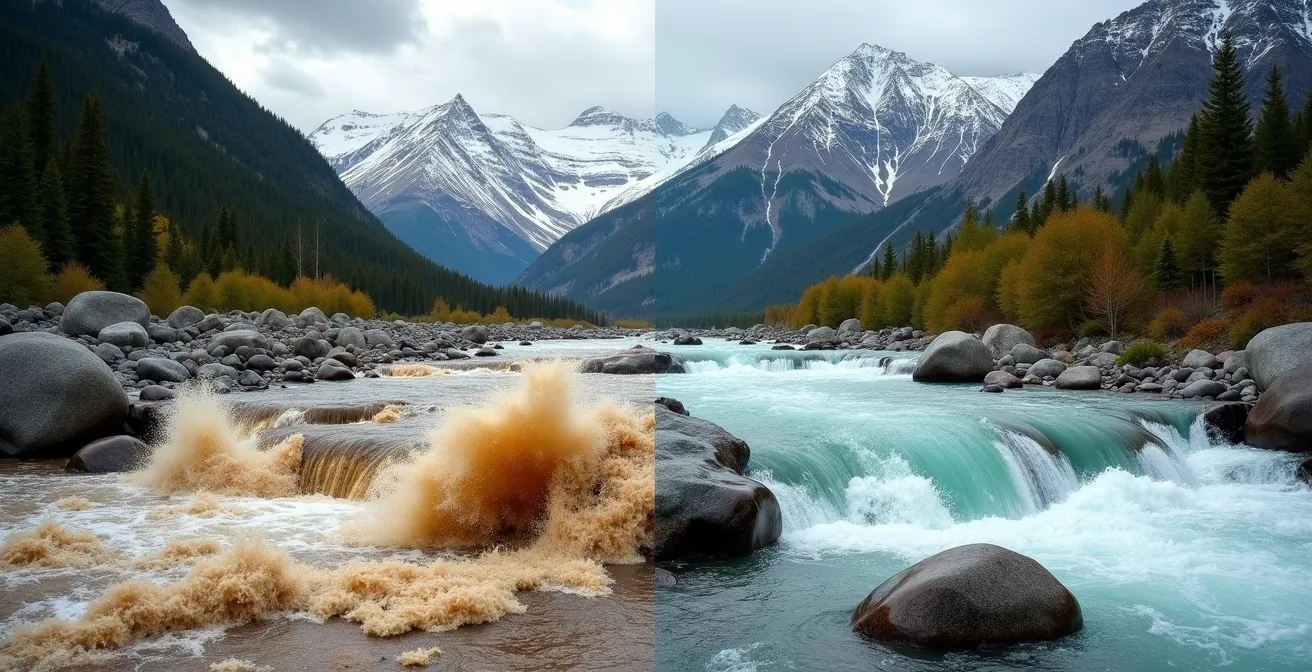
This table gives you a general idea of when to expect peak flows across Canada’s main rafting regions. These are the times when the rivers are at their most powerful and demanding. If you are a beginner or intermediate paddler, aiming for the period just after the peak runoff often provides the best combination of exciting water levels and warmer temperatures, especially on the Ottawa River.
| Region | Peak Runoff Period | Water Temperature | Optimal Visit Time |
|---|---|---|---|
| BC Coastal Ranges | May-June | 8-12°C | Early June |
| Canadian Rockies | June-July | 10-14°C | Late June |
| Quebec Rivers | May | 12-16°C | Late May |
| Ottawa River | May-June | 15-22°C | July-August |
Wetsuit essentials: why the glacial water requires neoprene even in August?
This is non-negotiable. In most of Canada, the water in our rivers comes from melting snow and glaciers. That means even on a hot 30°C day in August, the water temperature can be a shockingly cold 8-12°C. This isn’t just uncomfortable; it’s a major safety hazard. When you fall into water this cold, you experience cold water shock, an involuntary gasp reflex followed by hyperventilation. This is the body’s panicked reaction, and it’s when people are most at risk of drowning. This initial shock is followed by rapid loss of muscle control and then hypothermia.
Your guide will drill you on the critical survival timeline. In Canadian whitewater, cold water immersion follows the critical 1-10-1 rule: you have about 1 minute to get your breathing under control, about 10 minutes of meaningful movement and muscle function to help with your own rescue, and about 1 hour before you lose consciousness due to hypothermia. A proper wetsuit doesn’t make the water warm; it drastically extends that 10-minute window by trapping a thin layer of water against your skin, which your body heats up, creating an insulating barrier. It gives you the time you need to think, act, and survive.
Do not compromise on gear. A professional outfitter will provide a full, clean, and well-fitting wetsuit, a splash jacket, and neoprene booties. A “farmer-john” style wetsuit (sleeveless) is often not enough for the glacial rivers of the Rockies. A full 4/3mm wetsuit (4mm neoprene on the torso, 3mm on limbs) is the standard for spring and early summer trips. If an outfitter is casual about this or their gear looks old and compressed, it’s a major red flag. Your life literally depends on the quality of that neoprene.
The ” T-Grip” rule: how to not knock out your raft-mates teeth?
Once you’re in the raft, you are no longer a passenger; you are an active crew member. The guide is the captain, but you are the engine and the ballast. Your ability to respond instantly to paddle commands is what gets the raft through rapids safely. The most fundamental rule of paddle safety is holding the “T-Grip”—the plastic T-shaped handle at the top of the paddle shaft—at all times. One hand should be on the T-Grip, the other on the shaft. This prevents the paddle from becoming a loose projectile in a big wave. A flying paddle can easily knock out teeth or cause a serious head injury. Always maintain control.
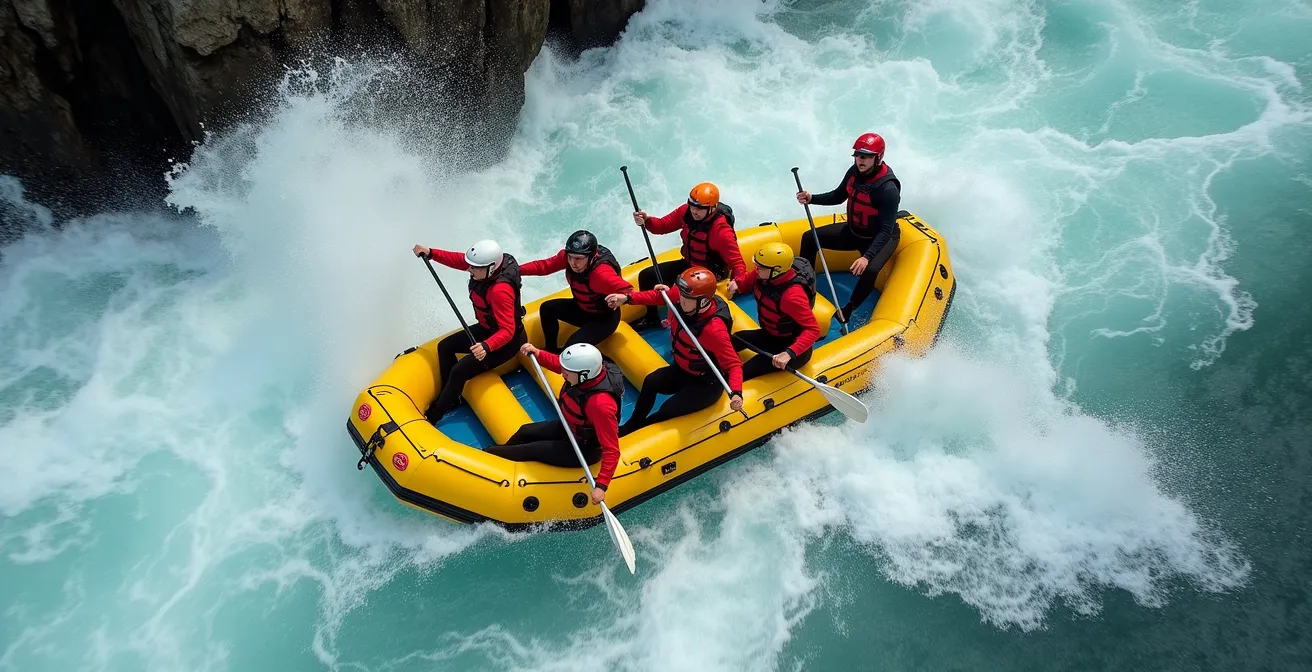
Beyond that, you must listen for and execute a few key commands without hesitation. “All Forward!” is your gas pedal. “Back Paddle!” is your brakes. But the most important safety command is “High-Side!” This is an emergency command shouted when the raft gets pushed sideways against a rock or a large wave (a “broach”) and is in imminent danger of flipping. When you hear “High-Side!”, you must immediately and aggressively throw your body and weight to the “high” side of the raft—the downstream side that is being lifted out of the water. This counter-balancing action is often the only thing that prevents a capsize.
Case Study: The High-Side Command at Kicking Horse River’s “Monster”
At the “Monster,” a notorious rapid on BC’s Kicking Horse River, the current relentlessly pushes rafts against a canyon wall. Professional guides from outfits like Wild Water Adventures emphasize that the “High-Side” command is critical here. They report that proper execution of this single maneuver prevented at least 12 rafts from capsizing at this spot in the 2023 season alone. This proves that the synchronized response of the crew is what determines the raft’s stability, transforming paddlers from passive tourists into a team responsible for their own safety through Class IV+ rapids.
Adventure waivers: understanding what rights you sign away before getting in the boat
Every outfitter will have you sign a liability waiver. It’s easy to treat this as just another piece of paperwork, but in Canada, it’s a powerful legal document. You are not just acknowledging that rafting has risks; you are often contractually agreeing to give up your right to sue the company, even if an accident is caused by their negligence. This is a crucial distinction. The concept of “inherent risk” refers to dangers that are an integral part of an activity and cannot be eliminated without changing the nature of the activity itself—like the risk of falling on a ski slope. However, waivers in Canada often go much further.
It’s vital to understand the gravity of what you are signing. A quality outfitter will present their waiver not as a formality, but as part of the safety briefing. They will give you time to read it and will have staff available to answer your questions. This process itself is a sign of professionalism. Be wary of any operation that rushes you through the signing process or dismisses its importance. Belonging to a provincial outfitters’ association is also a good sign, as it indicates adherence to a code of conduct and safety standards.
Following Supreme Court rulings like Loychuk v. Cougar Mountain Adventures, Canadian courts have upheld waivers that release companies from liability even for their own negligence, making the waiver more than just a formality.
– Canadian Tourism Commission Legal Guidelines, Adventure Tourism Safety Standards Report 2023
This legal precedent means your primary defense is choosing a reputable, professional company in the first place. Use the waiver process as a test: if they are serious about you understanding the risks you’re accepting, they are likely serious about all other aspects of their safety procedures.
Trim and balance: avoiding capsizing by packing your gear correctly
For day trips, your outfitter handles the gear. But on multi-day expeditions, packing the raft becomes a critical group task that directly impacts stability and safety. The principle is simple: keep the center of gravity as low and as centered as possible. A top-heavy, poorly balanced raft is far more likely to become unstable in waves or capsize. The “trim” of the raft—its balance from front-to-back and side-to-side—is essential for performance and safety.
Heavy items like food coolers, kitchen boxes, and heavy-duty dry bags should be strapped down low and in the center of the raft’s frame, often on the floor. Lighter, personal gear is then distributed along the sides and top. This ensures the raft remains stable and predictable in whitewater. An experienced guide will direct this process meticulously, as they know that a well-packed boat is a safe boat. This also becomes critical during a portage (carrying gear and rafts around an unrunnable rapid), where a well-organized system saves immense time and energy.
Case Study: 14-Day Nahanni River Expedition Packing Strategy
On the legendary 14-day Nahanni River expedition in the Northwest Territories, professional guides master the art of raft loading with hundreds of pounds of gear. As documented by Canadian adventure outfitters, the standard procedure is to secure heavy items like coolers and kitchen boxes low in the center of the raft frame. Personal dry bags are then strapped along the “chafe strip” on the outer tubes. On numerous expeditions, this configuration has been proven to maintain stability through Class IV rapids and made the mandatory portages around Virginia Falls manageable. This low center of gravity has been credited with preventing capsizes on rafts carrying over 800 pounds of essential expedition gear.
The amount and type of gear change drastically depending on your trip’s length. Understanding your role in managing that gear, even if it’s just your personal dry bag on a full-day trip, is part of being a responsible rafter.
| Trip Type | Gear Responsibility | Weight Load | Packing Priority |
|---|---|---|---|
| Half-Day Trip | Outfitter handles all | 50-75 lbs | Safety equipment only |
| Full-Day Trip | Personal items only | 100-150 lbs | Lunch & emergency gear |
| Multi-Day Expedition | Shared group gear | 600-1000 lbs | Kitchen, camping, personal |
| Remote Fly-In | Weight-restricted | Per plane limits | Essential gear prioritized |
Hypothermia signs that set in within 15 minutes of exposure during accidents
We’ve talked about the importance of a wetsuit, but it’s equally important for every person on the river to be able to recognize the signs of hypothermia in their raft-mates. It can set in deceptively fast, especially after an unexpected swim in frigid water. The initial adrenaline rush of getting back in the boat can mask the early symptoms. The key is to watch for subtle changes in behavior and coordination. The early warning signs are often called the “umbles” – because people start to stumble, mumble, fumble, and grumble.
The risk varies dramatically depending on where and when you are rafting. According to data comparing Canadian rivers, hypothermia risk varies dramatically with 4°C water in BC rivers in May vs 20°C in the Ottawa River in August. In the colder western rivers, symptoms can appear within 15 minutes of exposure. If you see someone exhibiting these signs, you must act immediately. Don’t ask them if they’re cold; they may be too confused to answer accurately. Tell the guide right away. The solution is to get them warm and dry as quickly as possible, which may involve hot drinks, extra layers, or stopping the trip.
Here are the “umbles” you need to watch for in yourself and your fellow paddlers. Recognizing these is not a medical diagnosis, but a critical first-responder skill on the river.
Action Plan: Spotting the ‘Umbles’ – Early Hypothermia Warning Signs
- Stumbles: Watch for a loss of coordination. Is someone tripping while moving around in the raft or struggling with their footing on shore?
- Mumbles: Listen for slurred, slow, or incoherent speech. Are their answers to questions delayed or confused?
- Fumbles: Notice if someone is repeatedly dropping their paddle or struggling with simple tasks like zipping a jacket.
- Grumbles: A sudden change in personality, like uncharacteristic irritability, apathy, or confusion, is a major red flag.
- Act Immediately: These are not signs of weakness; they are medical symptoms. Alert your guide instantly. The person needs to be warmed up within minutes.
Key Takeaways
- Water conditions are paramount: The river’s power (flow rate) and temperature are more critical risk factors than its class number.
- You are active crew, not a passive passenger: Your ability to follow paddle commands and perform self-rescue is fundamental to the raft’s safety.
- The waiver is a serious legal document: In Canada, it signifies your acceptance of inherent risks and often releases the outfitter from liability.
Planning a Fly-In Expedition: Logistics for Remote Canadian Rivers
For the ultimate Canadian adventure, nothing beats a fly-in rafting expedition. Rivers like the Nahanni in the Northwest Territories or the Tatshenshini in the Yukon are inaccessible by road, requiring access via float plane. This adds an incredible layer of wilderness and isolation, but also a significant layer of logistical complexity. This is the pinnacle of rafting, where all the skills we’ve discussed become absolutely essential, as you are completely self-sufficient for days or weeks at a time.
Planning for these trips begins months, sometimes years, in advance. It involves coordinating charter flights, which have strict weight and space limitations. All gear—rafts, food, camping equipment, communication devices—must be meticulously planned and weighed. There are no corner stores, so every meal and every piece of safety equipment, including comprehensive medical kits and satellite phones, must be packed in. Many of these rivers, such as the famous Moisie in Quebec, also offer world-class fishing for species like Atlantic Salmon, requiring participants to manage both rafting and fishing gear logistics, as well as the correct provincial licenses.
The remote nature of these trips means there is zero margin for error. The self-assessment of skills is no longer a suggestion; it is an absolute requirement. Outfitters for these expeditions will rigorously vet participants on their experience, fitness, and swimming ability. This is where your honest self-assessment pays off, ensuring you are prepared for a true, world-class wilderness experience.
| River | Location | Access Point | Class Rating | Fishing Species |
|---|---|---|---|---|
| Nahanni | NWT | Norman Wells | III-IV | Arctic Grayling |
| Tatshenshini | Yukon/BC | Haines Junction | III-IV | Salmon, Trout |
| Moisie | Quebec | Sept-Îles | III-V | Atlantic Salmon |
| Firth | Yukon | Inuvik | II-IV | Arctic Char |
Now that you’re armed with a guide’s perspective on risk, your next step is to use this knowledge. Talk to outfitters, ask them pointed questions about their safety procedures, water levels, and guide qualifications. A great company will welcome your informed questions. Choose your adventure wisely, and I’ll see you on the river.