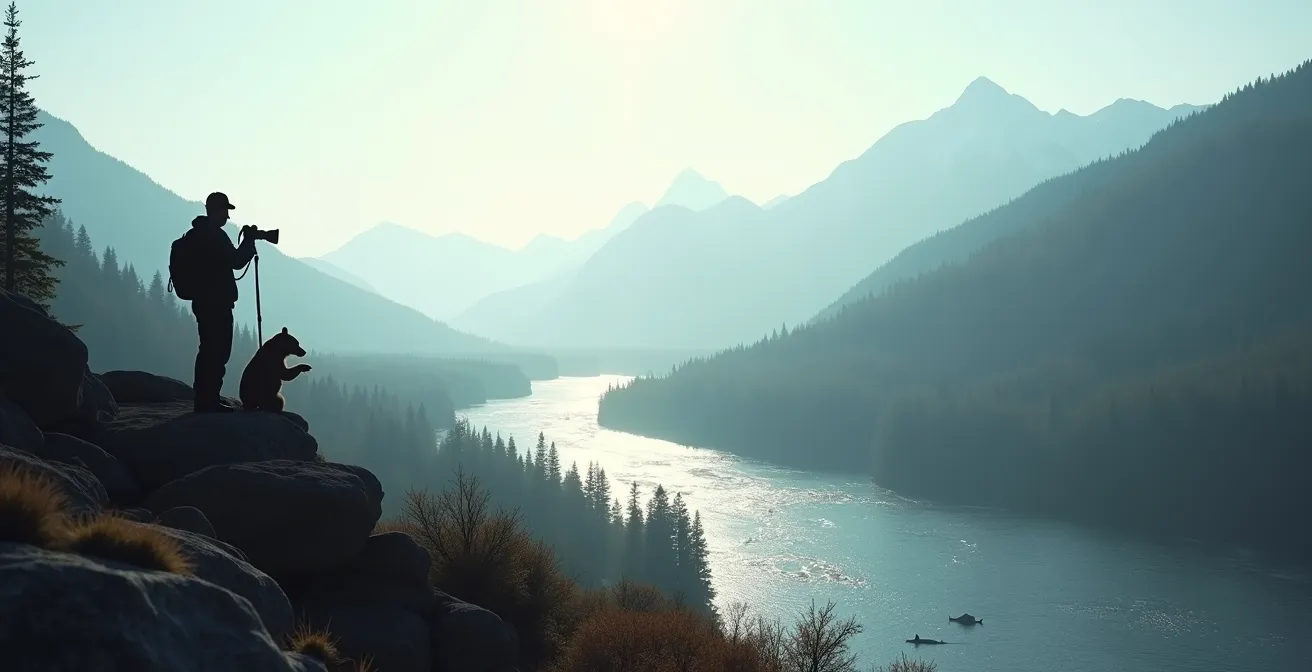
The thrill of seeing a bear or moose in the wild must be balanced with a strict, non-negotiable ethical code that prioritizes animal welfare above all else.
- Feeding wildlife is not a kind act; it’s a dangerous behaviour that leads to animal habituation, aggression, and potential fines up to $25,000 CAD.
- Maintaining a mandatory minimum distance (100 metres for bears) is the cornerstone of ethical viewing, protecting both you and the animal from stress and conflict.
Recommendation: Adopt a biologist’s mindset. Your goal is not to interact, but to observe without impact. This means using the right tools (telephoto lenses), choosing ethical operators, and understanding the severe consequences of breaking the rules.
The sight of a grizzly bear foraging in a meadow or a bull moose emerging from a misty lake is a quintessential Canadian experience. It’s a powerful reminder of the wildness that still defines vast parts of this country. For many nature lovers, this is the ultimate goal: a close, memorable encounter. However, this desire, if not guided by a deep understanding of wildlife biology and ethics, can lead to disastrous outcomes for the very animals we admire. The common advice—”keep your distance,” “don’t feed the animals”—is often treated as a gentle suggestion rather than the strict, life-or-death protocol it truly is.
This guide moves beyond those platitudes. As a wildlife biologist, my perspective is uncompromising: the well-being of the animal is paramount. An ethical encounter is not defined by the quality of your photograph, but by the complete absence of your impact on the animal’s behaviour. We will explore the ecological principles and Canadian laws that govern these interactions. This is not a list of tips; it is a framework for adopting a professional code of conduct. The core principle is one of non-interference. We will examine why feeding wildlife is a criminal act, how to handle a defensive encounter, and why the best wildlife photographers are masters of remaining invisible.
By understanding the ‘why’ behind the rules, you transition from being a simple tourist to an informed custodian of the wild. This article breaks down the essential components of that responsibility, from legal obligations to the practical choices you make in the field. Let’s explore the framework that ensures Canada’s iconic species continue to thrive, undisturbed.
Summary: A Guide to Ethical Wildlife Observation in Canada
- Why feeding wildlife results in fines up to $25,000 CAD?
- How to use bear spray correctly in a defensive situation?
- The “Jam” danger: stopping on highways to photograph bears causes accidents
- Guided tours vs. self-drive viewing: success rates compared for spotting wolves?
- Using telephoto lenses to maintain the mandatory 100m distance
- How to spot a Spirit Bear without disturbing its habitat?
- Why ethical operators turn off engines and keep distance?
- Photography in the Tundra: Capturing Barren Landscapes Without Damaging Ecosystems
Why feeding wildlife results in fines up to $25,000 CAD?
The act of feeding a wild animal, whether it’s a squirrel, a fox, or a bear, is fundamentally misunderstood. It is not an act of kindness; it is an act of conditioning that can sign the animal’s death warrant. This is why the Canada National Parks Act is so severe. In Canada, Parks Canada can impose fines up to $25,000 for this offense. This figure is not arbitrary; it reflects the profound ecological damage and public safety risks that stem from a single, seemingly innocent gesture. The legal framework allows courts to impose even higher penalties based on aggravating factors, such as repeat offenses or if the act resulted in significant environmental harm.
The core biological problem is habituation. When an animal learns to associate humans with food, it loses its natural fear. This creates a dangerous cycle with predictable and tragic consequences:
- Creation of “Problem Animals”: A bear that seeks food from humans is deemed a “problem bear.” It may become aggressive in its search for an easy meal, leading to property damage or human injury. In almost all cases, these animals must be located and destroyed by park staff to ensure public safety.
- Generational Corruption: An adult female who learns these behaviours will teach them to her offspring. A single person feeding a bear can corrupt an entire lineage, creating generations of habituated animals.
- Ecosystem Disruption: Animals congregating near roadsides and campgrounds waiting for handouts are no longer fulfilling their natural roles in the ecosystem, such as seed dispersal or predation. This also dramatically increases their risk of being struck by vehicles.
Ultimately, the heavy fine is a deterrent designed to protect wildlife from misguided human compassion. The strictest, most ethical rule is absolute: never feed a wild animal. Your food can become their poison, and your “kindness” can lead directly to their destruction.
How to use bear spray correctly in a defensive situation?
While prevention is the cornerstone of wildlife safety, you must be prepared for a defensive encounter. Bear spray is a non-lethal deterrent, an essential tool for anyone venturing into bear country in Canada. It is not a repellent to be sprayed on tents or clothing; it is a last-resort weapon for stopping a charging or aggressive bear. It’s important to note that for travelers, strict regulations apply; for instance, CATSA regulations completely ban bear spray on flights, even in checked baggage. You must purchase or rent it at your destination.
Proper use is critical, and panic can make deployment difficult. Practice with an inert training canister before your trip. The goal is to create a cloud of capsaicinoids (pepper-based irritant) that the bear will run into. This cloud inflames the bear’s eyes and respiratory system, causing temporary distress and disrupting its charge without permanent injury. Always carry it in a quickly accessible holster, not inside your backpack.

The decision of when to deploy the spray depends on the species and its behaviour. Bears exhibit different types of aggression, and understanding the context is key to a safe outcome. A defensive charge from a mother protecting her cubs is very different from a predatory approach by a curious or habituated black bear.
| Bear Type | When to Deploy | Distance | Behavior Signs |
|---|---|---|---|
| Grizzly Bear | Defensive charge with contact imminent | Less than 10m (bus length) | Ears back, huffing, jaw popping |
| Black Bear | Predatory approach not deterred by noise | 7-10m effective range | Silent stalking, direct stare |
| Both Species | Mother with cubs charging | Wait until 7m or less | Aggressive vocalizations |
The “Jam” danger: stopping on highways to photograph bears causes accidents
One of the most common and dangerous scenarios in Canada’s national parks is the “wildlife jam.” A single vehicle stops on the shoulder of a highway to photograph a bear, and within minutes, a dozen more have joined, creating a chaotic and perilous situation for both humans and wildlife. This behaviour, born from excitement, directly contradicts ethical viewing principles and creates multiple hazards. The line of stopped cars can block an animal’s escape route, trap it between lanes of traffic, or separate a mother from her cubs, causing immense stress that can trigger aggressive, defensive behaviour.
Parks Canada has a clear protocol for roadside encounters designed to mitigate these risks. The priority is to give the animal space and ensure traffic can flow safely. Your desire for a photograph is secondary to the animal’s right to move freely and the safety of other drivers. If you are driving through a national park like Banff or Jasper, you are a guest in the animal’s home, and you must act accordingly. This means being prepared to move on without getting the shot.
If you encounter wildlife on the road, follow these non-negotiable rules:
- Consider Not Stopping: The best action is often to slow down and continue driving, giving the animal the space it needs to forage or cross.
- Use Designated Pull-outs: If you must stop, only do so in a designated pull-out area with adequate shoulder space. Never stop in a live traffic lane.
- Stay in Your Vehicle: Your car acts as a “hide” or blind. Exiting your vehicle habituates the animal to human presence and puts you at extreme risk.
- Maintain Distance: The mandatory minimum distance is 100 metres from any bear, wolf, or cougar, and 30 metres from animals like moose, elk, and bighorn sheep.
- Keep it Brief: Observe for a minute, take your photo from inside the car, and move on, especially if you see other vehicles starting to accumulate behind you. Be the one to break up the jam, not contribute to it.
These traffic jams have led to countless vehicle accidents and wildlife fatalities. By refusing to participate, you are actively practicing conservation and ensuring the safety of everyone on the road.
Guided tours vs. self-drive viewing: success rates compared for spotting wolves?
For many, spotting an elusive animal like a wolf is a lifetime goal. The question then becomes: what is the best strategy to achieve this ethically? The choice between a guided tour and a self-drive expedition involves a trade-off between flexibility and probability of success. While driving yourself offers freedom, guided tours provide a significant advantage in locating rare or wide-ranging species, particularly predators like wolves. This is due to a combination of deep local knowledge and active communication networks.
Professional guides spend thousands of hours in the field. They understand seasonal animal movements, preferred habitats, and denning site locations. Crucially, they are often part of a radio network where guides share real-time sightings. If one guide spots a wolf pack in a particular valley, that information is relayed, dramatically increasing the chances for other groups. A self-drive visitor, in contrast, relies on luck, static information from park notice boards, and their own limited knowledge. For an animal as elusive as a wolf, this puts them at a significant disadvantage.

Beyond success rates, guided tours offer an inherent layer of safety and ethics. A professional guide will ensure all protocols are followed, manage guest behaviour, and interpret animal actions to prevent disturbance. They are trained to recognize signs of stress in wildlife and will pull back or leave an area if they sense the group’s presence is having a negative impact. This professional oversight is a key component of responsible tourism.
| Factor | Guided Tours | Self-Drive |
|---|---|---|
| Success Rate | 75-90% sighting probability | 10-20% sighting probability |
| Key Advantage | Radio network between guides sharing real-time sightings | Complete flexibility of schedule and route |
| Local Knowledge | Seasonal movement patterns, denning sites known | Must rely on park boards and apps |
| Cost | $200-500 per person | Park pass only ($10-20) |
| Safety | Professional supervision and protocols | Self-responsibility for safety measures |
Using telephoto lenses to maintain the mandatory 100m distance
The single most important tool for an ethical wildlife photographer is not their camera, but their telephoto lens. It is the technology that enables adherence to the cornerstone of responsible viewing: distance. The mandatory 100-metre (330 feet) minimum distance from bears, wolves, and cougars in Canada’s National Parks is a legal requirement, not a suggestion. A long lens allows you to capture frame-filling, intimate-feeling portraits while physically remaining far enough away to ensure the animal is not disturbed, stressed, or even aware of your presence. Trying to get the same shot with a smartphone or standard lens requires violating this critical buffer zone, which constitutes wildlife harassment.
A telephoto lens bridges the gap between your desire for a powerful image and your ethical duty of non-interference. For serious amateurs and professionals, this means investing in or renting appropriate gear. A lens in the 400mm to 600mm range is standard for capturing detailed shots of large mammals from a safe and respectful distance. Furthermore, using a tripod or a monopod is essential to stabilize these heavy lenses and produce sharp images, preventing the frustration that might tempt a photographer to creep closer.
Before you even raise your camera, your first tool should be a pair of binoculars. Use them to observe the animal from a distance. Assess its behaviour. Is it relaxed and foraging? Or is it watchful, with its head up and ears pointed in your direction? If you are affecting its behaviour in any way, you are too close, regardless of the distance. The photograph is a byproduct of a successful, non-intrusive observation, not the goal itself.
Action Plan: Your Ethical Wildlife Photography Kit
- Lens selection: Secure a 400-600mm telephoto lens as a minimum for capturing frame-filling shots from the mandatory 100m distance.
- Stabilization: Pack a sturdy tripod or monopod to ensure your long-lens shots are sharp and to avoid the temptation to move closer.
- Observation first: Always carry and use binoculars (e.g., 8×42 or 10×50) to assess animal behaviour before you even think about photographing.
- Location privacy: Commit to never geotagging your wildlife photos on social media to prevent overcrowding and habituation at sensitive locations.
- Equipment practice: Familiarize yourself with your gear at home, not in the field, so you can operate it quickly and quietly when an opportunity arises.
How to spot a Spirit Bear without disturbing its habitat?
The Kermode bear, or Spirit Bear (Moksgm’ol in the Tsimshian language), is not an albino, but a subspecies of black bear with a recessive gene that gives it a white or creamy coat. Found almost exclusively within the 6.4 million hectares of British Columbia’s Great Bear Rainforest, this elusive animal is a powerful symbol of Canada’s pristine wilderness. Viewing a Spirit Bear is a profound privilege, and doing so ethically requires an approach rooted in deep respect for its incredibly sensitive temperate rainforest habitat and the Indigenous cultures that have coexisted with it for millennia.
The answer to spotting one without disturbance is unequivocal: you must go with local First Nations guides. As the operators of Spirit Bear Lodge, a Kitasoo/Xai’xais Nation-owned ecotourism venture, state clearly, this is the only truly ethical path. In the words of an expert from Canadian Affair discussing Indigenous tourism, the most ethical way to see the Spirit Bear is with guides from the local Kitasoo/Xai’xais or Gitga’at First Nations who have multi-generational knowledge of the Moksgm’ol. These guides possess knowledge passed down through generations about the bears’ movements, their reliance on salmon streams, and how to observe them with minimal impact.
The most ethical way to see the Spirit Bear is with guides from the local Kitasoo/Xai’xais or Gitga’at First Nations who have multi-generational knowledge of the Moksgm’ol
– Spirit Bear Lodge, Canadian Affair – Indigenous Tourism
Case Study: The Conservation Tourism Model of the Great Bear Rainforest
The protection of the Great Bear Rainforest is a world-renowned success story in Indigenous-led conservation. Ecotourism operations, such as those run by the Gitga’at and Kitasoo/Xai’xais First Nations, are not just businesses; they are integral components of a conservation economy. The revenue generated by visitors who come to see Spirit Bears and grizzlies directly funds habitat preservation initiatives, scientific research, and Guardian Watchmen programs that monitor and protect the territory. By choosing an accredited, Indigenous-owned operator, a tourist is not a passive consumer but an active participant in a sustainable model that ensures the long-term survival of the temperate rainforest and its delicate salmon streams, which are the lifeblood of the entire ecosystem.
Why ethical operators turn off engines and keep distance?
Choosing a guided tour is often the most ethical way to view wildlife, but not all operators are created equal. A key differentiator of a truly responsible guide is their commitment to minimizing sensory pollution. This means more than just keeping quiet; it involves a conscious effort to reduce the noise and chemical signature of their presence, primarily by cutting boat or vehicle engines once an animal is sighted. The constant hum of an engine, while seemingly minor to us, can mask the subtle sounds a bear or moose relies on to detect predators, find mates, or locate their young. This forces the animal to be more vigilant, expending precious energy and increasing its stress levels. Ethical operators understand this and will drift silently in a boat or sit quietly in a vehicle with the engine off.
Distance is the other non-negotiable pillar. Reputable operators adhere strictly to, and often exceed, the official guidelines set by authorities like Parks Canada or the Commercial Bear Viewing Association of BC. They maintain a respectful distance that allows the animal to continue its natural behaviours—foraging, resting, or playing—undisturbed. They will never “bait” an animal with food or position their vessel to block its path. If they see signs of stress, such as a bear stopping its feeding to watch them, they know they are too close and will retreat. This disciplined approach requires prioritizing the animal’s comfort over the clients’ desire for a closer look.
As a prospective client, you have the power and the responsibility to vet your tour operator. Your choice sends a market signal, either rewarding ethical practices or encouraging reckless ones. Before booking, ask direct questions and look for clear evidence of a commitment to conservation.
- Does the operator have explicit, written policies on viewing distances?
- Are they certified by a recognized body like the Commercial Bear Viewing Association of BC?
- Do their online reviews specifically mention respectful practices and engine shutdown protocols?
- Do they contribute to local conservation efforts?
Choosing an operator who is transparent about these practices, as highlighted by resources like BC Parks’ guidelines on responsible visitation, is the best way to ensure your investment supports true conservation.
Key takeaways
- The ‘Don’t Feed Wildlife’ rule is absolute, backed by Canadian law with fines up to $25,000 to prevent animal habituation and destruction.
- Maintaining mandatory minimum distances (100m for predators) is the most critical component of ethical viewing, and a telephoto lens is the essential tool to achieve this.
- Your choices matter: opting for certified, ethical guides—especially Indigenous-led tours in sensitive areas—actively contributes to conservation and ensures a respectful experience.
Photography in the Tundra: Capturing Barren Landscapes Without Damaging Ecosystems
The ethics of non-interference extend beyond the animals themselves to the very ground beneath your feet. This is nowhere more true than in Canada’s fragile Arctic and sub-Arctic tundra environments. Landscapes that appear barren and resilient are often incredibly delicate, composed of slow-growing lichens, mosses, and biological soil crusts that are the foundation of the ecosystem. A single footstep can destroy what took centuries to grow. For the photographer seeking to capture the stark beauty of these landscapes, the “leave no trace” principle becomes a microscopic imperative.
Case Study: The Invisible Life of Cryptobiotic Soil
In Canadian National Parks like Wapusk (Manitoba) and Auyuittuq (Nunavut), much of the ground is covered by cryptobiotic soil crusts. These dark, bumpy crusts are living communities of cyanobacteria, lichens, and mosses. They play a vital role in preventing wind erosion, absorbing moisture, and fixing nitrogen in a nutrient-poor environment. As Parks Canada documents, these crusts are extremely vulnerable. A single misplaced step can break the crust, and recovery can take decades or even centuries. Ethical tundra photographers must stay on designated trails or durable surfaces like rock and gravel, treating the entire landscape as a living organism.
The principle of minimizing sensory pollution also takes on a new dimension in the vast, quiet tundra. The use of drones, for example, is strictly prohibited in all of Canada’s National Parks. The high-pitched whine can cause extreme stress to wildlife, disrupting nesting birds, causing stampedes in caribou herds, or disturbing denning predators like polar bears. The consequences are severe, as using drones in any Canadian National Park can result in a $25,000 fine. The silence of the tundra is not empty; it is a critical part of the habitat, and preserving it is a primary ethical duty.
The ultimate test of an ethical photographer is the willingness to forgo a shot to protect the environment. It requires a profound shift in mindset: the image is secondary to the integrity of the ecosystem. Your legacy as a visitor should be nothing more than your footprints on a designated path.
Your next step is to integrate this ethical framework into your travel planning, ensuring every wildlife encounter you have is one of true respect for Canada’s magnificent wild spaces. Plan your trip not around what you can get from the wild, but what you can give back through responsible, informed, and respectful observation.