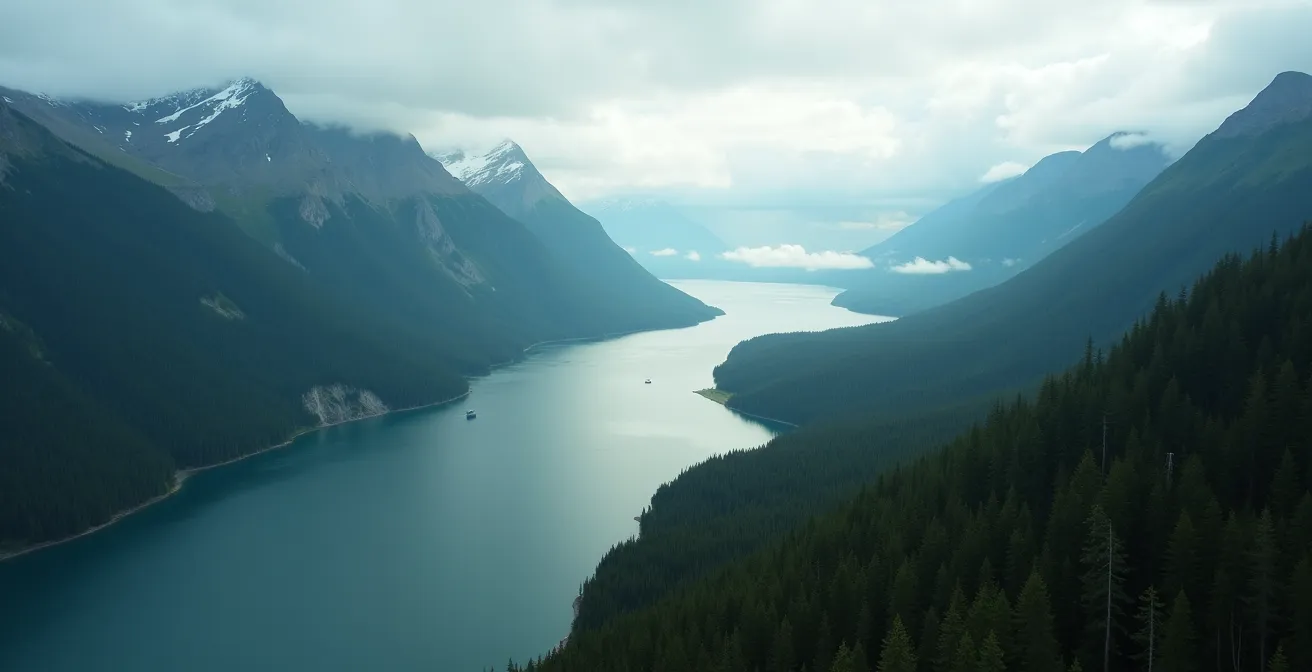
A truly meaningful trip to the Great Bear Rainforest isn’t just about what you see, but how your visit contributes to its protection.
- Prioritize Indigenous-led tours and understand the protocols for ethical wildlife viewing.
- Invest in a complete rain system, not just a jacket, to stay safe and comfortable in extreme humidity.
- Your choice of destination (e.g., a remote lodge vs. Tofino) has a direct and measurable conservation impact.
Recommendation: Book remote lodges at least 12 months in advance and choose operators who demonstrate a clear commitment to ecosystem-based management and First Nations partnerships.
The dream of visiting the Great Bear Rainforest often starts with a single image: a white Spirit Bear fishing for salmon against a backdrop of emerald green, or a cathedral-like grove of thousand-year-old cedars. This vast expanse of coastal temperate rainforest in British Columbia is one of the last truly wild places on Earth. Many guides will tell you to pack rain gear, book a tour, and hope for the best. This advice is not wrong, but it is incomplete. It treats the rainforest as a spectacle to be consumed, a backdrop for a selfie.
But what if the true essence of a visit here wasn’t about extraction—taking photos, ticking off a bucket list—but about reciprocity? What if the most profound experience came from understanding that your presence, your choices, and your tourist dollars could be a powerful force for conservation and cultural revitalization? This is the perspective of those who call this coast home. It’s an understanding that a journey here is a partnership with the land and its ancestral guardians.
This guide is built on that principle. It moves beyond the surface-level tips to explore the deeper context of visiting this sacred landscape. We will delve into the practicalities of respectful wildlife encounters, the critical gear choices that make or break a trip, the economic realities of conservation tourism, and the vital role of First Nations stewardship. This is your manual for becoming a thoughtful guest, not just a tourist, in the Great Bear Rainforest.
text
This article provides a comprehensive framework for planning a responsible and unforgettable journey. Below, the table of contents outlines the key pillars of a successful trip, from the ethics of wildlife viewing to the logistics of accessing this remote wilderness.
Table of Contents: A Guide to the Great Bear Rainforest Experience
- How to spot a Spirit Bear without disturbing its habitat?
- Rain gear failures that ruin 50% of hiking trips in the temperate rainforest
- Tofino vs. Bella Coola: accessing the rainforest for different budgets?
- Why logging protests shape the tourism experience in certain ancient groves?
- Booking eco-lodges 12 months in advance for prime season access
- Why feeding wildlife results in fines up to $25,000 CAD?
- Why ethical operators turn off engines and keep distance?
- Indigenous Tourism Experiences: Moving Beyond the Museum Display
How to spot a Spirit Bear without disturbing its habitat?
Seeing a Spirit Bear (Kermode bear), a rare white-coated subspecies of the black bear, is a profound, once-in-a-lifetime privilege. But the desire for that perfect photo can lead to harmful pressure on these vulnerable animals. The most ethical approach is rooted in a simple principle: you are a guest in their home. This means shifting your mindset from pursuit to patience. The Kitasoo/Xai’xais First Nation, whose traditional territory is the heart of Spirit Bear country, has perfected a model of low-impact, Indigenous-led tourism that prioritizes the bears’ well-being above all else.
Their approach, developed over millennia of co-existence, involves using small groups, visiting specific viewing areas that minimize disturbance, and sharing traditional ecological knowledge. The goal is to observe the bears’ natural behaviours without altering them. This often means learning to read the forest’s subtle cues—the alarm call of a Steller’s jay, the splash of a distant salmon—rather than crashing through the undergrowth. True ethical viewing is about letting the encounter happen on the bear’s terms, not yours.
Case Study: The Kitasoo/Xai’xais First Nation’s Conservation Model
Operating out of Klemtu, the Kitasoo/Xai’xais have created a world-leading conservation model through their Spirit Bear Lodge. They lead small groups of 4-6 people to carefully selected viewing areas, guided by strict protocols on noise, approach angles, and time limits, especially during critical feeding periods. This approach, blending traditional knowledge with modern science, has not only ensured stable Spirit Bear populations but has also created a sustainable economy built on reciprocity with the land rather than resource extraction. Choosing an operator like this directly supports this successful conservation-in-action.
- Maintain a minimum 100 yards distance from bears at all times. This is both a legal requirement in many BC parks and critical for reducing bear stress.
- Use telephoto lenses of at least 400mm to capture intimate photos without encroaching. The guiding principle is “zoom with your lens, not your feet.”
- Book tours exclusively with Indigenous-led operators like the Kitasoo/Xai’xais Guardian Watchmen who follow traditional protocols.
- Practice ‘sensory tracking’ by listening for the forest’s sounds rather than actively pursuing visual sightings.
- Never use flash photography or make sudden movements that could disrupt critical feeding patterns.
Rain gear failures that ruin 50% of hiking trips in the temperate rainforest
As a guide, I can tell you that the number one element that ends trips prematurely isn’t bears or difficult terrain; it’s failed rain gear. In the Great Bear Rainforest, you don’t just get rain; you get persistent, high-humidity saturation. Your enemy isn’t a single downpour, but the constant dampness that finds its way through every weakness in your gear. Many travellers buy an expensive jacket and think they’re prepared, only to find themselves cold, wet, and miserable after two days.
The key is to think in terms of a complete rain *system*, not just a single piece of clothing. A “breathable” waterproof membrane that works in a city will quickly become overwhelmed here, wetting out from the inside with condensation and the outside with rain. Success depends on layers and features designed for this specific environment. This includes a reliable hard shell with mechanical venting (like pit zips), quick-drying base layers (merino wool is king), and fully waterproof pants and gaiters to stop water from seeping up from the ground.
Before you even leave home, you must test your gear. The Durable Water Repellency (DWR) coating on your jacket’s exterior is your first line of defense. It’s what makes water bead up and roll off. If this coating has worn out, the fabric will “wet out,” feeling heavy and cold, and its breathability will plummet to zero.

As you can see in the image, a properly functioning DWR coating causes water to form distinct droplets on the fabric’s surface. A simple pre-trip spray test with a water bottle will tell you if your gear is ready. If the water soaks in instead of beading, it’s time to re-treat it with a product like Nikwax. This small step can be the difference between a trip of a lifetime and a cold, damp retreat.
- Test your jacket’s DWR coating before departure by spraying water—if it doesn’t bead, re-treat it with Nikwax TX.Direct.
- Create a complete system: merino wool base layers, waterproof pants with full-length zippers, waterproof gaiters, and a pack rain cover.
- For local expertise, visit Vancouver’s MEC or Valhalla Pure Outfitters in Smithers for advice on BC-specific rain gear.
- Choose jackets with mechanical venting (pit zips) rather than relying solely on ‘breathable’ membranes which fail in constant humidity.
- Pack a backup lightweight rain shell. When your primary jacket inevitably wets out after days of constant rain, you’ll have a dry alternative.
Tofino vs. Bella Coola: accessing the rainforest for different budgets?
The term “Great Bear Rainforest” covers a massive area, and accessing it can mean very different experiences and costs. The two main gateways, Tofino (Clayoquot Sound) and the Bella Coola Valley, represent two distinct models of tourism. Your choice between them is one of the most significant decisions you’ll make, impacting your budget, experience, and conservation footprint.
Tofino, on Vancouver Island’s west coast, is a well-developed tourism hub. It’s famous for its surf culture, vibrant foodie scene, and accessibility. You can drive from Vancouver or take a short flight. This infrastructure provides a wide range of options, from budget-friendly hostels to luxury resorts, making it a more accessible entry point for many. However, its high visitor volume means the wilderness experience is often found in day trips rather than deep immersion.
The Bella Coola region and other remote access points like Klemtu are the heart of the expedition-style experience. Access is a journey in itself, often requiring a long ferry ride, a multi-day drive, or a charter flight. Accommodation is almost exclusively in high-end, all-inclusive eco-lodges or on live-aboard vessels. While the upfront cost is significantly higher, this model is built on the principle of low-volume, high-value tourism that directly funds conservation.
This comparative table breaks down the fundamental differences between these two access points.
| Aspect | Tofino/Clayoquot Sound | Bella Coola/Bella Access |
|---|---|---|
| Tourism Model | Developed hub with high visitor volume | Remote, expedition-style with limited access |
| Accommodation Range | $80-500/night (hostels to luxury resorts) | $250-1200/night (eco-lodges, vessel-based) |
| Access Method | 4-hour drive from Vancouver or 45-min flight | Ferry + drive (20hrs) or charter flight |
| Conservation History | ‘War in the Woods’ 1990s protests | 2016 Great Bear Rainforest Agreement |
| Primary Experience | Surf culture, foodie scene, day trips | Wildlife immersion, Indigenous culture |
| Visitor Infrastructure | Extensive – restaurants, shops, tours | Minimal – focus on wilderness preservation |
It’s tempting to see the high cost of remote lodges as a barrier. However, an analysis of their economic impact reveals a powerful story about “Conservation ROI.” A study by The Nature Conservancy highlights that each visitor dollar spent at these remote locations has approximately 3x the conservation impact compared to high-volume areas. This revenue directly funds Indigenous Guardian programs, habitat monitoring, and sustainable community employment, making your trip a direct investment in the protection of the ecosystem.
Why logging protests shape the tourism experience in certain ancient groves?
To truly understand the Great Bear Rainforest today, you must understand its recent history of conflict. The serene old-growth forests you can now visit were, just a few decades ago, the front lines of the “War in the Woods.” These intense logging protests, particularly in areas like Clayoquot Sound, pitted environmental groups, First Nations, and the forestry industry against one another in a battle for the future of these ancient ecosystems.
This history is not just a footnote; it directly shapes the modern visitor experience. The conflict culminated in the landmark 2016 Great Bear Rainforest Agreement, a collaborative accord between 26 First Nations, the B.C. government, and forestry companies. This agreement is a masterclass in conflict resolution, and its legacy is the very framework that governs tourism today. It permanently protected 85% of the 6.4 million hectare forest from logging and established a system of Ecosystem-Based Management (EBM).
EBM zones dictate where and how tourism can operate, ensuring that all activities are designed for long-term ecological and cultural integrity. Many guides working in the rainforest today are former loggers, protesters, or Indigenous negotiators who share powerful, firsthand accounts of this transformation. A walk through a protected grove is not just a nature tour; it’s a living history lesson in how conflict can lead to collaboration and conservation.
The Great Bear Rainforest Agreement entrenched First Nations’ rights to share in decision-making processes concerning their traditional territories, and these Nations now play central roles in the conservation, stewardship, and restoration of natural resources throughout their ancestral lands.
– Dr. Russell Markel, Outer Shores Expeditions
This shift in power, as Dr. Markel points out, is central. Tourism is no longer an industry imposed upon the land, but one that operates within a First-Nations-co-managed framework, where forest carbon projects and responsible travel contribute directly to community well-being and stewardship programs.
Booking eco-lodges 12 months in advance for prime season access
The most renowned eco-lodges in the Great Bear Rainforest—places like Spirit Bear Lodge, Nimmo Bay, or King Pacific Lodge—are not typical hotels. They are small, remote, and offer unparalleled access to wildlife and wilderness. This exclusivity, combined with a short operating season and a global reputation, means that securing a spot requires strategic, long-term planning. For prime season, particularly the September salmon run when bear viewing is at its peak, you often need to book 12 to 18 months in advance.
This isn’t an exaggeration. Spots are extremely limited to maintain a low environmental impact and a high-quality guest experience. Waiting until the spring to book a fall trip will almost certainly result in disappointment. The booking process is a competitive event in itself. The key is to get on waitlists, be ready the moment new dates are released, and have flexibility in your travel window.
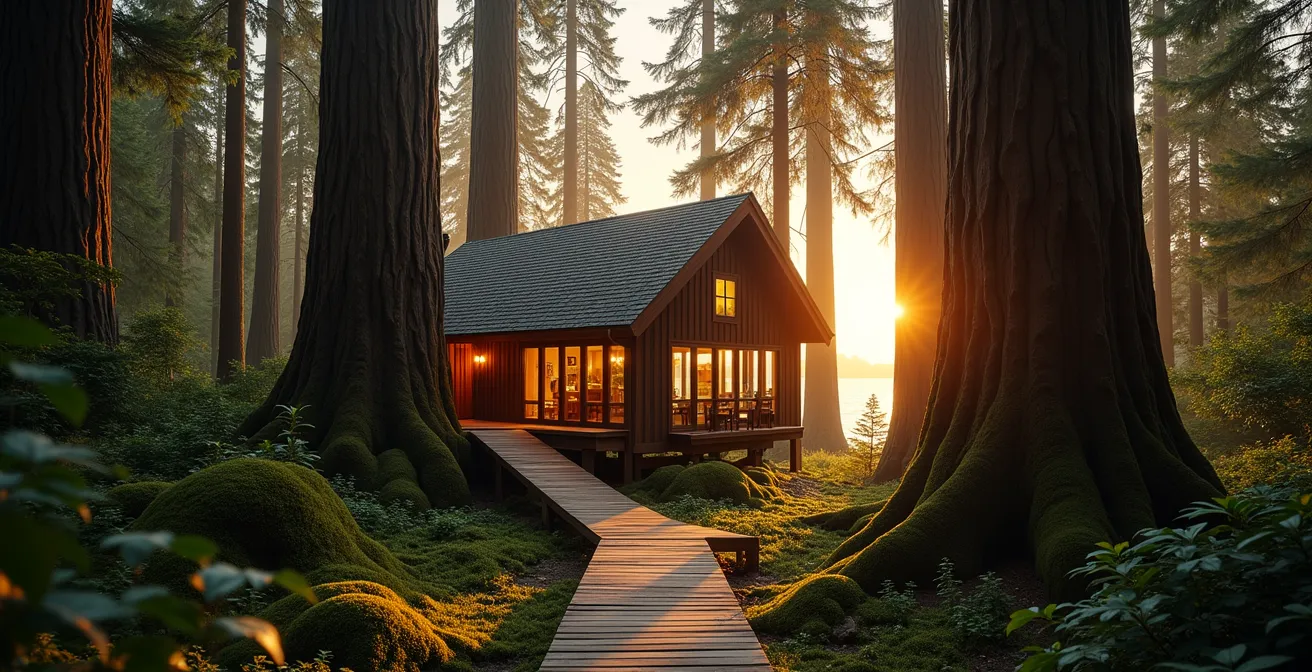
The reward for this foresight is an immersive stay in a place built in harmony with its surroundings. These lodges are more than just accommodation; they are the command centers for your wilderness experience, staffed by expert guides and often operated in partnership with or owned by local First Nations. If lodge-based trips are out of reach or fully booked, consider vessel-based alternatives. Companies like Maple Leaf Adventures offer multi-day expeditions on classic ships, providing access to different areas and sometimes having more booking flexibility.
- August 2025: Join waitlists for the September 2026 peak salmon run season at top-tier lodges like Spirit Bear Lodge, King Pacific Lodge, and Nimmo Bay.
- September 2025: Be ready to book immediately when 2026 dates are released. Have your credit card ready and be flexible on specific dates.
- Consider vessel-based alternatives like Maple Leaf Tours, which often have later booking windows.
- Contact lodges directly to express serious interest, providing your group size, desired experience, and date flexibility.
- Book the shoulder season (June or October) for better availability and to witness unique behaviours like spring foraging or pre-hibernation feeding.
Why feeding wildlife results in fines up to $25,000 CAD?
The rule is simple and absolute: never, ever feed wildlife. This includes both direct acts, like throwing food to a bear, and indirect ones, like leaving a cooler visible in your car, storing food improperly at a campsite, or even using strongly scented cosmetics. The phrase “a fed bear is a dead bear” is not a metaphor; it’s a tragic reality of wildlife management. When a bear becomes habituated to human food, it loses its natural fear of people and begins to associate them with an easy meal. This is a dangerous path that almost always ends with the animal being destroyed by Conservation Officers to protect human safety.
The steep fine reflects the immense true cost of managing a single food-conditioned animal. The $25,000 CAD maximum penalty under Section 33.1 of the B.C. Wildlife Act is not just a deterrent; it’s a figure that begins to approximate the actual taxpayer expense involved. A single incident can trigger a cascade of costly actions.
The response from Conservation Officers can involve helicopter deployments (costing thousands per hour), the time of multiple officers, complex and expensive relocation attempts, and, if all else fails, the final act of euthanization. Each bear that must be destroyed represents a failure on our part as visitors and a significant loss to the ecosystem. The fine is a stark reminder that our small, seemingly innocent actions can have massive, fatal, and expensive consequences. Respecting this rule is the most fundamental act of care you can show in the wild.
Why ethical operators turn off engines and keep distance?
When you’re on a vessel watching for whales or other marine life, one of the clearest signs of an ethical, expert operator is what they do with their engine. While Canada’s Marine Mammal Regulations mandate minimum approach distances—typically 100m for most whales and up to 400m for at-risk orcas—the best guides go far beyond these legal minimums. They proactively cut their engines long before they get close.
This isn’t just a precautionary measure; it’s a demonstration of deep expertise. Low-frequency engine noise travels for miles underwater, capable of masking the complex vocalizations whales use to communicate, navigate, and hunt. For orcas, which rely on sophisticated echolocation to find their prey, this acoustic interference can be devastating. An operator who cuts their engine shows they are confident in their ability to read the currents and anticipate the animals’ movements, positioning the boat for a respectful, silent drift-by encounter without needing the engine as a crutch.
In contrast, an operator who constantly repositions, approaches animals head-on, or “chases” them is demonstrating a lack of understanding of both animal behaviour and the physics of underwater sound. They are prioritizing a fleeting glimpse for their clients over the well-being of the wildlife. As a traveller, you have the power to vote with your wallet by choosing operators who put the animals’ sensory world first.
Your Scorecard for Identifying Ethical Marine Wildlife Operators
- The operator cuts engines proactively when marine mammals are spotted within 400m.
- Approaches are always parallel to the animal’s direction of travel, never head-on or from behind.
- The pre-tour briefing includes specific information about local species’ behaviour and conservation status.
- The operator participates in stewardship programs like the North Island Marine Mammal Stewardship Association (NIMMSA) or the BC Cetacean Sightings Network.
- Viewing time is limited to a maximum of 30 minutes per encounter to minimize cumulative disturbance.
Key Takeaways
- True ethical travel in the Great Bear Rainforest is about reciprocity, where your choices actively support conservation and Indigenous stewardship.
- A successful trip depends on a complete rain *system* (layers, venting, DWR treatment), not just an expensive jacket, to combat constant humidity.
- Your budget and choice of access (remote lodge vs. developed hub) have a direct, measurable impact on conservation funding and the local economy.
Indigenous Tourism Experiences: Moving Beyond the Museum Display
For too long, Indigenous culture has been presented to travellers as a static artifact—something to be viewed in a museum or observed in a historical reenactment. In the Great Bear Rainforest, you have the profound opportunity to experience something entirely different: living culture in action. Here, Indigenous tourism is a contemporary and powerful expression of sovereignty, stewardship, and self-determination.
When you book a tour with a community-owned operator certified by Indigenous Tourism BC, you are stepping away from the museum display and into a living relationship between a people and their ancestral lands. The guide is not a performer; they are a knowledge keeper, a scientist, a guardian, and a host. The stories they share are not just from the past; they are about the present and the future of their Nation’s work to protect their territory. As Kitasoo/Xai’Xais Chief Councillor Doug Neasloss eloquently states, this work is guided by a sacred, long-term vision.
We have a belief, in all of our work, that what we have here is not ours. It belongs to future generations. And my Elders have always stated that if you take care of the land, the land will take care of you.
– Doug Neasloss, Kitasoo/Xai’Xais Chief Councillor, Great Bear Rainforest IMAX Film
Your tourism dollars become a direct investment in this vision. They fund programs like the Coastal Guardian Watchmen Network, where Indigenous guardians monitor the health of their territories, conduct research, and ensure that all activities (including tourism) adhere to their laws and values. This is not “Indigi-washing”; it is genuine, community-led conservation. To be a respectful guest, it’s vital to listen with the intent to understand, ask questions about the present, and respect that some places or stories are sacred and not for sharing. Your visit is an act of participation in a vibrant, modern culture actively shaping the future of one of the planet’s most precious ecosystems.
To start planning a trip that is both unforgettable and regenerative, begin by researching Indigenous-led tour operators and the remote lodges that partner with them, keeping the long booking lead times in mind.