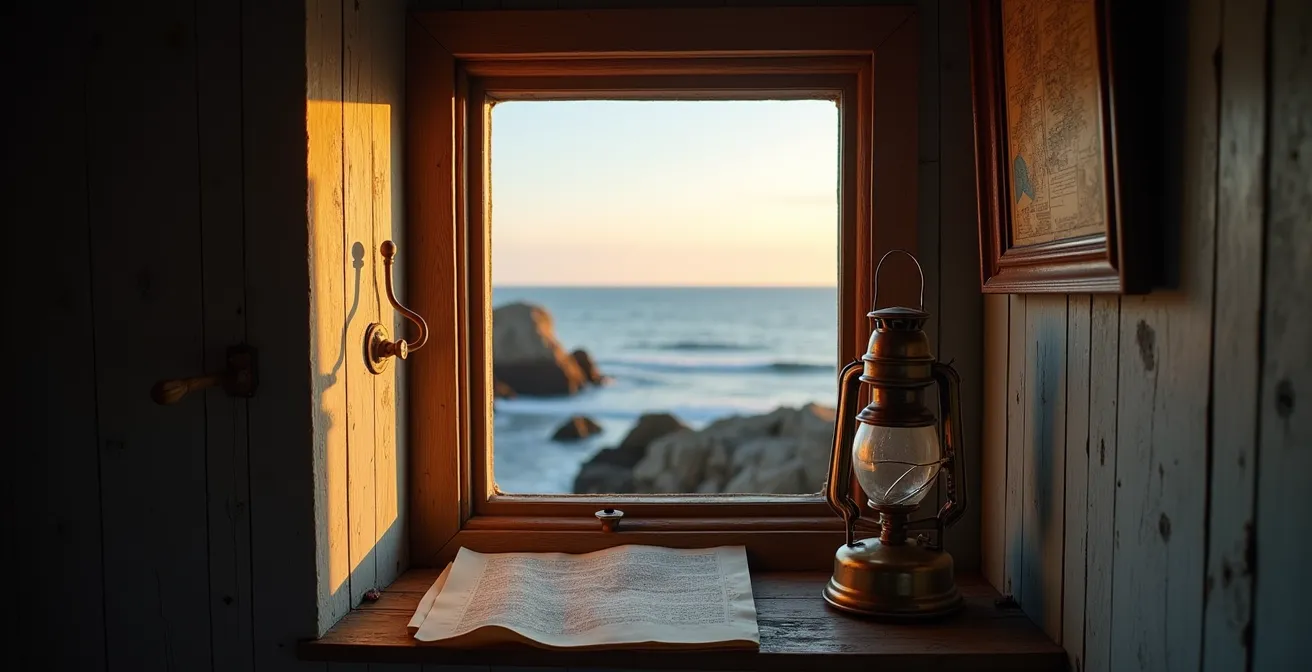
Securing a stay in a Canadian heritage lighthouse is less about luck and more about a strategic approach to booking and embracing rustic authenticity.
- High-demand sites, especially those managed by Parks Canada, require planning months in advance and navigating a competitive queue system that often opens in January.
- The “rustic” charm is a feature, not a bug, stemming from conservation mandates that prioritize heritage integrity over modern luxury.
Recommendation: Verify specific details like accessibility, tide schedules, and available amenities directly with local operators, as the most unique experiences are often the least standardized.
The image of a solitary lighthouse standing against a dramatic coastal sky is a powerful symbol of refuge and romance. For many travelers, the idea of sleeping within these historic beacons is a bucket-list dream. Canada, with its vast and rugged coastlines, offers some of the world’s most spectacular opportunities to turn this dream into reality. Couples and solo adventurers seeking quiet contemplation are drawn to the promise of wind-swept shores and the rhythmic pulse of the light.
However, the reality of a lighthouse stay is often more complex than the postcard fantasy. Many guides simply list available properties, glossing over the practical hurdles. They speak of magic but not of the very real challenges of booking, the rustic nature of the amenities, or the logistical planning required. The most coveted spots can be booked solid within minutes of becoming available, and the charmingly spartan conditions are a direct result of a commitment to historical preservation.
But what if the key to an unforgettable lighthouse experience wasn’t just finding a beautiful location, but in understanding and embracing its authentic character? This guide moves beyond the romance to offer a practical look at the realities. We will explore the “why” behind the rustic charm and the “how” of navigating the booking gauntlet. This is about setting the right expectations to fully appreciate the profound, unique, and deeply Canadian experience of living, even for a short time, by the sea’s rhythm and the keeper’s clock.
This article provides a detailed roadmap for your journey, from securing your coveted spot to understanding the unique etiquette of Canada’s coastal communities. Explore the sections below to prepare for an authentic and memorable heritage escape.
Summary: A Practical Guide to Staying in Canada’s Historic Lighthouses
- How to book a lighthouse keeper’s cottage before they sell out in January?
- Active vs. decommissioned lighthouses: difference in guest experience and noise?
- Why amenities are often rustic in heritage lighthouse properties?
- Accessibility issues for travelers with mobility concerns in old towers
- When to book primarily for storm watching season on the West Coast?
- Missing the tide changes at Bay of Fundy harbors: a scheduling error
- Why the Bas-Saint-Laurent sunsets are considered some of the best in the world?
- Experiencing Maritime Hospitality: Social Etiquette in Atlantic Canada
How to book a lighthouse keeper’s cottage before they sell out in January?
Securing a spot in a sought-after Canadian lighthouse isn’t a casual affair; it’s a competitive event that requires a strategic approach. The demand for these unique accommodations is immense, with the Canadian tourism market showing its strength as accommodation services in Canada reached a record-high operating revenue of $35.9 billion in 2024. This popularity translates into a “booking gauntlet,” especially for properties managed by Parks Canada, which often see their entire summer season sell out within hours.
The key is preparation and timing. The booking window for many federal and provincial sites opens on a series of staggered dates, typically from late January to mid-February. Failing to be ready on launch day often means waiting another year. You aren’t just competing with other travelers; you’re competing against a computerized queue system designed to handle a massive influx of traffic. Being prepared means having your account set up, your preferred dates chosen, and several backup options ready to go.
Beyond the official park systems, many lighthouses are managed by local non-profit preservation societies. These groups often announce their booking dates on social media channels like Facebook, providing a separate avenue for those in the know. Following these local pages can give you a critical edge.
Your Action Plan: The Canadian Lighthouse Booking Gauntlet
- Create your Parks Canada reservation account well before January to avoid system crashes or delays during peak booking times.
- Mark the specific Parks Canada launch dates (typically January 19-February 13) for your target province in your calendar.
- Log in between 7:30-7:59 AM local time on launch day to be placed into the randomized queue system for a fair chance.
- Have backup dates ready, focusing on the shoulder seasons of May and October when competition is significantly lower.
- Follow the individual Facebook pages of lighthouse preservation societies for early booking announcements on non-Parks Canada properties.
Success in this first stage is a rewarding victory that opens the door to the truly unique experience that awaits.
Active vs. decommissioned lighthouses: difference in guest experience and noise?
When you book a lighthouse stay, you’re not just choosing a location; you’re choosing its operational character. This is a crucial distinction that dramatically shapes your experience, particularly concerning light and sound. Accommodations are available in both active, automated lighthouses and those that have been fully decommissioned. Understanding the difference is key to aligning your expectations with reality.
An active lighthouse is still a functioning navigational aid. While the era of the resident keeper manually lighting a lamp is gone, modern, automated systems continue the work. This means you will experience the light. Instead of a sweeping, romantic beam from a Fresnel lens, it’s more likely to be a powerful, rhythmic LED flash. The foghorn, also automated, may sound its deep, resonant call depending on weather conditions. For some, this is the entire point—an immersive connection to the lighthouse’s living purpose. For light sleepers, it could be a significant disruption.
Decommissioned lighthouses, by contrast, offer pure historical immersion without the operational elements. The tower is a silent monument, and the keeper’s cottage is a quiet refuge. The experience is one of stillness and history, where the only sounds are the wind and waves. The choice between them is deeply personal: do you want to be a spectator of history, or a guest inside a still-working piece of maritime infrastructure?
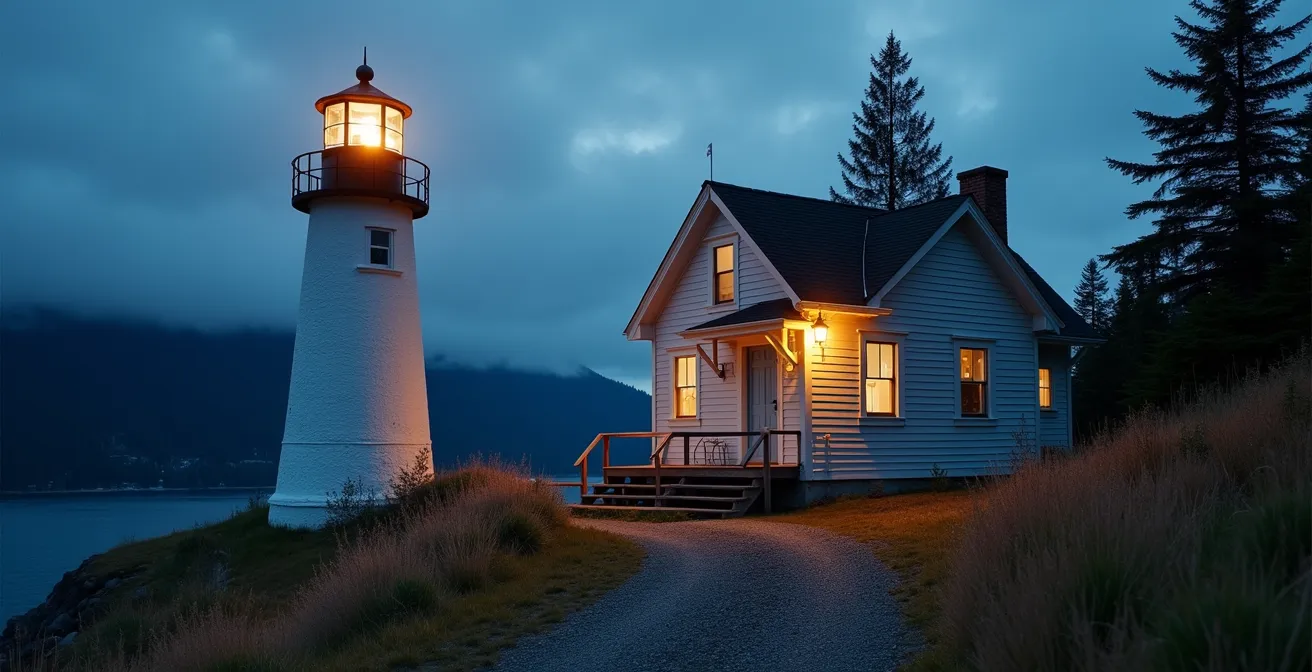
As you can see, the modern beacon coexists with the historic structure, creating a unique blend of past and present. This duality is central to the modern lighthouse experience.
Ultimately, neither option is better—they simply offer two fundamentally different ways to connect with Canada’s coastal heritage.
Why amenities are often rustic in heritage lighthouse properties?
Travelers accustomed to hotels may be surprised by the amenities at a heritage lighthouse. Wi-Fi can be spotty, electricity limited, and bathrooms may feature composting toilets. This isn’t a sign of neglect; it’s a deliberate choice rooted in the principle of heritage integrity. The primary mission of the societies that manage these properties is preservation, not profit. Guest fees are almost always reinvested directly into the conservation of these fragile, historically significant buildings.
The case of the Île aux Perroquets lighthouse in Quebec’s Mingan Archipelago is a perfect example. It offers what is described as “4-star accommodation,” yet operates with limited electricity, rainwater collection systems, and composting toilets. This is a requirement of its heritage designation. The focus is on maintaining the structure and the spirit of the keeper’s life. Everything from the quilts to the light fixtures is often handcrafted by local residents, creating an atmosphere of authentic, lived-in history rather than sterile luxury.
This philosophy echoes the self-sufficient and practical life of the keepers themselves. It was a life of making do, of profound connection to the immediate environment, and of human judgment that technology can’t replace. As former lighthouse keeper Caroline Woodward noted in an interview with CBC Radio about the essential human element of the role:
We feel it was worthy work and good work. There’s no substitute for eyes and ears, and the human judgment to call in for people in trouble.
– Caroline Woodward, CBC Radio Interview on lighthouse keeper life
Choosing a lighthouse stay is choosing to participate in this legacy. The rustic amenities are not a flaw; they are an integral part of an authentic experience, connecting you to a more resourceful and resilient way of life.
By staying in one of these properties, you are not just a tourist; you become a temporary steward, contributing directly to the preservation of a vital piece of Canadian history.
Accessibility issues for travelers with mobility concerns in old towers
The romantic allure of a lighthouse tower, with its promise of panoramic views, comes with a significant practical limitation: accessibility. For travelers with mobility concerns, it’s crucial to understand that the towers themselves are almost universally inaccessible. These structures were built in the 19th or early 20th century as purely functional buildings, featuring steep, narrow, and winding spiral staircases that were never designed for public access.
Furthermore, their status as protected heritage sites means that modern interventions like installing elevators or ramps within the towers is strictly forbidden. The goal is to preserve the original architecture in its exact historical state. Therefore, climbing the tower to the lantern room is an activity reserved for those who can safely navigate these challenging stairwells.
However, this does not mean the entire experience is off-limits. Many lighthouse stations have focused on making the ground-floor keeper’s cottages accessible. These single-level dwellings can be perfectly suitable for guests who use wheelchairs or have difficulty with stairs. For example, the West Point Lighthouse Inn in Prince Edward Island offers accessible ground-floor rooms, even though its tower remains inaccessible. The key is to distinguish between staying at the light station and climbing the actual light tower.
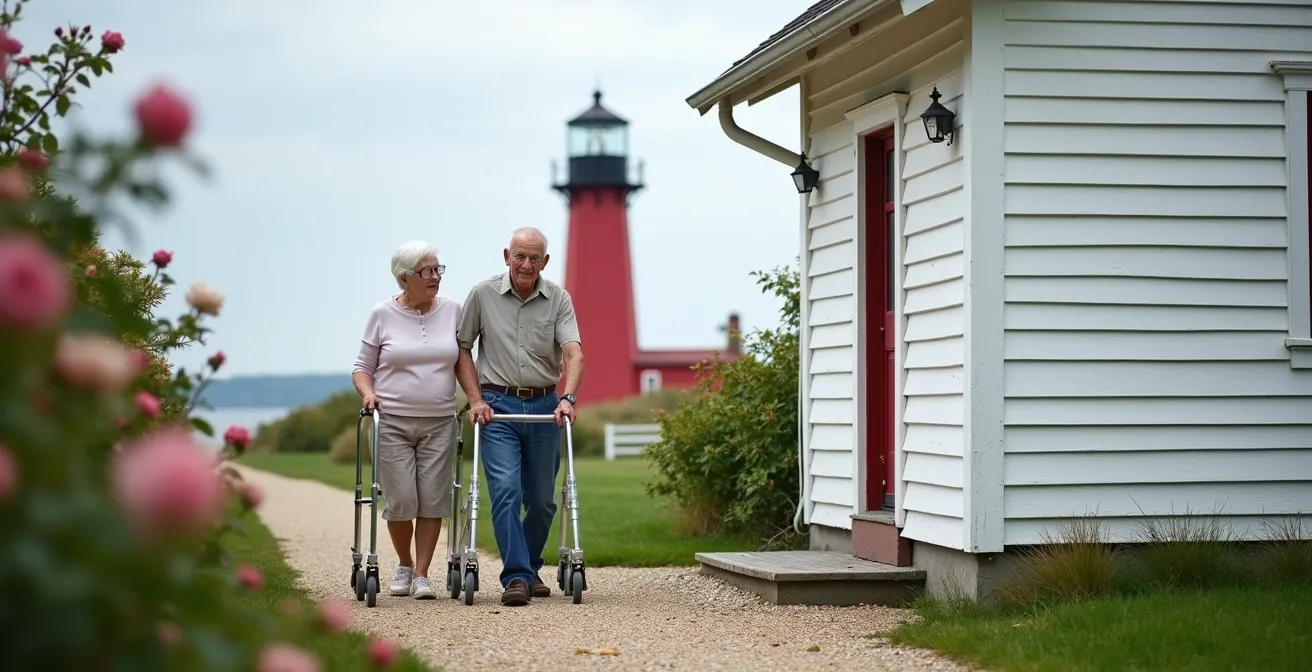
Because accessibility details can vary widely and are often not listed on booking websites, the most important step is direct communication. Before you book, you must contact the local Canadian preservation society or operator that manages the specific site. They can provide precise, case-by-case information about pathways, doorways, and bathroom facilities, ensuring there are no surprises upon arrival.
With proper research, the dream of a coastal stay can still be a comfortable and enjoyable reality, even if the tower’s peak remains out of reach.
When to book primarily for storm watching season on the West Coast?
While many seek out lighthouses for serene summer days, a growing number of adventurous travelers book them for the dramatic spectacle of storm watching. Canada’s Pacific Coast, particularly the western shore of Vancouver Island, is a world-renowned destination for this powerful natural theatre. Booking a lighthouse cottage here during the right season offers a front-row seat to crashing waves and tempestuous skies, all from a cozy, historic shelter.
Timing is everything. According to Cottage Life, a resource for Canadian coastal properties, the prime storm-watching window for British Columbia’s Vancouver Island coast runs from November to late February. During these months, the Pacific Ocean unleashes its full force, creating the awe-inspiring conditions that storm watchers seek. Booking your stay within this period is essential for the authentic experience.
This type of trip requires specific preparation beyond what a typical summer visit would entail. The weather is not just an inconvenience; it’s the main event. This means packing serious waterproof gear and being prepared for potential travel disruptions. The very storms that make the views spectacular can also lead to ferry cancellations or road closures. Having a flexible mindset and a plan for indoor activities is crucial. Proximity to towns like Tofino and Ucluelet, the epicenters of the storm-watching scene, is also a strategic advantage.
- Pack full waterproof gear, including a high-quality rain jacket, pants, and waterproof boots suitable for rugged Pacific Northwest conditions.
- Focus your accommodation search near Ucluelet and Tofino, as they offer the best access to prime storm-watching locations like the Wild Pacific Trail.
- Always check ferry schedules and road conditions before you travel, as access can become limited during major storm events.
- Prepare for the possibility of power outages by bringing flashlights, headlamps, and portable battery banks for your devices.
- Plan for cozy indoor backup activities—a good book, board games, or simply watching the storm from your window—during the most extreme weather.
For those properly prepared, a winter lighthouse stay offers a profound connection to the raw power of nature that is both humbling and exhilarating.
Missing the tide changes at Bay of Fundy harbors: a scheduling error
Nowhere in the world is scheduling more critical to a coastal experience than at the Bay of Fundy. Home to the highest tides on Earth, this region offers a spectacle of nature so dramatic that mis-timing your visit is not a minor inconvenience—it’s a fundamental error that can cause you to miss the very essence of the place. The difference between high and low tide can be a staggering 16 meters (52 feet), completely transforming the landscape in just over six hours. Forgetting to consult the tide tables is the single biggest mistake a visitor can make.
The experience at Hopewell Rocks Provincial Park in New Brunswick is a prime example of why planning around the “tidal clock” is essential. As detailed on their official site, the park brilliantly designs its visitor experience around this natural rhythm. Your entrance fee is valid for two consecutive days, explicitly encouraging you to witness both extremes. At low tide, you can walk on the ocean floor among the iconic “flowerpot” sea stacks. Just hours later, at high tide, the same spot will be deep underwater, accessible only by kayak. Arriving at the wrong time means you simply cannot have the defining experience of the location.
This principle extends throughout the bay, but the timing varies from harbor to harbor. What is low tide at Hopewell Rocks is not low tide an hour down the coast. Each location has its own unique tidal feature and timing, from the grounding of fishing boats at Halls Harbour to the “Dory Rips” whirlpools at Cape d’Or.
| Location | Tide Variation | Key Experience | Time Difference from Hopewell |
|---|---|---|---|
| Hopewell Rocks, NB | Up to 16m (52 ft) | Walk ocean floor at low tide | Reference point |
| Cape Enrage, NB | Up to 14m | View tidal rapids | +45 minutes |
| Halls Harbour, NS | Up to 15m | Watch fishing boats ground/float | +1 hour 15 minutes |
| Cape d’Or, NS | Up to 13m | See ‘Dory Rips’ whirlpools at high tide | +1 hour |
In the Bay of Fundy, your itinerary is not your own; it is dictated by the moon and the ocean, a powerful and humbling lesson in the rhythms of nature.
Why the Bas-Saint-Laurent sunsets are considered some of the best in the world?
While lighthouses offer dramatic scenery along all of Canada’s coasts, the sunsets viewed from the shores of the Bas-Saint-Laurent region in Quebec are legendary. They are consistently ranked among the best in the world, not due to local pride, but because of a unique combination of geography and atmospheric conditions that create a nightly spectacle of breathtaking beauty and complexity.
The primary reason for this phenomenon is the sheer scale of the St. Lawrence River at this point. As the Quebec Maritime Tourism Board explains, “The river’s estuary in this part of Quebec is so wide and faces directly west, creating an unobstructed horizon akin to an ocean, a rare feature that allows the sun to sink fully below the water line.” This vast, open stage sets the scene for the daily performance.
The Pointe-au-Père lighthouse site, a National Historic Site, serves as a perfect vantage point. Here, the spectacle is enhanced by unique atmospheric effects. The interaction of the setting sun’s light with the cold, salty air of the St. Lawrence Estuary produces strange and beautiful light refractions and mirages, including the occasional and highly sought-after “green flash.” The experience is a multi-sensory event, as the sky explodes in shades of orange, pink, and deep purple, reflecting off the water and even the hull of the historic Onondaga submarine, which is also part of the museum site. It is a daily ritual that has guided and inspired St. Lawrence River pilots for generations.

This is more than just a pretty view; it is a complex interplay of light, water, and air. The colors are not just seen but felt, creating a moment of profound peace and awe that lingers long after the last glow has faded from the horizon.
Witnessing a Bas-Saint-Laurent sunset from a lighthouse is the romantic peak of a Canadian coastal journey, a memory etched in vibrant color.
Key Takeaways
- The best lighthouse stays require strategic booking, often months in advance through competitive systems, especially for Parks Canada sites in January.
- Embrace the “rustic” nature of amenities; it stems from a commitment to heritage conservation, not a lack of care.
- Always verify accessibility directly with operators, as towers are generally inaccessible, but ground-floor cottages may be suitable for those with mobility concerns.
Experiencing Maritime Hospitality: Social Etiquette in Atlantic Canada
A stay in an Atlantic Canadian lighthouse offers more than just coastal views; it provides an entry into a culture renowned for its warmth and friendliness. Maritime hospitality is not a performance for tourists; it’s a genuine and deeply ingrained way of life. Understanding its unwritten rules can transform your visit from a simple stay into a rich cultural exchange.
As Barry Porter, a former Newfoundland lighthouse keeper, explained in a CBC interview, this culture has practical roots: “Maritime hospitality stems from a history of isolated fishing villages where community interdependence was essential for survival.” This history has fostered a social fabric where conversation is currency and taking time for others is the norm. Rushing is antithetical to the “Maritime time” mindset. Engaging in small talk with a shopkeeper or a fisherman mending nets isn’t an interruption; it’s an expected and valued part of the daily rhythm.
This sense of community extends to simple gestures. A friendly, two-finger wave from the steering wheel is standard practice on rural roads. If you’re fortunate enough to be invited to a “kitchen party,” accept with enthusiasm. These informal gatherings are the heart of Maritime social life, filled with music, storytelling, and unpretentious connection. Showing appreciation for the local community, perhaps by bringing a small gift from a local artisan if you’re staying in a B&B, is a sign of respect that will be warmly received.
- DO engage in small talk with locals you meet—it’s expected and appreciated as a sign of friendliness.
- DON’T be in a rush. “Maritime time” means slowing down and valuing conversation over tight schedules.
- DO accept an invitation to a kitchen party if offered. It’s a genuine honor and a chance to experience authentic local culture.
- DO give a friendly two-finger wave from your steering wheel when driving on rural roads; it’s the local way of saying hello.
- DO consider bringing a small gift from a local artisan for a B&B stay to show respect for the local economy and your hosts.
By embracing this slower, more connected way of being, you will find that the greatest treasure of your lighthouse stay is not the scenery, but the people you meet along the way.