True respect in Indigenous tourism isn’t about memorizing a list of rules. It’s about fundamentally shifting your perspective from that of a passive tourist to an engaged guest. The key lies in understanding and practicing reciprocity—a two-way exchange that honours the culture you are visiting. This guide focuses on the ‘why’ behind the protocols, helping you transform your visit into a meaningful connection that supports community sovereignty and cultural preservation.
As interest in authentic cultural experiences grows, many travellers in Canada are drawn to the rich and diverse heritage of First Nations, Inuit, and Métis peoples. The desire to learn is a powerful first step, but it often comes with a quiet anxiety: “How do I engage without being disrespectful?” Mainstream advice often boils down to generic tips like “be respectful” or “ask questions,” which, while well-intentioned, fail to provide the deeper understanding needed to be a truly good guest.
Many visitors believe that following a simple checklist of dos and don’ts is sufficient. However, this transactional approach misses the heart of Indigenous worldviews, which are often based on relationships and mutual respect. The real faux-pas is not simply taking a photo at the wrong time; it’s approaching a living, breathing culture as if it were a museum exhibit or a product to be consumed. This guide moves beyond the surface-level rules to explore the foundational principles that govern respectful engagement.
But what if the key to respectful tourism wasn’t about avoiding mistakes, but about actively contributing to a positive exchange? The core principle is reciprocity. It’s about understanding that you are a guest on someone’s ancestral lands and that your presence should bring value, not just take away memories or photographs. It’s the difference between buying a mass-produced souvenir and purchasing art directly from a creator, thereby participating in their economic self-determination.
This article will provide a framework for this relational approach. We will explore how to support artists directly, the etiquette of asking questions at a Pow Wow, the significance of photography protocols, and the meaning behind land acknowledgements. By understanding the ‘why’ behind these practices, you can move from being a passive observer to an active, respectful, and welcomed guest.
To help you navigate this journey, this guide breaks down the essential aspects of respectful cultural engagement. The following sections offer practical advice grounded in the principle of reciprocity, ensuring your visit is both memorable for you and honourable to your hosts.
Summary: A Guide to Meaningful Indigenous Cultural Engagement
- Why you should buy art directly from Indigenous creators rather than souvenir shops?
- How to ask respectful questions at a Pow Wow without causing offense?
- The faux-pas of photographing sacred ceremonies without explicit permission
- Haida Gwaii vs. Wendake: distinct cultural experiences explained
- Supporting local communities through Indigenous Tourism Association approved operators
- How to verify the ‘Igloo Tag’ on Inuit carvings to ensure provenance?
- Why land acknowledgements are spoken at the start of events in Canada?
- Indigenous Tourism Experiences: Moving Beyond the Museum Display
Why you should buy art directly from Indigenous creators rather than souvenir shops?
Choosing where you purchase Indigenous art is one of the most direct ways to practice reciprocity. When you buy a piece of art, you are not just acquiring an object; you are engaging with a story, a lineage, and an economy. Souvenir shops, particularly in major tourist areas, are often filled with mass-produced items that are “Indigenous-style” but have no connection to the communities they claim to represent. This practice, often called cultural appropriation, devalues authentic work and diverts income away from the artists and communities who are the rightful culture bearers.
Buying directly from an Indigenous creator or a community-owned gallery is an act of economic reconciliation. It ensures that the revenue generated from cultural expression flows back to the people it belongs to, supporting families, language revitalization programs, and youth mentorship. It is a powerful statement that you value the artist’s skill, intellectual property, and cultural sovereignty. This approach transforms a simple transaction into a meaningful relationship, where you know the story behind the art and the person who made it.
Furthermore, systems are in place to help visitors make informed choices. In British Columbia, for example, the Authentic Indigenous system was launched to help identify and promote work made by BC Indigenous artists, creating a trusted standard for consumers. Verifying authenticity is a key step in being a responsible cultural tourist. It requires a little more effort than grabbing a trinket off a shelf, but it’s a crucial part of honouring the culture you’ve come to learn about.
Your Action Plan: How to Identify Authentic Indigenous Art
- Artist Identification: Look for the artist’s signature and their Nation affiliation clearly marked on the piece.
- Official Verification: For Inuit art, verify the ‘Igloo Tag’ with the Inuit Art Foundation. For other regions, look for accreditations from bodies like the Indigenous Art Centre.
- Direct Engagement: Purchase from accredited galleries or directly from artists at markets and studios. Ask vendors about the artist’s story and their community connection.
- Critical Evaluation: Be wary of items labelled “Indigenous-style” or “Native-inspired,” especially in generic tourist shops. These are red flags for mass-produced imitations.
- Source Inquiry: If in doubt, ask the seller directly: “Who is the artist, and what community are they from?” A legitimate vendor will be proud to share this information.
How to ask respectful questions at a Pow Wow without causing offense?
A Pow Wow is a vibrant, powerful celebration of culture, dance, and community—not a performance for tourists. As a guest, your curiosity is welcome, but it must be paired with deep respect. The key is to understand that knowledge is a gift, not a commodity. In many Indigenous cultures, asking for knowledge requires first establishing a respectful relationship. A profound way to show this respect is through traditional protocol, such as offering tobacco to an Elder or dancer before asking a question. This gesture signifies that you value their time and the wisdom they are about to share, creating a reciprocal exchange rather than a one-sided interview.
When you do ask questions, the framing is critical. Your goal should be to learn, not to pry or judge. Avoid questions that are personal, transactional, or rooted in stereotypes. For instance, asking about the cost of a dancer’s regalia is akin to asking a stranger how much their wedding dress cost; it’s invasive and reduces sacred, often handmade, items to a mere price tag. Similarly, questions about identity like “How much Indian are you?” are deeply offensive and stem from colonial concepts of blood quantum.
A good guest listens more than they speak. Observe the flow of the event and approach people when they are not busy or performing. The best questions are open-ended and demonstrate a genuine desire to understand the culture from their perspective. Framing your inquiry with humility is always a good approach. Here is a simple guide:
- Green Light Questions (Respectful & Open): “Could you tell me more about the story behind this dance?” or “This is my first Pow Wow, what is the best way for me to be a good guest?”
- Red Light Questions (Invasive & Disrespectful): Avoid anything about cost (“How much did your regalia cost?”), identity (“Are you a real Indian?”), or presumptions of trauma (“Tell me about residential schools.”).
The faux-pas of photographing sacred ceremonies without explicit permission
In our digital age, it’s almost instinctual to raise a camera to capture a beautiful or moving moment. However, within the context of Indigenous ceremonies, this instinct must be consciously managed. A sacred ceremony, whether it’s the Grand Entry at a Pow Wow or a private community ritual, is a spiritual event, not a photo opportunity. The act of photographing or recording can be seen as deeply intrusive, disrupting the spiritual focus and treating participants as subjects rather than people engaged in a profound cultural practice. The most significant faux-pas a visitor can make is assuming permission is granted.
The rules around photography are not meant to be exclusionary; they are in place to protect the sanctity of the ceremony. During specific moments, like the Grand Entry, prayers, or honour songs, photography is almost universally forbidden. You will often see an announcer or MC state this clearly. As a guest, the most respectful action you can take during these times is to put your camera away, stand, and remove your hat. This demonstrates that you are present and participating with respect, rather than simply documenting from a distance.
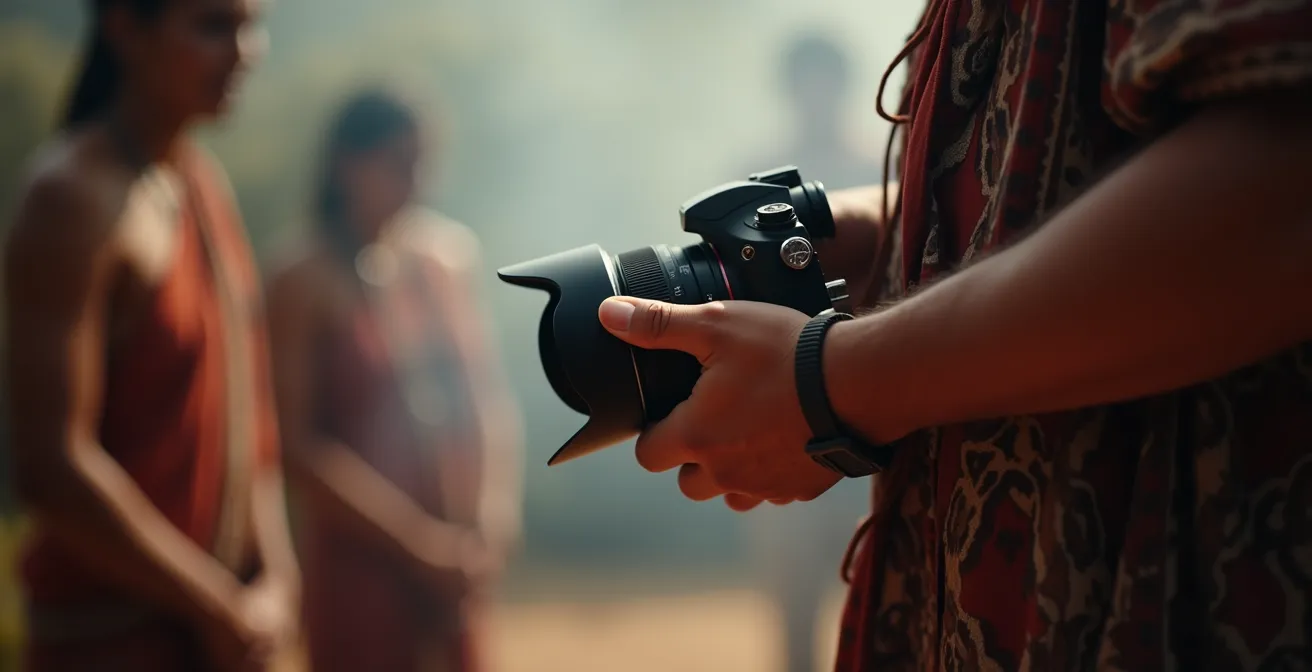
Permission is paramount. While photography of dance competitions or intertribal dances may be allowed, you must never photograph an individual without their explicit consent, especially children. Approach dancers between dances, compliment their regalia, and politely ask if you may take their picture. If they decline, thank them for their time and respect their decision without question. As Lisa Meeches, Executive Director of the Manito Ahbee Festival in Winnipeg, states, “Pow Wows are where we can showcase the best of who we are.” A good guest honours this showcase with respect, not with an intrusive lens.
Haida Gwaii vs. Wendake: distinct cultural experiences explained
A common mistake for visitors is to view “Indigenous culture” as a monolith. Canada is home to hundreds of distinct Nations, each with its own language, history, and protocols. The way different communities choose to engage with tourism is a powerful expression of their cultural sovereignty and self-determination. A comparison between the tourism models of Haida Gwaii in British Columbia and Wendake in Quebec provides a clear example of this diversity. Both are successful, but they represent two very different paths rooted in their unique histories and environments.
Haida Gwaii, an archipelago off the coast of British Columbia, has a tourism model deeply focused on ecological and cultural preservation. Tourism is tightly controlled by the Haida Nation, with access to ancient village sites often requiring visitors to be accompanied by a Haida Gwaii Watchman—stewards who protect the cultural and natural integrity of these sacred places. The experience is shaped by the Pacific Ocean and ancient cedar forests, and protocols are tied to the authority of Hereditary Chiefs. In contrast, Wendake is a Huron-Wendat community located within Quebec City. As a people displaced from their original homelands, their tourism model is a testament to resilience and economic integration. It is a major economic driver focused on dynamic, community-owned enterprises like the acclaimed Hôtel-Musée Premières Nations and a reconstructed longhouse. The experience is more structured, providing an immersive cultural education in an urban setting.
These two examples demonstrate that there is no single “authentic” Indigenous experience. As the following table illustrates, authenticity lies in the fact that the community itself is leading and defining the terms of engagement.
| Aspect | Haida Gwaii (BC) | Wendake (QC) |
|---|---|---|
| Governance Model | Tightly controlled by Haida Nation | Major economic driver in urban setting |
| Tourism Focus | Ecological and cultural preservation | Community-owned enterprises |
| Key Program | Haida Gwaii Watchmen program | Hôtel-Musée Premières Nations |
| Geography Impact | Pacific Ocean and cedar forests shape protocols | Great Lakes/St. Lawrence history influences expression |
| Visitor Experience | Ancient village sites, Hereditary Chiefs authority | Reconstructed longhouse, structured cultural site |
Supporting local communities through Indigenous Tourism Association approved operators
The most effective way to ensure your tourism dollars support Indigenous self-determination is to seek out experiences vetted and promoted by Indigenous-led organizations. In Canada, the leading body is the Indigenous Tourism Association of Canada (ITAC) and its provincial partners, like Indigenous Tourism BC or Indigenous Tourism Quebec. These organizations work at the grassroots level to nurture, develop, and market authentic, high-quality tourism businesses that are at least 51% Indigenous-owned and controlled. Choosing an ITAC-approved operator is a guarantee that you are participating in an experience that is culturally appropriate and directly benefits the host community.
The impact of this sector is significant. The Indigenous tourism industry is a vital part of Canada’s economy and a cornerstone of reconciliation in action. According to a report from ITAC, their vision for 2030 is to grow the sector to 2,700 Indigenous tourism businesses and 60,000 jobs, a substantial increase from pre-pandemic levels. By consciously choosing these businesses, you contribute directly to this growth, helping to create sustainable employment, preserve languages, and fund community programs.
Finding these businesses is straightforward. ITAC has developed the “Original Original” seal, a mark of authenticity that helps visitors easily identify accredited operators. Their website, IndigenousTourism.ca, serves as a national hub where you can filter experiences by province, activity type (such as culinary, adventure, or cultural), and community. Booking through this platform or directly with the operator ensures that the maximum amount of revenue stays within the community, honouring the principle of reciprocity. This simple act of due diligence transforms your travel planning into a deliberate act of support for Indigenous economic sovereignty.
How to verify the ‘Igloo Tag’ on Inuit carvings to ensure provenance?
For those looking to purchase Inuit art, particularly soapstone carvings, understanding the “Igloo Tag” is essential. This small, trademarked tag is far more than a label; it is a symbol of authenticity, cultural heritage, and artistic sovereignty for Inuit artists. Created by the Canadian federal government in the 1950s, the Igloo Tag program was designed to protect the integrity of Inuit art from a flood of southern-made fakes and to provide a source of sustainable income for Northern communities. Today, it remains a cornerstone of the Northern economy and a guarantee of provenance for collectors and visitors worldwide.
Each authentic piece of Inuit sculpture is registered and bears this tag, which certifies that the work was handmade by an Inuit artist in Canada. The tag connects the artwork to the Inuit Art Foundation’s central database, allowing for verification and ensuring the artist is properly credited and compensated. When you see the Igloo Tag, you can be confident that you are not buying a cheap imitation, but rather a genuine piece of cultural expression that supports the artist and their community. It is a powerful tool against cultural appropriation and for economic empowerment.

Verifying the tag is a critical step in responsible purchasing. Look for the official tag attached to the artwork and ask the gallery or vendor about its connection to the Inuit Art Foundation. Reputable dealers will be knowledgeable and proud to discuss the provenance of their pieces. By taking the time to look for and understand the Igloo Tag, you move beyond being a mere consumer and become a conscious patron of Inuit art, ensuring your purchase honours the artist’s legacy and contributes to the vitality of their culture. This simple act of verification is a direct application of the principle of respectful engagement.
Why land acknowledgements are spoken at the start of events in Canada?
Visitors to Canada may quickly notice a unique practice at the beginning of conferences, hockey games, concerts, and public meetings: a speaker formally acknowledging the traditional Indigenous territory on which the event is taking place. For many, the meaning behind this gesture may not be immediately clear. A land acknowledgement is not just a polite formality; it is a conscious and deliberate act of reconciliation. As defined in a CBC News article on the subject, “A territorial or land acknowledgement is an act of reconciliation that involves making a statement recognizing the traditional territory of the Indigenous people who called the land home before the arrival of settlers.”
The widespread adoption of this practice is a direct response to the modern journey of reconciliation in Canada. Specifically, it stems from the work of the Truth and Reconciliation Commission (TRC), which spent years documenting the history and devastating legacy of the country’s residential school system. In 2015, the TRC released its final report, which included 94 Calls to Action—specific, tangible steps for all sectors of Canadian society to take to redress that legacy. Land acknowledgements have become one of the most visible responses to these calls, serving as a constant reminder of the Indigenous presence that predates colonization.
These statements are a crucial step in correcting the erasure of Indigenous peoples from Canada’s history. They acknowledge that treaties were often broken and that much of the land, particularly in places like British Columbia, was never formally ceded or surrendered. For a visitor, hearing a land acknowledgement is an opportunity to learn about the specific Nations whose land you are on—the Squamish, Tsleil-Waututh, and Musqueam in Vancouver; the Haudenosaunee and Mississaugas of the Credit in Toronto. It grounds you in a history that is much deeper than the colonial narrative and invites you to see the land not as a generic place, but as a cherished homeland.
Key Takeaways
- Shift Your Mindset: The most important step is moving from the role of a passive “tourist” to that of an engaged “guest” who practices reciprocity.
- Support as Reconciliation: Your economic choices matter. Buying art directly and using ITAC-approved operators is a form of economic reconciliation.
- Protocols Protect Living Culture: Rules around photography and engagement are not arbitrary; they exist to protect the sanctity and integrity of a living, breathing culture.
Indigenous Tourism Experiences: Moving Beyond the Museum Display
For generations, the primary way non-Indigenous people learned about Indigenous cultures was through a museum display case—a canoe behind glass, beadwork presented as a static artifact, or stories told exclusively in the past tense. This model, while often well-intentioned, reinforced the idea of Indigenous cultures as historical relics. The modern Indigenous tourism movement in Canada is about shattering that glass case and inviting guests into a living, dynamic, and contemporary culture. It is a fundamental shift from passive observation to active, respectful participation.
This new paradigm is built on interactive exchange. Instead of just reading about beading techniques, you can join a workshop with a Métis artist. Instead of looking at a canoe in a gallery, you can learn to paddle one with a Squamish Nation guide on their ancestral waters. This model transforms a one-way transfer of information into a two-way cultural exchange. It creates space for genuine connection, where you can learn directly from a Knowledge Keeper and understand the culture through their eyes. This is the heart of relational tourism and the most profound form of respect a visitor can show.
Despite a strong desire for these authentic connections, a gap remains between interest and action. A recent study in Quebec revealed that while 90% of respondents have a favorable view of Indigenous tourism, over half have never participated in an experience. This highlights the crucial need for visitors to take the next step: to actively seek out and engage with these community-led initiatives. The table below highlights the powerful difference between the old model and the new, participatory one.
| Traditional Museum Model | Modern Indigenous Tourism |
|---|---|
| Canoe behind glass | Paddle with Squamish Nation guide |
| Read about beading techniques | Join workshop with Métis artist |
| View static displays | Participate in living culture |
| Historical focus only | Contemporary and traditional fusion |
| One-way information transfer | Interactive cultural exchange |
To truly honour these principles, your journey begins with intention. Start by exploring the community-led experiences certified by the Indigenous Tourism Association of Canada and choose to be a guest who listens, learns, and contributes respectfully.
Frequently Asked Questions about Indigenous Tourism Etiquette
Can I take photos during the Grand Entry?
No, Grand Entry is a sacred part of the Pow Wow and cannot be photographed or filmed. It is a sign of respect to stand and remove your hat during this time.
When is photography generally allowed at a Pow Wow?
Photography of the group of dancers in the circle during intertribal songs is generally permitted. However, you must always ask for permission before taking photos of individuals, especially if they are not in the dance arena.
How should I ask for permission to photograph a dancer in their regalia?
Approach dancers respectfully when they are not performing or preparing to dance—never during a ceremony or song. Politely ask for permission, and if they say no, thank them and respect their decision.