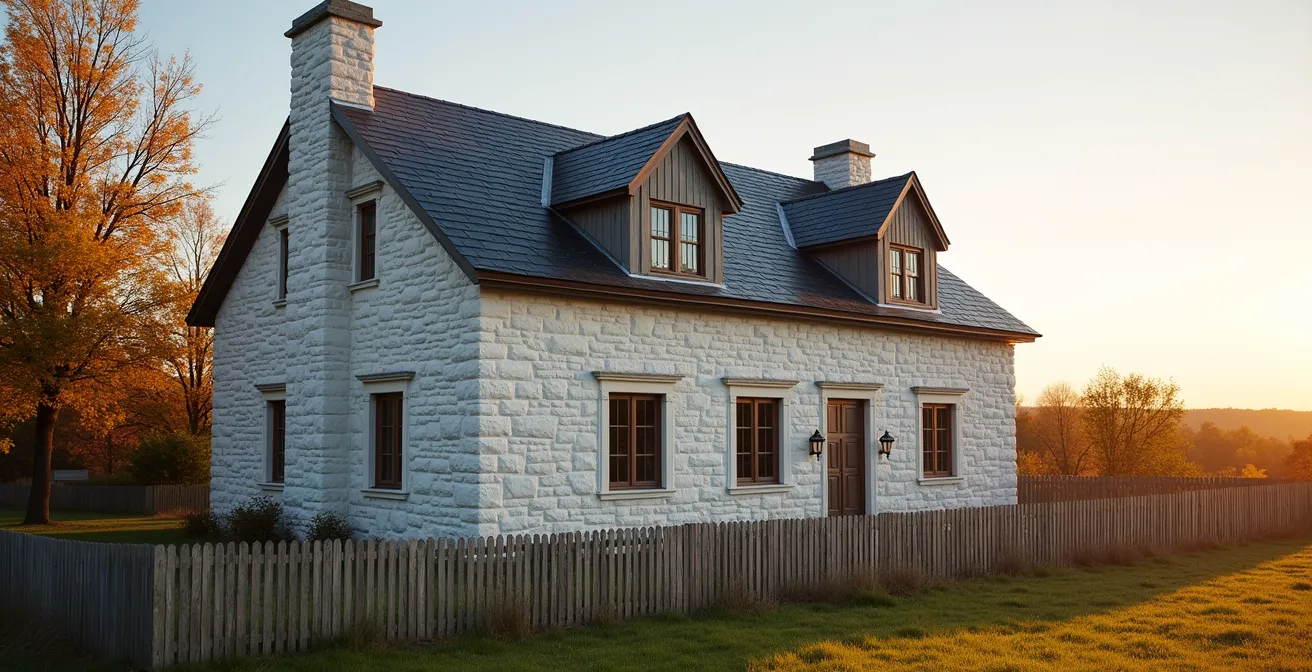
Beyond a picturesque facade, New France architecture is a practical language of survival; its features tell a story of climate adaptation, local materials, and cultural identity.
- Key identifiers include the steep, bell-cast “toit à la canadienne,” massive stone walls protected by lime wash, and small-paned casement windows.
- The style evolved significantly after 1760, with British influence introducing features like larger sash windows and symmetrical Georgian layouts, creating an architectural palimpsest.
Recommendation: To truly understand a heritage home, learn to read its structural and material choices as a historical document revealing the challenges and ingenuity of its builders.
For any history or architecture enthusiast travelling through Quebec, the sight of an ancestral stone house is a powerful link to the past. These structures, with their steep roofs and robust walls, are more than just charming buildings; they are historical records written in stone and timber. Many guides point out the obvious features—the thick walls, the distinctive rooflines—but often miss the deeper narrative. They describe what you see, but not why it exists. This superficial view overlooks the ingenuity and resilience embedded in every joint and stone.
The story of this architecture is one of practical solutions to harsh realities. It’s a tale of vernacular resilience, where builders used the very earth beneath their feet to create shelters that could withstand long, snowy winters and the demands of colonial life. But if the key to understanding these homes wasn’t just listing their features, but learning to read their language? What if every architectural choice, from the curve of a roof to the whitewash on a wall, revealed a specific story of survival, culture, and adaptation?
This guide moves beyond a simple checklist. As a heritage architect, my goal is to provide you with the tools to decipher this architectural language. We will explore the functional elegance of the “toit à la canadienne,” understand the science behind whitewashed stone, and dissect the subtle but significant shifts in design that occurred as the French Regime gave way to the English. For those considering ownership, we’ll also confront the modern realities of preserving this living heritage, from insurance costs to window maintenance. By the end, you won’t just see a house; you’ll see a testament to Canadian history.
This article provides a structured path to understanding these historic homes, from their most iconic features to the practicalities of their preservation. The following sections will guide you through each essential element.
Summary: A Heritage Architect’s Guide to Quebec’s Ancestral Homes
- How to spot a “toit à la canadienne” curved roofline from the road?
- Why stone walls were whitewashed in the 1700s for durability?
- French Regime vs. English Regime influence on Quebec homes: the differences
- The cost of insuring heritage properties in Old Quebec for new owners
- Maintaining wooden casement windows in a modern climate without replacing them
- Acadia vs. Franco-Ontarian communities: distinct dialects explained for visitors
- Kamouraska vs. Rimouski: where to stay for sunset views and dining?
- Navigating Francophone Heritage: Bilingualism Beyond Quebec’s Borders
How to spot a “toit à la canadienne” curved roofline from the road?
The most iconic and immediately recognizable feature of New France architecture is its roof. Known as the “toit à la canadienne,” its form is a direct response to the Canadian climate. From a distance, the first thing you’ll notice is its steep pitch, a crucial element designed to shed heavy loads of snow. But as you get closer, the defining detail reveals itself at the very edge: a graceful, upward curve at the eaves. This is the bell-cast eave, or larmier retroussé, and it is the signature of this style.
This curve is not merely decorative; it is a brilliant piece of climate-driven design. The flair at the bottom of the roof slows down rainwater and snowmelt, directing it away from the base of the stone walls. This prevents water from seeping into the mortar and causing damage from freeze-thaw cycles. This feature gained prominence as stone dwellings gained popularity in the countryside during the 17th and 18th centuries, where protecting the structural integrity of the walls was paramount. A prime example is the Maison Drouin on Île d’Orléans, whose preserved form perfectly showcases this distinctive roofline, a hallmark of construction adapted to local conditions.
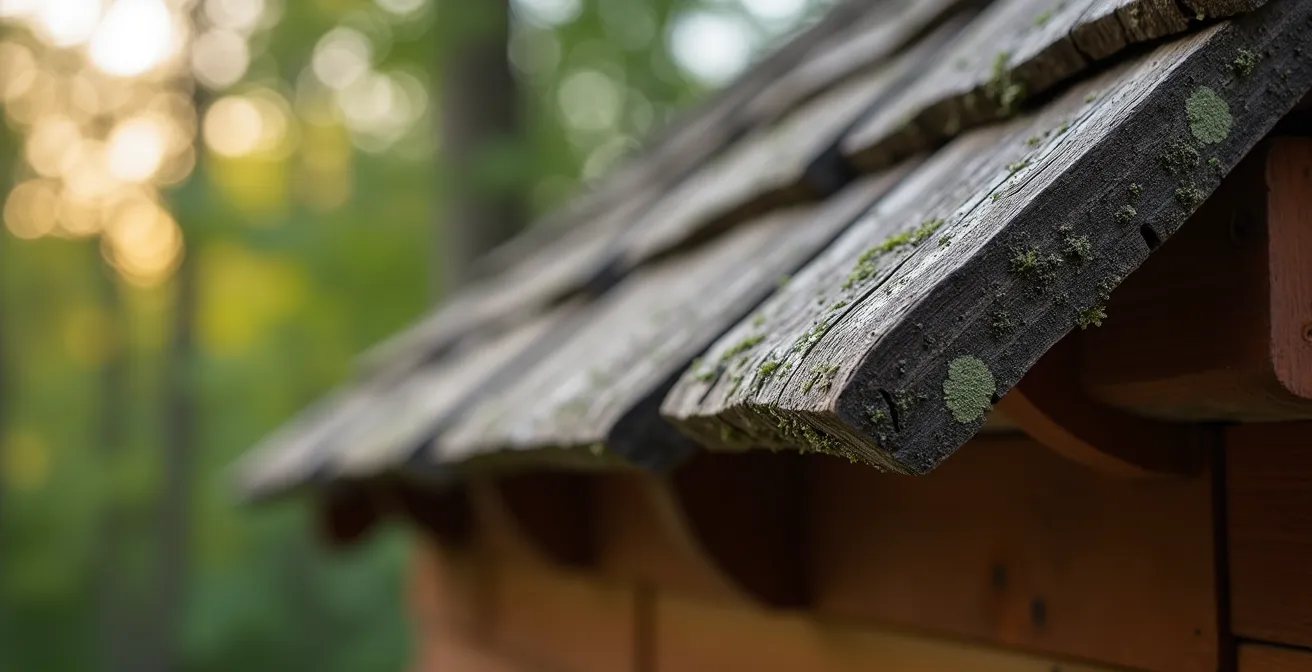
As you can see in the detail, the gentle sweep is both functional and aesthetically pleasing, creating a sense of lightness in an otherwise heavy, robust structure. When scanning the Quebec countryside, train your eye to look for this specific silhouette: a steep, straight pitch that suddenly curves outward at the bottom. It’s the clearest signal that you are looking at a home with roots deep in the French Regime.
Why stone walls were whitewashed in the 1700s for durability?
The massive, thick walls of New France homes are a testament to their purpose: to provide a fortress-like shelter against the elements. They were typically constructed from local fieldstone, a material that was abundant but also porous. The secret to their longevity lay not in the stone itself, but in the mortar holding it together and the coating protecting it from moisture. This is where the practice of whitewashing becomes critical.
The durability of these walls depended on a principle of “material honesty”—using what the land provided. As the Canadian Museum of History notes, the lowlands of the St. Lawrence contain limestone deposits, which provided settlers with both stone and the lime needed for high-quality mortar. This lime-based mortar was flexible and, most importantly, “breathable.” It allowed any moisture that entered the wall to escape. Applying a coat of whitewash—a simple mixture of lime putty and water—extended this same principle to the entire surface. Unlike modern paints, lime wash bonds with the stone and allows the wall to breathe, preventing moisture from becoming trapped inside, which would lead to crumbling mortar and stone degradation during winter freezes.
This breathable coating acted as a sacrificial layer, protecting the stone and mortar from direct exposure to rain and sun. It was inexpensive to produce and easy to reapply every few years, making it a sustainable maintenance practice. The bright white finish also had the aesthetic benefit of giving disparate fieldstones a clean, uniform appearance, reflecting sunlight and brightening the landscape. Preserving these historic walls today requires adhering to these same traditional methods.
Your Action Plan: Preserving Historic Stone Walls
- Identify materials: Determine if the construction is original limestone or fieldstone to choose the correct approach.
- Use proper mortar: Always use traditional, breathable lime-based mortar for repairs, never modern cement which traps moisture.
- Apply correct coating: Use a breathable lime wash coating for protection, avoiding any impermeable modern paints that can cause severe damage.
- Document everything: Keep detailed photographic records of all maintenance and repairs for heritage conservation files.
- Consult experts: Before undertaking any major restoration, consult with heritage preservation specialists to ensure proper techniques are used.
French Regime vs. English Regime influence on Quebec homes: the differences
A common misconception is that Quebec’s ancestral architecture is a single, static style. In reality, these homes are often an architectural palimpsest, with layers of history reflecting the monumental shift in power after the Conquest of 1760. While the core DNA of the house remains French, the influence of the English Regime introduced new tastes and technologies that are clearly visible if you know where to look.
The French Regime house (pre-1760) was born of rustic necessity. Its layout was often centered around a single, massive stone hearth for heating and cooking. Rooms were communal and open. Windows were small, multi-paned casements—a reflection of the high cost of glass and the need to conserve heat. The overall aesthetic was asymmetrical and organic, driven by function over form. After 1760, the arrival of British administrators, merchants, and Loyalists brought with them the Georgian style, which valued order, symmetry, and privacy. This influence led to more partitioned floor plans, with separate rooms for specific functions. The central hearth was often replaced by smaller, more efficient fireplaces at the gable ends of the house.
This stylistic evolution was also driven by new regulations. For instance, following a devastating fire, the intendant’s palace destroyed by the 1726 fire inspired an ordinance that mandated stone construction in urban areas, solidifying a trend that would define Quebec’s cityscape. The most visible changes are often in the windows and facades, as detailed in the comparison below.
| Feature | French Regime (pre-1760) | English Regime (post-1760) |
|---|---|---|
| Windows | Small multi-pane casements | Larger sash windows |
| Roof Style | Steep, bell-cast eaves | Georgian symmetrical |
| Heating | Central massive hearth | Multiple gable-end fireplaces |
| Materials | Stone and timber frame | Brick and stone |
| Layout | Open communal spaces | Divided private rooms |
The cost of insuring heritage properties in Old Quebec for new owners
Owning a piece of history is a rewarding experience, but it comes with unique responsibilities and costs. For new owners of ancestral homes, particularly in designated heritage districts like Old Quebec, insurance is a critical and often complex consideration. The concept of living heritage means balancing preservation with modern-day risks, and insurers view these properties through a very specific lens. Premiums are typically higher than for a modern home, and for a simple reason: the replacement cost.
Unlike a standard house, a heritage property cannot be rebuilt with modern materials from a big-box store. Insurance on heritage homes can be more expensive because the materials and craftsmanship required for an authentic restoration are rare and costly. If a 200-year-old timber frame is damaged by fire, it must be replaced with a similar hand-hewn beam, not a standard 2×10. This requires specialized artisans and sourced materials, driving up the potential claim cost significantly.
Daniel Mirkovic, CEO of Square One Insurance, explains this challenge clearly in a discussion with Heritage BC. He states that because the building techniques and materials popular 150 years ago are now niche, they come at a premium. As he puts it:
it’s actually more expensive to rebuild a heritage home than it is to build a new one. Building techniques and materials evolve over time… many trades or materials that were perhaps popular 150 years ago when the heritage home was built, are now niche and, as such, they come at a premium
– Daniel Mirkovic, CEO and President of Square One Insurance
However, owners are not without options. Insurers look favourably on proactive risk mitigation. Demonstrating that you have updated critical systems can significantly impact your premiums. This includes modernizing knob-and-tube wiring, upgrading plumbing and heating systems, and installing comprehensive fire and security alarms. Proving that the property is well-maintained and its unique risks are managed is key to securing affordable and appropriate coverage.
Maintaining wooden casement windows in a modern climate without replacing them
The small, multi-paned casement windows are a defining feature of the French Regime home. From an architectural preservation standpoint, they are as important as the stone walls or the roofline. Yet, they are often the first element that owners are tempted to replace in the name of energy efficiency. This is usually a mistake, both for the historic integrity of the building and often for the owner’s wallet. Maintaining original wooden windows is a cornerstone of responsible stewardship.
Original windows were made from high-quality, old-growth wood that is far more durable and rot-resistant than most modern wood products. With proper care, they can last for centuries. The key to their performance in a modern climate is not replacement, but restoration and augmentation. A well-maintained wooden casement window, properly weather-stripped and paired with a traditional storm window (an contre-fenêtre), can offer thermal performance comparable to many modern double-paned units. The air gap created between the primary window and the storm window provides an effective layer of insulation.
A perfect illustration of this principle is L’aile de la Procure in Quebec City. Built between 1678 and 1681, it stands as a clear example of the French architectural influence, and its preserved multi-pane windows, complete with traditional storm installations, demonstrate the longevity of this system. The primary cause of failure in historic windows is not the wood itself, but the glazing putty that holds the panes in place. When this putty cracks and fails, water gets into the wood, causing rot. Regular maintenance, including replacing old putty with a traditional linseed oil-based compound, is the most effective preservation strategy. This allows the wood to breathe, unlike modern silicone caulks which trap moisture and accelerate decay. Finding qualified artisans who understand these traditional materials is crucial for a successful restoration.
Acadia vs. Franco-Ontarian communities: distinct dialects explained for visitors
While this guide focuses on Quebec, the architectural language of New France developed distinct “dialects” in other Francophone communities across Canada, notably in Acadia and among Franco-Ontarians. These regional variations tell a story of different settlement patterns, local resources, and cultural isolation. Understanding these differences enriches one’s appreciation of the broader Francophone building tradition in North America.
Acadian architecture, particularly before the Deportation of 1755, was characterized by its deep connection to the marshlands of Nova Scotia. Archaeological work in areas like the Belle-Isle marsh has uncovered remains of a unique construction style. As documented by the Canadian Museum of History, excavations have revealed architectural remains showing distinctive poteaux-en-terre construction. This technique involved placing vertical timber posts directly into the earth, creating a sturdy frame that was then filled with a mixture of clay and grass (bousillage). It was a fast and effective method suited to a pioneer community establishing itself on new lands.
In contrast, Franco-Ontarian communities, particularly those involved in the fur trade and logging along the Ottawa River, heavily utilized a different timber construction method: pièce-sur-pièce. This technique, also common in Quebec’s more forested regions, involved stacking horizontal, squared-off logs and joining them with dovetail or mortise-and-tenon joints at the corners. It created a solid, tight structure reminiscent of a log cabin but with more sophisticated joinery. These buildings often rested on a simple stone foundation to protect the lowest timbers from ground moisture. These two distinct “dialects”—the vertical posts of Acadia and the horizontal logs of Ontario—speak to the different environments and economies that shaped these Francophone communities outside of the St. Lawrence Valley heartland.
Kamouraska vs. Rimouski: where to stay for sunset views and dining?
While Quebec City and Montreal are the epicenters of grand French Regime architecture, the coastal villages of the Bas-Saint-Laurent region offer a different, more maritime flavour of heritage building. Here, the stone and timber traditions of New France blended with the practical needs of a fishing economy and, later, the tastes of 19th-century tourism. Places like Kamouraska and Rimouski are not just destinations for stunning sunsets over the St. Lawrence; they are living museums of architectural evolution.
Kamouraska, in particular, is famous for its unique aesthetic. As one of Quebec’s oldest resort villages, its ancestral homes are often adorned with intricate Victorian “gingerbread” trim. This decorative woodwork, a legacy of its 19th-century popularity with wealthy urbanites, overlays the simpler, more robust forms of the original structures. This layering of styles is a perfect example of how architectural language evolves. Visitors on architectural tours often remark on this charming blend, where a traditional Quebec house might feature a surprisingly ornate veranda or eaves. This juxtaposition tells the story of the village’s transition from a simple settlement to a fashionable summer destination.

The maritime influence is also visible in the outbuildings, such as detached summer kitchens (coquerons) and fish-smoking sheds. These weathered wooden structures, built with the same pragmatism as the main houses, are integral to the region’s architectural identity. When choosing a place to stay, look beyond the sunset views and consider the architectural story. Kamouraska offers a more romantic, layered history, while Rimouski, a larger port town, presents a more functional, industrial maritime heritage. Both provide a fascinating glimpse into how the core principles of vernacular resilience were adapted to life on the coast.
Key Takeaways
- The “toit à la canadienne” with its steep pitch and bell-cast eave is the most defining visual feature, designed to manage snow and water.
- The use of breathable lime wash over stone walls was a critical preservation technique, not just a decorative choice.
- Quebec’s ancestral homes are often an architectural palimpsest, showing a blend of French Regime functionalism and later English Georgian symmetry.
Navigating Francophone Heritage: Bilingualism Beyond Quebec’s Borders
The architectural legacy of the French in Canada is not confined to the farmhouses of the St. Lawrence Valley. It extends to a wider network of military, religious, and commercial structures that established the footprint of New France across the continent. This “official” or formal architecture employed the same core principles of durability and functionality but often on a grander scale, using more sophisticated engineering derived from European military design. Recognizing this formal language is key to understanding the full scope of Francophone heritage.
The Fortress of Louisbourg in Nova Scotia is perhaps the most impressive example of formal French military architecture in North America. Though reconstructed, it is a powerful statement of strategic design, with fortifications and buildings planned according to the principles of Vauban, the foremost military engineer of the era. This style contrasts with the more organic, vernacular architecture of the average *habitant*, yet it shares a common DNA of stone construction and adaptation to the North American landscape. Similarly, the Martello towers found in Quebec City, Kingston, and Halifax, while built by the British, are a direct inheritance of a European military design tradition heavily influenced by the French.
At its core, however, most construction during the French colonial period relied on a few fundamental timber-framing techniques. As noted by architectural historians, a common method was poteaux-sur-sol, where a heavy timber frame of vertical logs was installed on a stone sill. This was an evolution of the more primitive poteaux-en-terre used by early Acadian settlers. These methods were efficient, strong, and relied on the abundant forests. Whether in a simple farmhouse or a fortified trading post, this commitment to robust, timber-and-stone construction is the unifying thread of Francophone building heritage across Canada.
By learning to read the language of these buildings—from the curve of a roof to the joinery in a timber frame—you connect with a deeper story of ingenuity and resilience. The next logical step is to apply this knowledge in the field, observing these details firsthand to truly appreciate the living history of Quebec’s ancestral homes.
Frequently Asked Questions on Identifying New France Architecture
Should I replace historic windows for better insulation?
Generally, no. The intent of heritage designation is to preserve the historic fabric of a property. While a designation by-law does not require an owner to replicate lost attributes if a building is destroyed, replacing intact historic windows for modern units is highly discouraged. A well-maintained and weather-stripped original window, paired with a storm window, often provides comparable insulation without sacrificing the building’s character.
What materials should I use for window repairs?
Use traditional materials that are compatible with the original construction. For glazing, use a linseed oil-based putty, which remains flexible and allows the wood to breathe. Avoid modern silicone caulks, as they trap moisture against the wood and can accelerate rot, causing more damage in the long run.
How do I find qualified restoration artisans?
Contact local or provincial heritage organizations, such as the provincial heritage authority or a municipal heritage advisory committee. They often maintain lists of certified craftspeople, carpenters, and masons who specialize in historic restoration and have proven experience working with traditional materials and techniques.