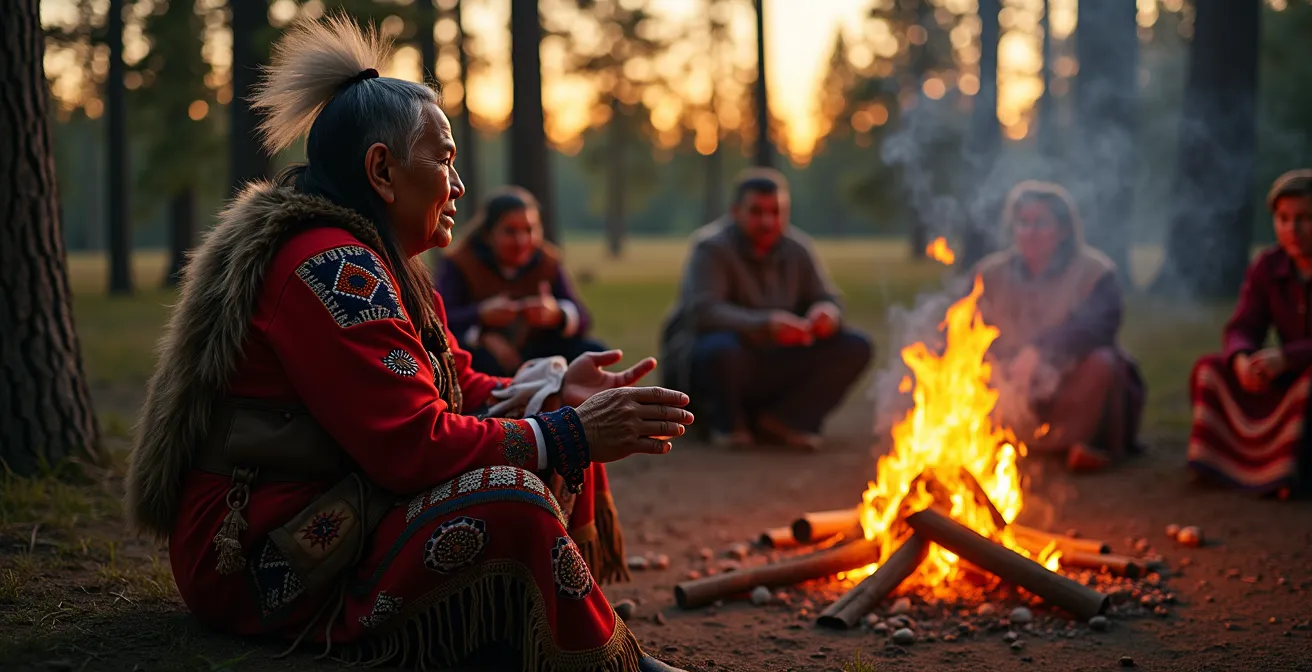
The most profound Indigenous travel experiences are not about what you see, but how you participate.
- True engagement means shifting from a passive spectator to an active, respectful guest invited into a living culture.
- Authenticity is guaranteed not by a checklist, but by choosing community-owned operators accredited for their commitment to cultural protocols and economic reciprocity.
Recommendation: Begin your journey by seeking experiences that emphasize storytelling and hands-on learning, and always verify operators through the Indigenous Tourism Association of Canada (ITAC).
The modern traveler craves connection, a genuine encounter that transcends the polished glass of a museum display. We journey across Canada’s vast landscapes not just to see, but to understand. Yet, when it comes to engaging with the vibrant, living cultures of First Nations, Inuit, and Métis peoples, a sense of uncertainty often prevails. The path of a respectful visitor can feel unclear, caught between the desire for authentic immersion and the fear of intrusive observation. Many travel guides offer simple advice: visit a cultural centre, see a historic site, or buy a craft. While well-intentioned, this approach often keeps us at arm’s length, perpetuating the role of the spectator gazing upon a culture, rather than a guest welcomed within it.
But what if the true measure of a transformative experience isn’t found in a photograph or a souvenir, but in the shared space of a story told, a meal prepared together, or a moment of quiet listening? The key is a profound shift in perspective: from consumption to co-participation. This is not about ‘doing’ things to a culture, but ‘being’ with a community. It’s a journey rooted in reciprocity, where your presence and your tourism dollars become a meaningful act of economic reconciliation and support for self-determination.
This guide moves beyond the surface to explore the “why” and “how” of deep cultural engagement. We will explore what it means to participate in hands-on workshops, the etiquette of listening to Elders, and how to ensure your journey contributes directly to the communities you visit. It is an invitation to learn the protocols of a good guest, transforming your travel from a passive tour into an unforgettable, shared human experience.
To help you navigate this journey from spectator to guest, this article will guide you through the essential aspects of respectful and immersive Indigenous tourism. We will cover everything from hands-on cultural workshops and accommodation protocols to the importance of supporting community-owned businesses and understanding the deeper meaning behind practices like land acknowledgements.
Summary: A Guide to Indigenous Tourism Experiences: Moving Beyond the Museum Display
- Making bannock vs. watching it: the value of hands-on culinary workshops?
- Tipi vs. Longhouse stays: what to expect in terms of comfort and amenities?
- The oral tradition: why listening to elders is the highlight of the tour?
- Member-owned businesses: ensuring your tourism dollars stay in the community
- Why pow wows are open to the public and when they happen?
- How to verify the “Igloo Tag” on Inuit carvings to ensure provenance?
- Why land acknowledgements are spoken at the start of events in Canada?
- Supporting local communities through Indigenous Tourism Association approved operators
Making Bannock vs. Watching It: The Value of Hands-On Culinary Workshops?
Food is a universal language, but in Indigenous tourism, it is also a library of stories. The difference between watching a demonstration and feeling the flour and dough in your own hands is the difference between reading a book’s summary and reading the book itself. Hands-on culinary workshops are not cooking classes; they are invitations into the heart of a community’s history, resilience, and connection to the land. When you learn to make bannock, you are not just mixing ingredients; you are participating in a tradition that has sustained people for generations, often in the face of immense hardship.
The value lies in the “why” behind the “what.” The stories shared by the host—about where ingredients are harvested, their ceremonial uses, or the ingenuity required to adapt recipes through history—are the main course. This act of co-participation builds a bridge of shared experience. It moves beyond a simple transaction and fosters a genuine, human-to-human connection. It is through these shared activities that a deeper understanding and a sense of reciprocity begin to form, turning a simple meal into a memorable lesson in cultural perseverance.
Case Study: Bannock and Clams in the Sand
On Lennox Island, a Mi’kmaq community on Prince Edward Island, the ‘Bannock and Clams in the Sand’ experience perfectly illustrates this principle. As detailed in a National Geographic feature on Indigenous Tourism, the experience emerged from conversations with community Elders about food security. They shared powerful stories of secretly baking bread in the sand to hide it from colonizers. The community transformed this story of survival into an immersive experience for visitors, combining the hands-on activity of making bannock with profound storytelling. It is a living example of how tourism can become a vehicle for both entertainment and authentic cultural exchange, directly from the source.
Ultimately, by participating, you are acknowledging that culture is not a static object to be observed, but a living, breathing practice to be shared.
Tipi vs. Longhouse Stays: What to Expect in Terms of Comfort and Amenities?
Choosing to stay in a traditional Indigenous dwelling is one of the most immersive ways to connect with a place and its people. However, understanding the difference between structures like a Plains Nations tipi and a Haudenosaunee longhouse is key to setting the right expectations for both comfort and cultural protocol. These are not simply “rooms” but are integral parts of a cultural worldview, each with its own history, purpose, and rules of conduct. A tipi, with its portable and conical design, reflects a life adapted to the vast prairies, while a longhouse represents a more permanent, communally-oriented society rooted in the woodlands of the East.
Modern Indigenous tourism operators have expertly blended tradition with hospitality. While you are staying in a historically significant structure, you can often expect modern comforts. However, the level of amenities can vary greatly. Some experiences offer a more rustic, close-to-the-land feeling with outdoor facilities, while others might incorporate features like heating, electricity, and private or indoor washrooms. It is crucial to read the experience description carefully. More importantly, arriving as a guest means being prepared to respect the specific cultural protocols of the dwelling, which your hosts will explain. This might include how to enter the space, where to sit, or understanding the social dynamics within a communal structure.
The following table provides a general overview to help you understand the fundamental differences between these two iconic structures.
| Aspect | Tipi (Plains Nations) | Longhouse (Haudenosaunee) |
|---|---|---|
| Structure | Conical, portable, buffalo hide/canvas | Rectangular, permanent, wood frame |
| Capacity | 4-8 people per dwelling | Multiple families, 20-60 people |
| Cultural Protocol | Enter clockwise, sit left of entrance | Matrilineal space, follow clan mother guidance |
| Modern Amenities | Heating, bedding provided, outdoor facilities | Indoor facilities, communal spaces, electricity |
| Best Season | Spring through Fall | Year-round accommodation |
This choice is your first act of participation, setting the stage for a respectful and deeply rewarding overnight experience far beyond that of a standard hotel.
The Oral Tradition: Why Listening to Elders is the Highlight of the Tour?
In a world saturated with visual information, the most profound part of an Indigenous tourism experience is often what you hear. The oral tradition is the bedrock of First Nations, Métis, and an Inuit cultures; it is the library, the legal system, and the spiritual guide all in one. Listening to an Elder share stories, teachings, or history is not a passive activity—it is the primary moment of co-participation. You are being invited into a sacred space of knowledge transfer that has existed since time immemorial. These stories are not just entertainment; they carry genealogies, land treaties, ecological knowledge, and moral teachings. They are the living breath of a culture.
This is where the shift from tourist to guest becomes most tangible. You are not there to extract information but to receive a gift. The experience is about presence and respect. As Inuk tour operator Erkloo explained in a National Geographic article on Canadian Indigenous Tourism, this is what separates authentic experiences from the mainstream:
Visitors aren’t just watching from the outside—they’re part of the community for that moment. That’s very different from traditional tourism. It’s shared, and it’s real.
– Erkloo, National Geographic article on Indigenous Tourism in Canada
Engaging respectfully in this exchange requires understanding certain protocols. It’s not like a typical Q&A session. It involves patient, active listening and showing gratitude through your attention and, often, through traditional offerings like tobacco. The silence between words is as important as the words themselves, allowing time for reflection. This is the heart of the journey, where you will find the connection you seek.
Your Action Plan: Protocol for Participating in Elder Storytelling Sessions
- Before the session: Prepare a tobacco offering wrapped in red cloth as a traditional gift of respect.
- Upon arrival: Wait to be invited to sit, typically in a circle formation, and avoid choosing a seat that may be reserved.
- During stories: Practice active listening without interrupting, even for questions. The time for clarification will come later.
- Non-verbal engagement: Make eye contact when culturally appropriate and nod to show you are listening and understanding.
- After the session: Thank the Elder personally for their time and teachings before asking any clarifying questions you may have.
By honouring this process, you are not just hearing a story; you are helping to carry it forward and becoming part of its long, unbroken chain.
Member-Owned Businesses: Ensuring Your Tourism Dollars Stay in the Community
When you choose an Indigenous tourism experience, your decision has power. It can be a simple commercial transaction, or it can be a direct act of economic reconciliation. The single most effective way to ensure your visit has a positive and lasting impact is to consciously choose businesses that are majority Indigenous-owned and operated. This ensures that the revenue generated flows directly back into the community, supporting not just the business itself but also local employment, youth programs, language revitalization, and cultural preservation initiatives.
Supporting member-owned businesses moves your role from consumer to partner. You are investing in a community’s self-determination and its ability to share its culture on its own terms. In Canada, this is a significant and growing sector. The Indigenous Tourism Association of Canada (ITAC) is a vital resource, representing a network of businesses committed to authenticity and community benefit. According to their research, there were 2,757 Indigenous tourism businesses identified in 2023 across the country, showcasing the immense diversity of experiences available.
These businesses are more than just tour companies; they are expressions of cultural pride and economic sovereignty. The impact is substantial. A report from the Conference Board of Canada highlights that the Indigenous tourism sector is a powerful economic force. For instance, recent investments and support programs distributed by ITAC and the Government of Canada have directed nearly $8.1 million in funding to close to 330 businesses, demonstrating a national commitment to fostering this growth. When you book with an Indigenous-owned operator, you become part of this positive economic story, ensuring that the legacy of your visit is one of empowerment, not extraction.
Before booking any tour or experience, always ask: “Who owns this business, and who benefits from my visit?” The answer to that question is the true mark of an ethical and impactful journey.
Why Pow Wows are Open to the Public and When They Happen?
The rhythmic pulse of the drum, the vibrant motion of dancers in intricate regalia, the collective energy of a community gathered—a pow wow is one of the most powerful and accessible expressions of living culture you can experience in Canada. Contrary to what some may think, most pow wows are public events. They are celebrations, social gatherings, and competitions where communities come together to share songs, dances, and traditions. The invitation to the public is a gesture of friendship and a chance for cross-cultural understanding. It is an open door, inviting you to witness and, at times, even participate.
The pow wow trail is most active during the warmer months, typically from May through September. A particularly significant time is National Indigenous Peoples Day on June 21st, when celebrations and pow wows happen in communities all across Canada. These events are often listed on community websites, regional tourism boards, or dedicated online resources like PowWows.com. Attending is an opportunity to support local artisans and food vendors who are an integral part of the event.
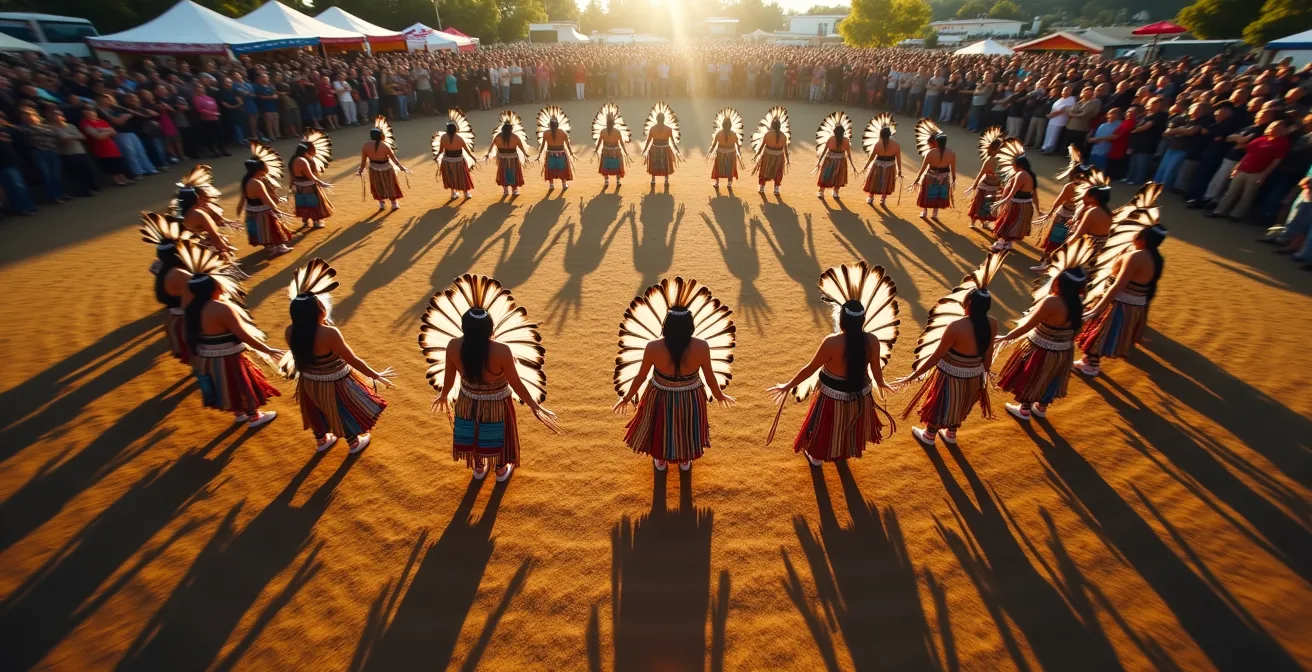
The most important part of attending is to do so with respect. Listen to the Master of Ceremonies (MC), who is the voice of the pow wow. The MC provides instructions, explains the different dances, and will announce when it is appropriate to take photos or when to stand in respect. A key moment of co-participation is the “Intertribal” dance. When the MC announces an Intertribal, everyone—Indigenous and non-Indigenous, young and old—is invited to enter the arbour and join the dance. This is not a performance; it is a moment of shared joy and community, and your respectful participation is warmly welcomed.
By following the guidance of the MC and participating when invited, you honour the spirit of the gathering and transform your experience from mere spectating to active, respectful appreciation.
How to Verify the “Igloo Tag” on Inuit Carvings to Ensure Provenance?
Bringing home a piece of art is a beautiful way to remember your travels, but in the context of Indigenous art, ensuring authenticity is an act of respect and economic support for the artist. The market is unfortunately filled with imitations, and buying an authentic piece guarantees the artist is fairly compensated for their skill and time. For Inuit art, the most reliable symbol of authenticity is the “Igloo Tag.” This trademark is managed by the federal government on behalf of Inuit artists and signifies that the work is handmade by an Inuk artist in Canada. When you purchase a carving or print with this tag, you are acquiring a piece with guaranteed provenance.
The Igloo Tag is a small sticker, often found on the bottom of a sculpture, that features a stylized igloo and a registration number. It’s a simple yet powerful tool for consumers to make ethical choices. However, authentication methods can differ across the diverse Indigenous cultures in Canada. While the Igloo Tag is specific to Inuit art, First Nations artists often provide a signed Certificate of Authenticity with their work, and Métis artisans may include documentation verifying their heritage and the story behind their beadwork. The most reliable place to purchase art is always from an Indigenous-owned gallery or directly from the artist at a studio or community event like a pow wow.
This comparative table can help you navigate the different forms of authentication you might encounter.
| Art Type | Authentication Method | What to Look For |
|---|---|---|
| Inuit Carvings | Igloo Tag (Federal) | Official sticker with igloo symbol and registration number |
| First Nations Art | Artist Certificate | Certificate of authenticity signed by artist with Nation affiliation |
| Métis Beadwork | Artisan Documentation | Artist statement with Métis citizenship verification |
| All Indigenous Art | Gallery Verification | Purchase from Indigenous-owned galleries with ITAC membership |
By taking these extra steps, you move beyond being a simple buyer to become a patron of an artist and a supporter of a living cultural tradition.
Why Land Acknowledgements are Spoken at the Start of Events in Canada?
If you attend almost any public gathering in Canada—from a hockey game to a city council meeting to a concert—you will likely hear a Land Acknowledgement. This practice, of formally acknowledging the traditional Indigenous territory on which the event is taking place, is a uniquely Canadian protocol rooted in a long history of Indigenous diplomacy. For a visitor, it can be a powerful entry point into understanding the deep connection Indigenous peoples have to their lands and the complex history of treaties (or lack thereof) across the country. A Land Acknowledgement is not just a formality; it is an act of respect and a conscious effort toward reconciliation.
It serves as a reminder that we are all on Indigenous land. It’s a statement of recognition, disrupting the colonial narrative by making Indigenous presence and stewardship visible. For the traveler, this practice offers a framework for your own journey. Before you visit a place, take a moment to learn whose traditional territory you will be on. Resources like the website native-land.ca can be an excellent starting point. This simple act of research fundamentally changes your perspective, transforming a generic “destination” into a specific Nation’s homeland, rich with its own history, language, and stories.
This practice connects directly to the broader mission of Indigenous tourism. As Keith Henry, President and CEO of ITAC, states, the link between tourism and reconciliation is direct and powerful. In response to the 2024 federal budget, he noted that “Investment in Indigenous tourism not only benefits the Canadian economy, it is always an avenue for reconciliation in Canada when led by Indigenous People.”
Investment in Indigenous tourism not only benefits the Canadian economy, it is always an avenue for reconciliation in Canada when led by Indigenous People.
– Keith Henry, ITAC President and CEO, Federal Budget 2024 Announcement
By understanding and perhaps even adopting your own personal practice of acknowledgement, you begin your visit not as an anonymous tourist, but as a mindful guest aware of the deep history of the land beneath your feet.
Key Takeaways
- Transformative Indigenous tourism is about active co-participation, not passive observation.
- Prioritize experiences that involve hands-on learning and storytelling to foster genuine connection.
- Always choose Indigenous-owned businesses and verify authenticity through programs like ITAC’s “The Original Original” to ensure your spending directly supports communities.
Supporting Local Communities Through Indigenous Tourism Association Approved Operators
You’ve embraced the mindset of a guest, not a spectator. You are ready to listen, participate, and ensure your visit is one of reciprocity. The final, most crucial step is translating this intention into action: how do you find and book these authentic, community-focused experiences? The answer lies with the Indigenous Tourism Association of Canada (ITAC) and its provincial partners. ITAC serves as the national voice for Indigenous tourism, and its primary role is to support and market authentic experiences that are ready to welcome visitors.
The most important tool for travelers is ITAC’s “The Original Original” accreditation program. When you see this mark, it is your assurance that a business is at least 51% Indigenous-owned and has met a rigorous set of quality standards. It signifies that the experience is not a caricature or imitation, but a genuine expression of culture shared by the community itself. Booking with an accredited operator is the single best way to guarantee the provenance of your experience and ensure your investment supports Indigenous self-determination. This is a sector with enormous potential for growth and positive impact; recent federal initiatives are expected to help attract an additional 187,000 tourists and create 200 new jobs, further strengthening community economies.
The ITAC website (destinationindigenous.ca) features a directory of accredited businesses, allowing you to filter by province, territory, and type of experience—be it adventure, culinary, or cultural. Whenever possible, book directly with the operator rather than through a third-party site. This ensures the maximum amount of revenue stays with the business and the community it supports. By using these resources, you are not just planning a trip; you are actively participating in a national movement of cultural revitalization and economic empowerment.
Your journey begins not when you arrive, but when you make the conscious choice to seek out and support the authentic, community-led experiences that are the heart and soul of Indigenous tourism in Canada. Start exploring the operators on Destination Indigenous today and prepare for a truly transformative adventure.
Frequently Asked Questions about Indigenous Tourism Experiences in Canada
When is the best time to attend pow wows in Canada?
Most public pow wows occur during summer months from May through September, with National Indigenous Peoples Day on June 21 featuring celebrations nationwide.
Can non-Indigenous visitors participate in the dances?
Yes, during ‘intertribal dances’ when announced by the Master of Ceremonies, all visitors are welcome to join the circle and dance alongside community members.
Is photography allowed at pow wows?
Photography policies vary by event. You must always ask permission before photographing individuals, especially dancers in their regalia, and never photograph during prayers or certain ceremonial moments. Listen for announcements from the MC.