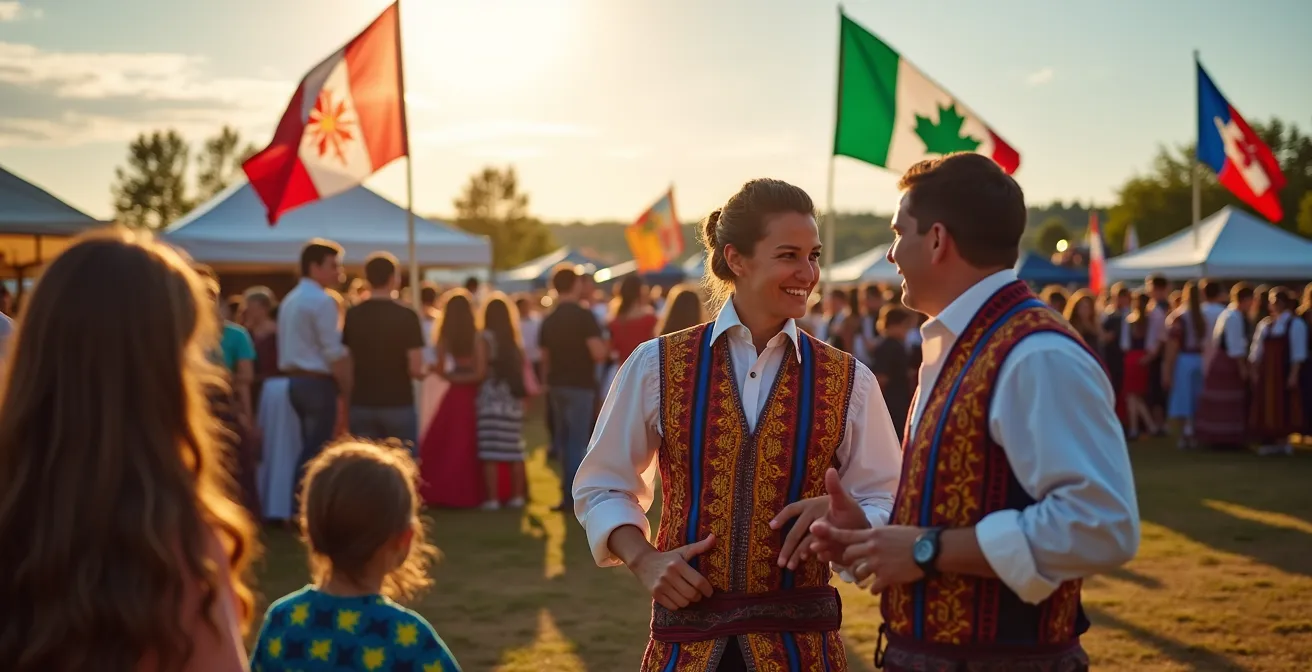
To truly experience Canada’s Francophone heritage, one must look beyond Quebec and appreciate the unique linguistic signatures and cultural resilience of communities from Acadia to British Columbia.
- Francophone communities outside Quebec have distinct dialects, traditions, and histories shaped by different paths of migration and survival.
- Engaging with these communities in French is not just polite; it’s a vital act that supports their cultural and institutional longevity.
Recommendation: Move past generic greetings and learn the key cultural and architectural markers that define each region’s unique French-Canadian identity.
When travelers think of French Canada, their minds often conjure images of Old Montreal’s cobblestone streets or Quebec City’s fortified walls. This perception, while understandable, overlooks a vast and diverse tapestry of Francophone life that thrives across the entire nation. For the curious traveler, a “hidden” French Canada exists in vibrant pockets from the Maritime coasts to the Pacific, home to nearly one million French speakers. The common approach is often superficial—learning a simple “bonjour” or visiting a town with a French name. However, this barely scratches the surface of a rich and complex identity.
The key to a deeper understanding lies not in treating these communities as monolithic extensions of Quebec, but in recognizing their profound individuality. This article abandons the generic tourist trail to adopt the perspective of a cultural historian. We will explore the distinct linguistic signatures of Acadian and Franco-Ontarian communities, understand the political weight behind a simple request for service in French, and identify the architectural DNA that tells a story of adaptation and resilience. By embracing this nuanced approach, a visit transforms from a simple sightseeing trip into a meaningful cultural exchange, unlocking a side of Canada that many visitors—and even many Canadians—never see.
This guide provides the tools to navigate this rich landscape. By exploring the unique dialects, social etiquette, and historical traditions of Canada’s diverse Francophone communities, you will be equipped to engage with them respectfully and authentically. The following sections will delve into the heart of what makes each region’s heritage distinct.
Summary: Navigating Francophone Heritage: Bilingualism Beyond Quebec’s Borders
- Acadia vs. Franco-Ontarian communities: distinct dialects explained for visitors
- Why asking for service in French matters in minority communities?
- How to find French services in Western Canada tourist hubs?
- Assuming everyone in New Brunswick speaks English fluently: a common error
- Learning key phrases to unlock deeper cultural connections in Manitoba
- French Regime vs. English Regime influence on Quebec homes: the differences
- Why New Year’s Day is traditionally more important than Christmas for families?
- Identifying New France Architecture: Characteristics of Ancestral Homes
Acadia vs. Franco-Ontarian communities: distinct dialects explained for visitors
The French spoken in Canada is far from uniform. The nearly one million Francophones living outside Quebec possess distinct linguistic heritages shaped by separate histories of settlement, isolation, and interaction with English. Two of the most prominent groups, the Acadians and Franco-Ontarians, offer a perfect example of this diversity. Their dialects are not mere variations; they are unique linguistic signatures telling the story of their origins.
Acadian French, heard primarily in the Maritime provinces, has roots in the Poitou-Charentes region of western France. Centuries of relative isolation following the British Conquest and the Great Deportation allowed it to preserve older pronunciations and vocabulary. A key feature is the use of archaic words like “char” for car. The dialect is also known for its melodic intonation and, in some areas like southeastern New Brunswick, its blend with English to form “Chiac,” a vibrant and often misunderstood hybrid language. For a visitor, recognizing this distinct historical path is crucial to appreciating the dialect’s legitimacy.
Franco-Ontarian French, by contrast, shares more similarities with Quebec French due to geographic proximity and continuous migration. However, it has its own unique flavour, heavily influenced by its status as a minority language surrounded by English. This has led to a greater adoption of anglicisms and a specific accent that differs from both Quebec and Acadian varieties. These communities have fought hard for their linguistic rights, making their dialect a symbol of cultural persistence in the heart of English-speaking Canada.

As this symbolic representation suggests, the linguistic landscape is a mosaic, not a monolith. For a traveler, understanding these differences is the first step toward genuine engagement. It’s not about mastering the dialects, but about acknowledging their existence and the unique histories they represent. Recognizing that the French of Moncton is not the French of Sudbury is a sign of profound respect.
Why asking for service in French matters in minority communities?
In a Francophone minority setting, choosing to speak French is more than a simple language preference; it’s a political and social act of solidarity. For travelers interested in heritage, understanding this is fundamental. Every time a customer initiates a conversation in French, they are casting a vote for the vitality and visibility of that community. This simple gesture sends a powerful message: that the language is valued, necessary, and alive. This is especially critical as Canada works to bolster its Francophone population, with 7.21% of immigrants outside Quebec being French-speaking in early 2024, contributing to the diversity and strength of these communities.
These communities have often had to fight for decades to secure government services, schools, and cultural institutions in their language. The availability of these services is frequently justified by demand. When French services are underutilized, they become vulnerable to budget cuts or elimination. Therefore, a traveler asking for a museum tour in French or ordering a coffee with a “je voudrais” is actively contributing to the data that proves these services are essential. It is a small but direct way to support the cultural resilience that has kept these communities thriving against the odds.
As the former Official Languages Commissioner of Canada highlighted in a key report, this act of speaking French has tangible consequences for the community’s survival.
Every request in French is a data point that helps justify the community’s resources and survival.
– Official Languages Commissioner, Building Bridges Report 2024
This principle transforms a simple transaction into a meaningful act of participation. It demonstrates an awareness that language rights are not a given but are the result of a continuous struggle. For the visitor, it’s an opportunity to move from a passive observer to an active ally in the preservation of Canada’s linguistic diversity. By choosing French, you are not just communicating; you are helping to sustain a heritage.
How to find French services in Western Canada tourist hubs?
While Francophone communities in Western Canada may be less concentrated than in the East, they are well-organized and vibrant. For a traveler, finding them is a matter of knowing where to look. Key cities like Winnipeg, Edmonton, Calgary, and Vancouver all have historic French quarters or strong community organizations that serve as hubs for French-language services, culture, and events. These are not just token presences; they are living communities with schools, theatres, and businesses that have sustained their heritage for generations. The key is to look for the institutional pillars: the cultural centres (like La Cité francophone in Edmonton) and community associations (like the Fédération des francophones de la Colombie-Britannique).
Case Study: St. Boniface, Winnipeg – A Francophone Hub in the Prairies
St. Boniface in Winnipeg represents one of the most successful Francophone communities outside Quebec. It is home to the Université de Saint-Boniface, the oldest French-language university in Western Canada. The community offers comprehensive French services including healthcare, education from kindergarten to university, and a vibrant cultural scene. This is most famously centered around the Festival du Voyageur, Western Canada’s largest winter festival celebrating French-Canadian and Métis culture, demonstrating a deep and living heritage right in the heart of the Prairies.
To help travelers navigate these hubs, the following table outlines some of the key resources available in major Western Canadian cities. These centres are often the best starting point for finding everything from French-language walking tours to local bakeries and bookshops.
| City/Region | French Population | Key Resources | Cultural Centers |
|---|---|---|---|
| Winnipeg (St. Boniface) | 40,000+ | Université de Saint-Boniface | Centre culturel franco-manitobain |
| Edmonton | 28,000+ | ACFA Alberta | La Cité francophone |
| Calgary | 35,000+ | Welcoming Francophone Community | Centre d’accueil francophone |
| Vancouver | 25,000+ | FFCB services | Maison de la Francophonie |
By targeting these specific neighbourhoods and organizations, a visitor can easily immerse themselves in the local Francophone scene. It’s an approach that requires a bit more research than simply wandering, but it unlocks a far richer and more authentic travel experience.
Assuming everyone in New Brunswick speaks English fluently: a common error
New Brunswick holds a unique position in Canada as its only officially bilingual province. This status, however, is often misunderstood by visitors. Many arrive assuming that bilingualism means everyone speaks English fluently and that French is merely a secondary or symbolic language. This assumption is a significant error that can lead to awkward interactions and a failure to appreciate the province’s complex linguistic identity. The reality is that while many are bilingual, significant portions of the population, particularly in northern and eastern regions like the Acadian Peninsula, live and work primarily in French.
The numbers themselves challenge the assumption of universal English fluency. In fact, statistics show that only about 34% of New Brunswick residents are bilingual. The province is more of a mosaic of French and English linguistic zones than a perfectly mixed entity. In regions with a strong Acadian heritage, French is the dominant language of daily life, from commerce to conversation. Assuming English service is available everywhere can be perceived not just as an inconvenience, but as a disregard for this deep-rooted cultural reality. It ignores the long history of language debates and the efforts made to preserve French in the province.

A culturally aware traveler should instead approach New Brunswick with curiosity and respect for its duality. Starting an interaction with a simple, neutral “Bonjour” is a widely accepted gesture that acknowledges the province’s official bilingualism. It allows the other person to respond in their language of comfort, creating a more respectful and authentic exchange. Rather than an error to be corrected, encountering a unilingual French speaker in New Brunswick should be seen as an authentic part of the travel experience—a direct connection to the living Acadian heritage that defines much of the province.
Learning key phrases to unlock deeper cultural connections in Manitoba
In Manitoba’s vibrant Franco-Manitoban community, language is a direct bridge to its unique history, which is deeply intertwined with that of the Métis people. Moving beyond generic French greetings and learning phrases that resonate with local culture can transform a simple interaction into a profound connection. This is not about perfect pronunciation, but about showing you’ve done your homework and recognize that Prairie French has its own character and history. Using a local colloquialism or referencing a key cultural institution signals a level of respect and curiosity that is deeply appreciated.
The influence of the Métis, who descended from European fur traders and First Nations women, is particularly important. Their language, Michif, is a unique blend of French nouns and Cree verbs. Acknowledging this connection is a powerful gesture. As linguistics expert Dr. Nicole Rosen from the University of Manitoba notes, using a greeting in Michif shows a profound level of respect for the intertwined history of French and Indigenous peoples on the Prairies. This demonstrates an understanding that goes far beyond a textbook version of Canadian history.
To facilitate this deeper connection, here are a few key phrases and cultural references to learn before visiting Franco-Manitoban communities like St. Boniface:
- Learn “Comment ça va?” with the local pronunciation to show familiarity with Prairie French.
- Master “C’est bien l’fun!” (That’s really fun) — a common Canadian French colloquialism that shows cultural fluency.
- Ask about “Le Festival du Voyageur” to demonstrate awareness of Manitoba’s premier French cultural event.
- Reference “Le Cercle Molière,” Canada’s oldest continuously operating French theatre company, when discussing arts.
- Use “Tawnshi” (the Michif greeting for “hello, how are you?”) to acknowledge the foundational Métis-French connection.
These are not just words; they are keys. They unlock conversations, show genuine interest, and open doors to understanding the specific cultural identity of the Franco-Manitoban people. This effort to learn and use culturally specific language is the essence of respectful and meaningful travel.
French Regime vs. English Regime influence on Quebec homes: the differences
While Quebec is the heartland of New France architecture, the stylistic influences of the French and English regimes can be seen in historic buildings across Canada. Understanding the key differences in their architectural DNA allows a traveler to “read” a building’s history, whether in old Quebec or in a Francophone settlement in Ontario. These are not just aesthetic choices; they are reflections of different eras, technologies, and cultural priorities. The French Regime style was born of necessity and adaptation to the Canadian climate, while the later English Regime style introduced new materials and different aesthetic ideals.
Even outside Quebec, Francophone communities have maintained and adapted these architectural traditions. The modern Centre culturel francophone de Vancouver, for example, consciously reinterprets the steep-pitched roofs of New France architecture but adapts them with West Coast materials like cedar and glass. Similarly, the new Acadian Museum in Moncton uses traditional log construction techniques but reimagines them with contemporary sustainable materials. This shows how Francophone communities maintain architectural connections to their heritage while embracing regional influences and modern innovations.
The following table breaks down the primary characteristics of each style, as well as how they are being reinterpreted in modern Francophone architecture, providing a clear guide for identifying these influences in the wild.
| Feature | French Regime Style | English Regime Style | Modern Francophone Revival |
|---|---|---|---|
| Roof Design | Steep-pitched for snow shedding | Gentler slopes, Georgian influence | Modernized steep angles with solar integration |
| Foundation | Raised stone foundations | Ground-level brick | Elevated designs for flood resilience |
| Windows | Small dormers, limited glass | Large sash windows | Triple-glazed with traditional proportions |
| Materials | Local stone, timber | Imported brick, lumber | Sustainable local materials with heritage aesthetics |
By paying attention to these details—the pitch of a roof, the size of the windows, the foundation material—a traveler can begin to see the layered history of a place. It transforms buildings from static objects into dynamic storytellers of cultural transition and persistence.
Why New Year’s Day is traditionally more important than Christmas for families?
For many French-Canadian families, especially in Quebec, “le Jour de l’An” (New Year’s Day) has historically overshadowed Christmas as the primary occasion for family gatherings and celebration. This tradition dates back to a time when the Catholic Church emphasized the religious solemnity of Christmas, leaving New Year’s as the main secular holiday for feasting, gift-giving, and receiving the paternal blessing. However, this is another area where assuming a single, monolithic French-Canadian culture can be misleading. Different Francophone communities have developed their own distinct festive priorities based on their unique histories.
A prime example is found in Acadian communities. While they also celebrate the holidays, their principal cultural gathering is the “Tintamarre” on August 15th, Acadian National Day. This is a joyous and noisy parade where people march through the streets with pots, pans, and instruments to “make a racket.” This tradition doesn’t commemorate a calendar date so much as it commemorates Acadian identity and resilience, specifically marking their survival after the Great Deportation. It demonstrates how a community’s core celebration can be tied directly to its foundational historical trauma and triumph, rather than the agricultural or religious calendars that shaped Quebec’s traditions.
This diversity is also reflected in culinary traditions. The festive foods prepared by a Franco-Ontarian family can be different from those in Manitoba or Acadia, each showing regional influences. Here are some examples of distinct regional holiday foods:
- Quebec New Year’s: Traditional ‘ragoût de boulettes’ (meatball stew) and ‘tourtière’ (a specific type of meat pie).
- Acadian Celebrations: ‘Pâté à la viande’ (a meat pie with different spicing than tourtière) and ‘ployes’ (buckwheat pancakes).
- Franco-Manitoban Tradition: Dishes inspired by ‘pemmican’, blending Métis and French culinary heritage.
- Franco-Ontarian Custom: ‘Cipaille’ (a layered meat pie), which can show British influence on French cuisine.
- West Coast Francophone: Incorporation of Pacific salmon into traditional French-Canadian recipes.
For a traveler, understanding these different festive priorities is key. It reveals that French-Canadian culture is not static but is a living, evolving entity with deep regional roots. Inquiring about local traditions, whether it’s New Year’s or the Tintamarre, shows a level of cultural curiosity that goes far beyond surface-level tourism.
Key takeaways
- Canada’s Francophone identity is a mosaic of distinct cultures, not a monolith centered on Quebec.
- Actively using French in minority communities is a meaningful act of support for their cultural and institutional survival.
- Regional architecture, dialects, and traditions are “linguistic signatures” that tell the unique story of each community’s history and resilience.
Identifying New France Architecture: Characteristics of Ancestral Homes
With a foundational understanding of architectural styles, a traveler can turn any visit to a historic Francophone community into an engaging scavenger hunt. The ancestral homes and churches found from Nova Scotia to Manitoba are living documents of history, adaptation, and cultural fusion. Identifying the key characteristics of New France architecture—and its regional variations—is a skill that enriches any journey through these heritage landscapes. It’s about noticing the details: the way a roof is pitched to handle snow in Ontario, or how a home in British Columbia incorporates wide eaves to manage rain, all while retaining a core French-Canadian design ethos.
The architectural DNA is not always pure. In the Prairies, for example, you can see the fusion of French and Métis building techniques, such as the “poteaux-sur-sol” (post-on-sill) log construction of the Red River region. This method, different from the stone-heavy style of Quebec, tells a story of resourcefulness and cultural exchange. Recognizing these subtle but significant variations is the ultimate goal for a cultural explorer. It’s a testament to how a foundational architectural style was adapted to new climates and local materials, creating something uniquely regional yet recognizably French-Canadian.
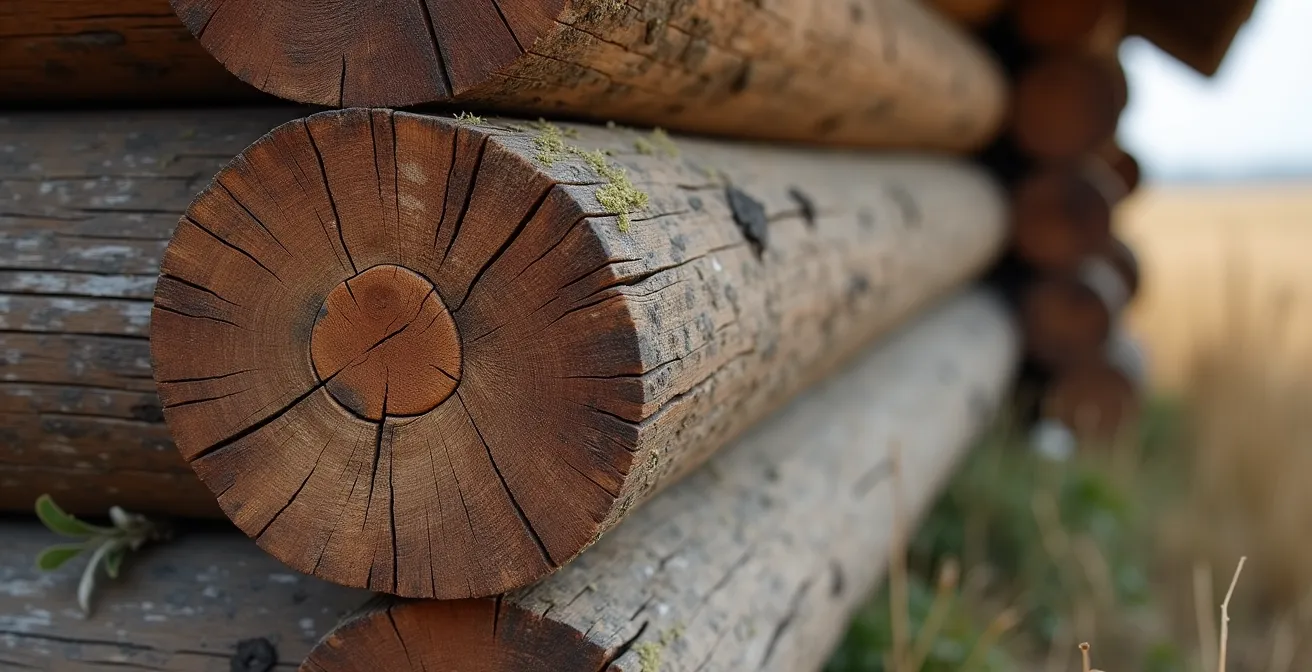
This close-up view of traditional joinery highlights the craftsmanship and material knowledge that defines this unique architectural heritage. To help you put this knowledge into practice, here is a practical checklist for your next architectural exploration.
Your Francophone Architecture Audit Plan
- Identify Key Sites: Before you visit, list potential architectural points of interest in the area (e.g., St. Boniface Cathedral in Manitoba, Our Lady of Assumption Cathedral in Gravelbourg, Saskatchewan).
- Gather Visual Elements: On-site, inventory the defining features of a building. Note the roof style (steep-pitched, bell-cast), window type (small dormers, large sash), and primary materials (local stone, pine logs, brick).
- Check for Coherence: Compare your observations to the classic characteristics of New France architecture. Does the building have a raised foundation? Are the walls fieldstone? Note any deviations.
- Spot Regional Adaptations: Identify features that are unique to the region versus those that are classic French. Is the roofline modified for local weather (e.g., West Coast rain)? Is there evidence of cultural fusion (e.g., Métis construction techniques)?
- Build the Narrative: Synthesize your findings to tell the building’s story. How does it represent both its French heritage and its local environment? What makes it distinct from a similar building in Quebec?
Armed with this approach, you are no longer just looking at old buildings. You are deciphering a language of resilience, adaptation, and identity written in stone, timber, and glass.
Now, go beyond the guidebooks and start your exploration. By seeking out these communities and engaging with them on their own terms, you participate in the living story of Francophone Canada.
Frequently Asked Questions on Navigating Francophone Heritage: Bilingualism Beyond Quebec’s Borders
Should I always start with ‘Bonjour’ in New Brunswick?
Yes, starting with ‘Bonjour’ is a neutral gesture that acknowledges the province’s official bilingualism and shows respect for both language communities.
What if someone responds only in French?
This likely means they are more comfortable in French. You can politely indicate if you need English service, but be aware that in some regions like the Acadian Peninsula, French is the primary language of commerce.
Is it offensive to assume English service is available everywhere?
In certain regions of New Brunswick, this assumption can be perceived as ignoring the province’s unique bilingual identity and long history of language debates. Being open to French service shows cultural awareness.