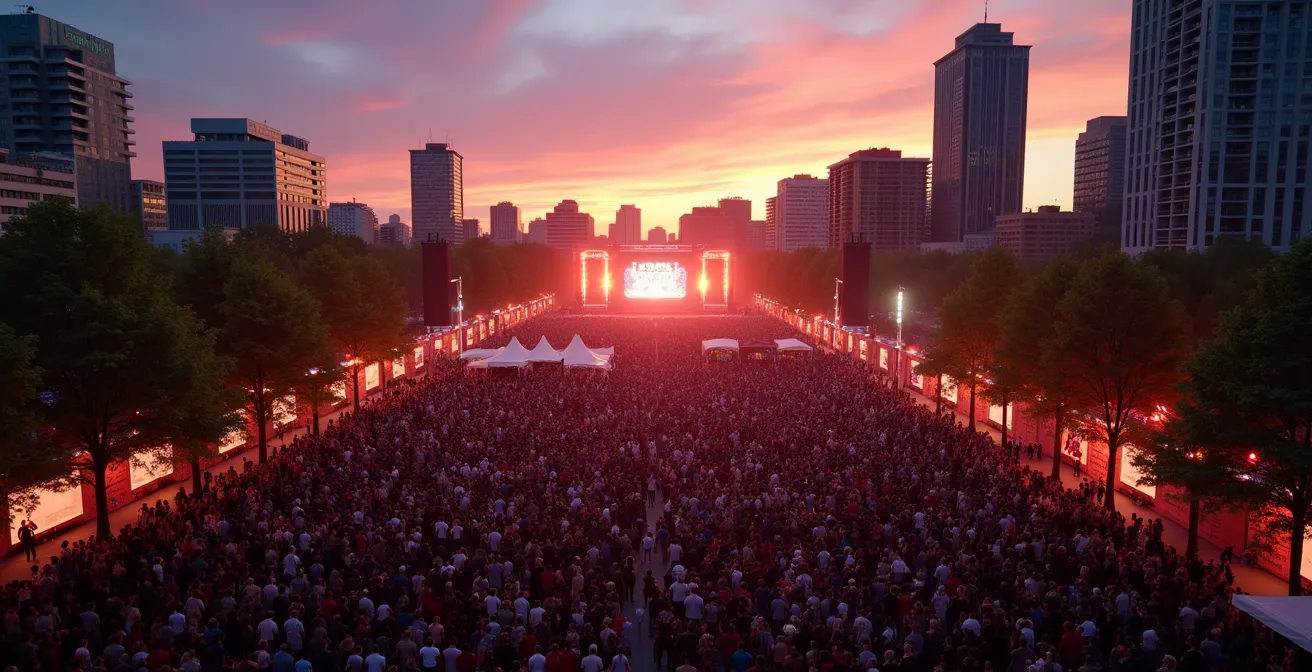
The secret to mastering the Montreal Jazz Festival isn’t finding the best shows; it’s mastering the logistics the crowds don’t know about.
- The vast majority of world-class performances are free, but require strategic positioning and timing to truly enjoy.
- Effectively navigating massive crowds and intense summer heat involves using hidden city infrastructure and a specific thermal strategy.
Recommendation: Shift your mindset from spectator to strategist. Plan your accommodation, food, and movement with this insider playbook to unlock the true, immersive festival experience.
The first time you step into the Quartier des Spectacles during the Festival International de Jazz de Montréal, the feeling is pure electricity. The air thrums with a dozen different rhythms, the streets are a river of people, and the energy is intoxicating. But for many first-time visitors, that initial thrill can quickly turn to overwhelming panic. How do you possibly navigate this? How do you find the good stuff without getting lost in a sea of people? The standard advice is predictable: “check the program,” “wear comfortable shoes,” “stay hydrated.” While true, this advice barely scratches the surface.
This isn’t a guide about which headliners to see. This is a logistical playbook from an organizer’s perspective. The real magic of the festival isn’t just on the main stages; it’s in the spaces between. It’s in knowing how to build a world-class musical journey for free, how to move through a crowd of 100,000 people with ease, and where the musicians *really* go to play when their official sets are over. The difference between a stressful tourist experience and an unforgettable local immersion lies in mastering this hidden curriculum.
We’re about to decode the festival’s operational DNA. We’ll cover the strategic value of booking accommodation months in advance, the art of the late-night jam session, and the thermal strategies required to not just survive, but thrive in Montreal’s notorious July humidity. This is your guide to experiencing the festival with the confidence and knowledge of a seasoned insider.
This article provides a comprehensive logistical framework for your visit. Explore the sections below to master each aspect of the festival experience, from managing your budget to navigating the city’s hidden pathways.
Summary: Your Insider’s Playbook for the Montreal Jazz Festival
- Free vs. Ticketed: building a world-class itinerary without spending a dime?
- Navigating the Place des Festivals: moving through 100,000 people safely
- Booking hotels 6 months out: the cost of waiting until lineup announcement
- Late-night jam sessions: where to see the stars play after their main set?
- Surviving the humidity: dressing for Montreal’s intense July heatwaves
- Kensington Market vs. St. Lawrence Market: which Toronto food tour fits your vibe?
- Delays caused by official state visits or protests: how to check status?
- Holidays in Quebec: Surviving the Cold While Embracing the Magic
Free vs. Ticketed: building a world-class itinerary without spending a dime?
The biggest misconception about the Montreal Jazz Festival is that you need expensive tickets to see top-tier talent. The reality is that the festival’s core is its massive free outdoor program. With around 450 free outdoor performances out of 650 total concerts, the free offering isn’t a secondary attraction; it’s the main event. The key isn’t spending money, but spending your time wisely. Building a “free” world-class itinerary is a game of geography and timing.
The strategy is to treat the free stages—like the main TD Stage at the Place des Festivals, the Scène Rogers, and the Rio Tinto Stage—like appointments. Arriving 30-45 minutes early for a popular act isn’t just about getting a good view; it’s about securing a spot with comfortable acoustics and an easy exit path. The biggest mistake visitors make is trying to wander into a major free show at the last minute, only to find themselves stuck at the back, unable to see or hear properly.
Beyond the music, a zero-dollar day can be incredibly rich. The festival’s perimeter is designed for strolling, and you can easily spend an afternoon just soaking in the atmosphere, discovering street performers, and enjoying the city’s vibe. Combine this with a strategic picnic plan, sourcing local products from nearby markets, and you’ve curated an experience that is both affordable and authentically Montrealais.
Action Plan: Your Strategic Free Festival Navigation
- Secure Spots: Arrive early at key free stages like TD Stage and Scène Rogers. No tickets are needed, but prime real estate is your currency.
- Master Transit: Download the Montreal-made Transit App for real-time STM metro updates to navigate between venues and avoid street-level congestion.
- Curate Your Picnic: Use the metro to shop at Jean-Talon Market (Orange Line) or Atwater Market (Green Line) for Quebec cheese curds, local strawberries, and craft beer.
- Explore Off-Festival: Venture into the Mile End and Plateau neighborhoods. Many local bars and cafes host smaller, less crowded jazz events that are often free or have a small cover.
- Follow the Artists: Monitor the Instagram stories of Montreal musicians. They often post last-minute, impromptu jam sessions or park performances.
Navigating the Place des Festivals: moving through 100,000 people safely
The sheer scale of the main festival site, the Place des Festivals, can be daunting. For the major free “Big Event” concerts, attendance records show crowds can swell to 100,000 or even 150,000 people. Moving through this dense human landscape requires a logistical mindset, not brute force. The golden rule of crowd dynamics here is simple: never move against the current. Observe the main flow of foot traffic and use the designated perimeters and crosswalks. Trying to cut directly through the centre of a packed crowd is the quickest way to get stuck and frustrated.
However, the ultimate insider trick for navigating the Quartier des Spectacles is to go underground. Montreal’s RESO (UGC), or “underground city,” is a network of tunnels connecting metro stations, shopping malls, and buildings. During the festival, it becomes a secret weapon. When the streets are packed and the sun is blazing, you can dip into the Place-des-Arts metro station and use the air-conditioned tunnels to bypass the most congested areas, emerging closer to your next destination, refreshed and stress-free. It’s the city’s built-in escape route.
This underground passage is the perfect visual for the festival’s logistical playbook: a hidden, more efficient path that most tourists don’t even know exists.
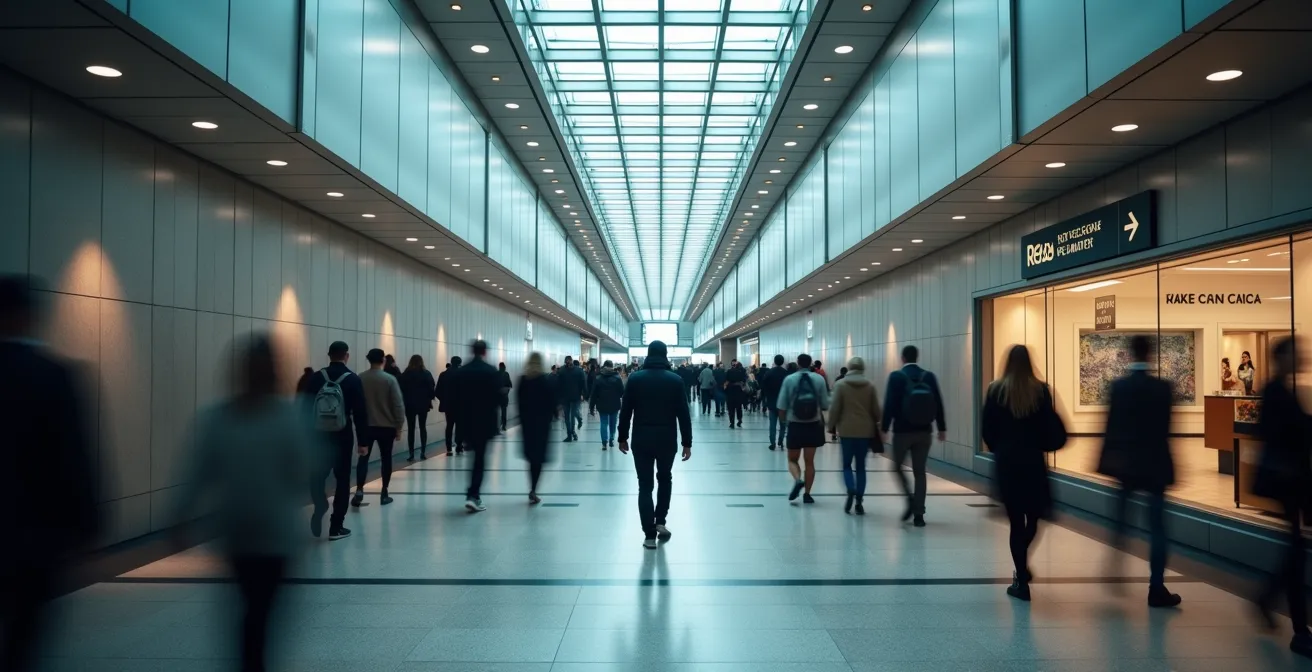
As the image illustrates, these corridors offer a calm and spacious alternative to the street-level chaos. Learning the key entry and exit points of the RESO around the festival site (like Complex Desjardins and Place des Arts) is a pro-level move that transforms your ability to move between venues. It’s not just about safety; it’s about preserving your energy for the music.
Booking hotels 6 months out: the cost of waiting until lineup announcement
Here is one of the most critical pieces of logistical advice: book your accommodation long before you even know who is playing. The Montreal Jazz Festival is a massive tourism driver, and waiting for the official lineup announcement in the spring is a costly mistake. The secret is that veteran festival-goers and international tourists book their hotels based on the festival’s dates, not its artists. They know the quality will be there regardless.
As soon as the festival dates are announced (usually a year in advance), the clock starts ticking. The price difference between booking 6 months out versus 1-2 months out isn’t incremental; it’s exponential. Hotels in the downtown core, within walking distance of the Place des Festivals, can see their prices double or triple as the event approaches. Even alternative options like Airbnbs in the Plateau or budget-friendly hotels on the South Shore (a short metro ride away) get snapped up quickly. A particularly savvy option is to look into university residences (like those at McGill or Concordia), which open up to the public in the summer and offer basic, affordable rooms in prime locations.
The following data, based on typical booking patterns, starkly illustrates the financial penalty of procrastination. This isn’t just about saving money; it’s about having options. Waiting too long might not just cost you more—it might leave you with no viable options at all, as many places are completely sold out weeks in advance.
This comparative analysis from festival visitor data on TripAdvisor highlights the dramatic price escalation across different accommodation types.
| Booking Window | Downtown Hotel | Plateau/Mile End | South Shore (Longueuil) | University Residences |
|---|---|---|---|---|
| 6 months advance | $180-250/night | $140-180/night | $90-120/night | $60-80/night |
| 3 months advance | $280-400/night | $200-280/night | $120-160/night | $80-100/night |
| 1 month advance | $450-600/night | $350-450/night | $180-250/night | Limited availability |
| Festival week | Mostly sold out | $500+/night | $300+/night | Not available |
Late-night jam sessions: where to see the stars play after their main set?
The official festival program is only half the story. The city’s deep jazz roots and tradition come alive after midnight in what locals call the “unofficial program”: the late-night jam sessions. This is where you can see world-famous headliners, freed from the constraints of their big-stage setlists, playing in an intimate club setting with local musicians. Finding these sessions is the holy grail for any serious music lover, and it requires a bit of detective work and an understanding of the local scene’s history.
These impromptu concerts aren’t widely advertised. They are a continuation of a tradition that has defined Montreal’s jazz identity for decades. The key is to know the legendary venues that have historically hosted these events. Bartenders, sound engineers, and veteran festival staff are your best source of real-time information. A friendly chat can often yield a tip about where a particular artist might be heading after their show. Additionally, monitoring social media hashtags like #montrealjazz and #fijm on Instagram and Twitter can reveal last-minute announcements from musicians or fans in the know.
Remember jam session etiquette: these are musicians’ spaces. Be respectful, order drinks between songs, keep conversation to a minimum during performances, and never use flash photography. Applaud the solos, and you’ll be welcomed as part of the inner circle.
Case Study: The Enduring Legacy of Montreal’s After-Hours Scene
Montreal’s jazz history, as documented by sources like The Canadian Encyclopedia’s history of the festival, was built in legendary clubs like Rockhead’s Paradise. This established a culture of late-night jam sessions that continues today. Upstairs Jazz Bar & Grill, an intimate 120-seat venue, is the modern torchbearer of this tradition. It regularly hosts impromptu performances by festival artists after their main sets, creating the authentic, electric atmosphere that once attracted icons like Oscar Peterson. Checking their late-night schedule (or just showing up after 11 PM) is a classic strategy for catching festival magic. Other key spots to watch include Dièse Onze on St-Denis, another hub for spontaneous late sets.
Surviving the humidity: dressing for Montreal’s intense July heatwaves
Montreal in July is a tale of two climates: the sweltering, humid outdoors and the powerfully air-conditioned indoors. A successful thermal strategy isn’t just about dressing for the heat; it’s about dressing for the extreme temperature swings. The humidity can make 30°C (86°F) feel like 40°C (104°F), especially within a dense crowd. Your clothing choices are a critical piece of your logistical equipment.
The key is strategic layering. Start with a base layer made of a modern, moisture-wicking fabric (like merino wool or a synthetic blend). This will pull sweat away from your skin, which is essential for comfort in high humidity. Cotton, while breathable, absorbs moisture and can leave you feeling damp and sticky. Over this, a light, loose-fitting outer layer like a linen shirt or a thin cotton cover-up is perfect. It protects you from the sun’s direct rays without trapping heat.
This layering system is also your defense against the “metro-freeze.” The STM metro and indoor venues are often heavily air-conditioned. Having that light second layer to throw on prevents you from getting chilled after being in the heat. Essential accessories include a wide-brimmed hat, UV-protection sunglasses, and comfortable walking shoes rated for standing on concrete for 8+ hours. Finally, the most important accessory is a refillable water bottle; the festival site has numerous free water stations to help you stay hydrated, which is your first line of defense against the heat.

That moment of relief from a cooling fountain or a cold drink is what keeps you going. A proper thermal strategy ensures you can comfortably enjoy the festival from a sunny afternoon performance to a cool, air-conditioned late-night show. Your wardrobe is as important as your schedule.
Kensington Market vs. St. Lawrence Market: which Toronto food tour fits your vibe?
While Toronto’s famous Kensington and St. Lawrence Markets offer incredible food experiences, the savvy Montreal Jazz Festival attendee knows that Montreal has its own world-class market scene, perfectly suited for assembling the ultimate festival picnic. The strategy isn’t just about finding food, but about integrating a culinary adventure into your festival logistics. The city’s two main markets, Jean-Talon and Atwater, offer distinct experiences and are both easily accessible via the metro system.
Jean-Talon Market, located on the Orange Line, is the heart of Montreal’s “Little Italy” and offers a sprawling, authentic experience. It’s the best place for fresh Quebec produce like local strawberries and blueberries, and it’s famous for its vendors selling squeaky-fresh cheese curds—a provincial specialty. It’s bustling, vibrant, and a true taste of local life. Atwater Market, on the Green Line and near the Lachine Canal, has a more gourmet, curated feel. It’s renowned for its high-quality butcher shops, cheese stores, and prepared food counters, making it ideal for quickly assembling a high-end picnic with artisanal sausages and a great selection of local craft beers.
Choosing between them depends on your goal. Are you looking for an immersive, authentic shopping experience or a quick, gourmet grab-and-go? Both are a short metro ride from the festival grounds, allowing you to bring a delicious, cost-effective meal right to the heart of the action. The grassy areas near the Musée d’art contemporain are coveted spots for a pre-show picnic.
To plan your culinary mission, consider the specific strengths and logistical details of Montreal’s premier markets. This approach transforms a simple meal into a memorable part of your festival journey.
| Market Feature | Jean-Talon Market | Atwater Market | Marché Maisonneuve |
|---|---|---|---|
| Metro Access | Orange Line (Jean-Talon) | Green Line (Lionel-Groulx) | Green Line (Pie-IX) |
| Distance to Festival | 25 min by metro | 20 min by metro | 30 min by metro |
| Specialty Items | Quebec cheese curds, local berries, ethnic foods | Gourmet meats, wine selection, prepared foods | Organic produce, artisanal breads, local honey |
| Best For | Authentic local experience | Quick gourmet assembly | Off-beaten-path discovery |
| Price Range | $ to $$ | $$ to $$$ | $ to $$ |
Delays caused by official state visits or protests: how to check status?
Montreal is a major international city, and the summer festival season can sometimes coincide with large-scale events like official state visits, major conferences, or public protests. These can lead to unexpected road closures, altered bus routes, and significant metro delays. As a festival-goer moving between venues, staying ahead of these disruptions is a crucial part of your logistical planning. Relying solely on a static schedule is a recipe for missed shows and frustration.
The key to navigating these potential disruptions is to adopt a real-time, digital-first approach. Your smartphone is your most powerful tool. The STM (Société de transport de Montréal) has a robust presence on social media, and its Twitter account is often the fastest source for information on service interruptions. Furthermore, Montreal is a city perpetually under construction, affectionately known for its ubiquitous “orange cones.” Spontaneous road closures for construction are common, making real-time traffic apps essential even if you are walking or biking.
It’s also wise to enable push notifications on the official Jazz Festival app. While it won’t report on city-wide traffic, it will provide immediate alerts for any last-minute venue changes, schedule delays, or cancellations within the festival itself. Being proactive with these digital tools turns potential chaos into a manageable inconvenience, allowing you to adjust your plans on the fly and ensure you still make it to your next set on time.
Checklist: Your Digital Toolkit for Real-Time Festival Navigation
- Install the App: Download the Montreal-based Transit App. It provides best-in-class, real-time data for STM metro and bus schedules, including disruption alerts.
- Follow on Twitter: Follow @STM_info on Twitter for the most immediate official alerts on service interruptions, provided in both French and English.
- Check Road Closures: Monitor @CirculationMTL for real-time updates on road closures, major traffic jams, and the infamous “orange cone” construction zones.
- Enable Notifications: Turn on push notifications for the official Jazz Fest app. This is your primary source for any direct changes to festival venues or performance times.
- Learn Key Terms: Familiarize yourself with key French transit terms to quickly understand alerts: ‘arrêt de service’ (service stopped) is critical, while ‘ralentissement’ (slowdown) is less severe.
Key Takeaways
- Master the Free Program: The majority of the festival’s best music is free; strategic planning of your time and position is more valuable than a ticket.
- Use the Underground: Leverage Montreal’s RESO network to bypass street-level crowds and heat, preserving your energy and time.
- Book Accommodation Early: Secure your hotel or rental 6+ months in advance, based on festival dates, not the lineup, to avoid extreme price hikes and sell-outs.
Holidays in Quebec: Surviving the Cold While Embracing the Magic
While many tourists associate holidays in Quebec with surviving the formidable winter cold, the province’s true cultural magic arguably ignites in the summer. Montreal’s explosive festival season is a direct and joyous response to the long, quiet winters—a city-wide phenomenon of embracing every moment of warmth and daylight with a unique intensity. The Jazz Festival, anchoring 10 days of non-stop celebration, is the epicentre of this “Carpe Diem” summer. To attend isn’t just to see music; it’s to participate in a core part of the city’s annual rhythm and cultural identity.
This collective energy is palpable. It’s why two million people descend on the downtown core, creating an atmosphere that is both exhilarating and, without the right strategy, exhausting. Understanding this cultural context is key to appreciating the festival’s spirit. The crowds, the late nights, the sheer density of events—it’s all part of a city making up for lost time. Even the moments of escape, like ducking into the air-conditioned halls of the Musée d’art contemporain or the Grande Bibliothèque, are part of the dance, offering cultural immersion alongside physical relief.
As an organizer, I see the festival as more than a series of concerts; it’s a temporary city built on joy. The experience is a business phenomenon, but its soul is communal. As Martin Roy, President of Festivals and Major Events (FAME), noted in a CBC News analysis on the growth of Montreal’s festivals:
Millennials are very interested by festivals. And urban tourism is getting bigger. It’s also a business phenomenon.
– Martin Roy, President of Festivals and Major Events (FAME)
By using the logistical playbook in this guide, you’re not just “surviving” the festival. You are unlocking the ability to fully participate in this incredible urban celebration, moving through it with the ease and confidence of a local.
Now that you have the insider’s playbook, the next step is to start putting it into action. Begin planning your visit not as a tourist, but as a strategic participant ready to experience the very best of what the Montreal International Jazz Festival has to offer.