A land acknowledgement is more than a polite formality; it is the entry point to understanding distinct Indigenous legal orders and building genuine, long-term relationships.
- Effective acknowledgements require moving beyond generic scripts to actively learn the specific history and Indigenous laws of a territory.
- Respectful engagement depends on recognizing the complex dual governance systems of Band Councils and Hereditary Chiefs, and the vast diversity among First Nations.
Recommendation: Shift your focus from simply reciting words to embodying the principle of reciprocity—learning, listening, and taking tangible actions to support the Indigenous communities whose lands you visit.
For many visitors and residents in Canada, the practice of opening an event with a land acknowledgement has become a familiar occurrence. We hear the words spoken, often noting the names of the First Nations, Métis, or Inuit peoples on whose traditional territory the gathering takes place. It is easy to view this as a modern procedural step, a polite nod to history or a box to be ticked for institutional compliance. This perspective, however, misses the profound depth and purpose behind the practice.
The common approach often stops at the “what”—the script itself. But the true meaning lies in the “why.” A land acknowledgement is not a historical plaque; it is intended as a living, breathing act of respect and a commitment to a relationship. It is the first step in a much longer journey of understanding the complex legal, social, and spiritual frameworks that have governed these lands for millennia. To engage meaningfully is to look beyond the statement and into the worldviews it represents.
This guide moves past the script. It is designed for the respectful visitor who seeks to understand the foundational protocols of engagement with First Nations. We will explore why this practice exists, the crucial nuances of terminology, the dual leadership structures you will encounter, and the spiritual significance of the land itself. The goal is to transform your understanding from one of public statement to one of personal relationship, turning a passive acknowledgement into an active and ongoing process of reconciliation.
To navigate this complex and essential topic, this article is structured to build your understanding step-by-step. Below is a summary of the key areas we will explore, designed to equip you with the knowledge needed for respectful and informed engagement.
Summary: Understanding Indigenous Protocols and Land Acknowledgements
- Why land acknowledgements are spoken at the start of events in Canada?
- Indigenous vs. Aboriginal vs. Indian: using the correct legal and respectful terms
- Band Council vs. Hereditary Chiefs: understanding the dual leadership structures?
- Why some hiking trails are closed for spiritual reasons?
- Cree vs. Ojibwe: recognizing that “First Nations” involves distinct languages and laws
- How to ask respectful questions at a Pow Wow without causing offense?
- Acadia vs. Franco-Ontarian communities: distinct dialects explained for visitors
- Indigenous Tourism Experiences: Moving Beyond the Museum Display
Why land acknowledgements are spoken at the start of events in Canada?
The widespread adoption of land acknowledgements in public and private settings is a relatively recent phenomenon in Canada, becoming much more common following the release of the Truth and Reconciliation Commission’s final report in 2015. The Commission’s 94 Calls to Action urged all sectors of Canadian society to engage in reconciliation, and acknowledgements were seen as a visible first step. However, this practice is not new; it is an adaptation of a protocol that Indigenous peoples have followed since time immemorial, recognizing and respecting neighbouring nations when entering their territories.
For Indigenous peoples, acknowledging the land is a foundational act of relationship and respect. It situates individuals and events within a specific place and honours the enduring presence, knowledge, and stewardship of the host Nation. Today, a meaningful acknowledgement serves a dual purpose: it honours the Indigenous connection to the territory while also prompting non-Indigenous participants to reflect on the history of that land and their own place within the ongoing story of colonialism and reconciliation. As the City of Toronto notes in its implementation, the practice requires thinking about both past events and the future changes needed.
The critical challenge is to prevent these statements from becoming empty, performative gestures. A true acknowledgement is a starting point, not a conclusion. It must be connected to genuine learning and tangible action to have any meaning. Without this commitment, it risks becoming another form of tokenism that obscures rather than illuminates the path to reconciliation.
Action Plan: The Learn, Acknowledge, Act Framework
- Learn: Before you acknowledge, take time to learn. Use resources to deeply reflect on where you are, whose traditional territory you are on, and your own relationship to that place and its history.
- Acknowledge: Craft a personalized acknowledgement that goes beyond a generic script. It should honour the specific Indigenous presence, knowledge systems, and ongoing care for the land you are on.
- Act: Include real, tangible commitments in your engagement. This can mean offering your time, providing financial support to local Indigenous initiatives, or making a genuine commitment to listening, learning, and amplifying Indigenous voices.
Indigenous vs. Aboriginal vs. Indian: using the correct legal and respectful terms
Navigating the terminology used to refer to the original peoples of this land is a critical aspect of respectful engagement. The terms “Indian,” “Aboriginal,” and “Indigenous” are not interchangeable; each carries specific legal, historical, and social weight in the Canadian context. Using them correctly demonstrates an understanding of and respect for the distinct identities and rights of First Nations, Métis, and Inuit peoples.
The term “Indian” is now considered outdated and often offensive in general conversation due to its colonial origins and inaccuracies. However, it remains a legal term in Canada, embedded in historical documents like the Indian Act (1876) and used to define legal status (e.g., “Status Indian”). The term “Aboriginal” is a legal term recognized in the Constitution Act of 1982, which affirms the rights of the “Aboriginal peoples of Canada,” defined as including the Indian, Inuit, and Métis peoples. In contrast, “Indigenous” is the modern, preferred term used globally, including in the UN Declaration on the Rights of Indigenous Peoples. It is an umbrella term that is widely accepted in everyday conversation and academic discourse.
While these broad terms have their place, the highest form of respect is to use the specific name of the Nation. Canada is home to hundreds of distinct First Nations, each with its own language, culture, and laws. Identifying someone as Anishinaabe, Mi’kmaq, or Haudenosaunee, for example, honours their specific identity rather than grouping them under a pan-Indigenous label. If you are unsure, the most respectful approach is to ask, “What Nation are you from?” or “What is the most respectful way to refer to your community?” This simple act of asking shows a willingness to learn and a commitment to genuine respect.
| Term | Context | Example Usage |
|---|---|---|
| Indian | Legal/Historical Documents | Indian Act (1876), Status Indian registration |
| Aboriginal | Constitutional/Legal Rights | Constitution Act Section 35 (1982) recognizes Aboriginal rights |
| Indigenous | Modern Preferred Usage | UN Declaration on Rights of Indigenous Peoples, everyday conversation |
| Specific Nation Name | Most Respectful | Anishinaabe, Mi’kmaq, Haudenosaunee Confederacy |
Band Council vs. Hereditary Chiefs: understanding the dual leadership structures?
A frequent point of confusion for visitors is understanding who holds leadership authority within a First Nation. This often stems from an unfamiliarity with the dual governance systems present in many communities: the elected Band Council and the traditional Hereditary Chiefs. These are not interchangeable roles; they represent two different sources of authority, one imposed by Canadian law and the other rooted in millennia of Indigenous legal tradition.
The Band Council system, composed of a chief and councillors, was imposed on First Nations by the Canadian federal government through the Indian Act. These leaders are elected by community members for fixed terms, and their jurisdiction primarily covers administrative matters on reserve lands as defined by the federal government. In contrast, Hereditary Chiefs (a term that can vary by Nation, e.g., Wet’suwet’en ‘Wing Chief’ or Haudenosaunee ‘Hoyaneh’) inherit their roles and responsibilities through ancient kinship systems and are often seen as stewards of a Nation’s traditional laws, spiritual practices, and unceded territories.
This duality is not merely symbolic; it has profound real-world consequences, as seen in the conflict over pipeline construction in Wet’suwet’en territory, which highlighted the tension between the Indian Act-imposed Band Councils (some of whom supported the project) and the Hereditary Chiefs, who asserted their authority over the unceded land and opposed it. For a visitor, knowing who to engage depends on the context: for administrative matters on a reserve, the Band Council is the appropriate contact. For matters of traditional protocol, ceremony, or access to traditional territories, engaging with Hereditary Chiefs is essential. The key is to research the specific governance model of the Nation you are visiting, as not all Nations use both systems.
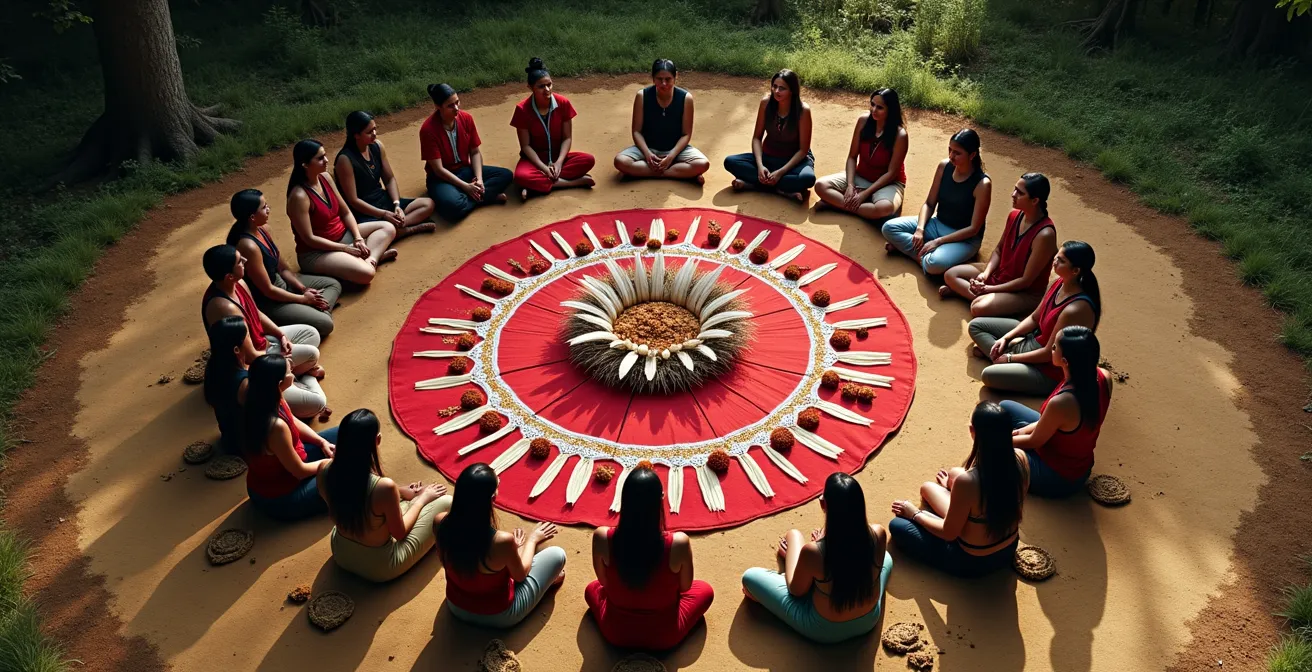
As this image suggests, traditional governance often emphasizes circular, consensus-based models that stand in stark contrast to the hierarchical systems imposed by colonial governments. Recognizing this difference is fundamental to understanding the political landscape of many First Nations today.
Why some hiking trails are closed for spiritual reasons?
For many visitors, a “closed” sign on a hiking trail or natural area can be a source of frustration, often interpreted as an access issue. However, when these closures are initiated by a First Nation, they are rarely about exclusion. Instead, they are an assertion of sovereignty and an expression of a worldview where the land is a living relative that requires periods of rest, healing, and ceremony. Understanding this perspective is key to respecting these decisions.
From an Indigenous worldview, land is not a resource to be exploited or a backdrop for recreation. It is Mother Earth, the source of all life. Certain areas are considered sacred sites, akin to churches or temples, used for spiritual ceremonies that cannot be disturbed. Closures may be necessary to conduct these private ceremonies or to protect the land during these sensitive times. It is an act of stewardship, ensuring the spiritual integrity of a place is maintained.
Furthermore, many closures are seasonal and directly linked to the principle of reciprocity—the idea that if you take from the land, you must also give back. This includes:
- Harvesting Periods: Trails may be closed to allow for the undisturbed harvesting of traditional medicines, roots, or berries. The protocol often involves offering tobacco to the land as a sign of respect before taking anything.
- Regeneration: Just like humans, the land needs time to rest and heal from human impact. Temporary closures allow ecosystems to regenerate, ensuring their health for future generations.
- Animal Migrations: Areas may be closed to protect wildlife during critical periods like mating or birthing seasons.
A visitor’s responsibility is to see these closures not as an inconvenience, but as a teaching. They are a reminder that we are guests on the land and that our desire for recreation does not supersede the land’s need for healing or a Nation’s need for spiritual practice. Respecting a closure is a simple yet powerful act of reconciliation.
Cree vs. Ojibwe: recognizing that “First Nations” involves distinct languages and laws
One of the most significant errors a visitor can make is to assume that “First Nations” or “Indigenous” refers to a single, monolithic culture. The reality is that Canada is home to a vast diversity of distinct Nations, each with its own unique language, history, cultural practices, and, crucially, its own legal order. To speak of Cree and Ojibwe culture as if they are the same is as inaccurate as equating French and German culture simply because both are European. True respect begins with recognizing this deep diversity.
This diversity is profoundly reflected in treaty-making traditions. The numbered treaties in the Prairies, involving Cree and Ojibwe Nations, were written agreements with the Crown, whereas the Peace and Friendship Treaties in the Maritimes with the Mi’kmaq were based on oral agreements about relationships. In the Great Lakes region, the “Dish With One Spoon” wampum represents a legal covenant between the Anishinaabe and Haudenosaunee for sharing resources peacefully. These are not just historical artifacts; they are living legal frameworks that continue to inform a Nation’s relationship with the land and its neighbours.
This legal and cultural distinctiveness is made clear when looking at the different approaches to treaty-making and governance across the land now called Canada.
| Treaty Type | Nations Involved | Territory | Legal Tradition |
|---|---|---|---|
| Numbered Treaties (1-11) | Cree, Ojibwe, others | Prairies & Northern Ontario | Written agreements with Crown |
| Peace & Friendship Treaties | Mi’kmaq, Wolastoqiyik | Maritimes | Oral agreements focused on relationship |
| Dish With One Spoon | Anishinaabe, Haudenosaunee | Great Lakes region | Wampum belt covenant for sharing resources |
| Robinson Treaties | Anishinaabeg | Northern Ontario | Land cession with hunting/fishing rights |
Modern tools like Native Land Digital are invaluable resources for visitors, as they map not only traditional territories but also the hundreds of distinct languages and treaties. As an Indigenous-led organization, its work helps to correct colonial narratives by encouraging territory awareness in everyday life. Using such tools is an active way to learn and honour the specific Nation whose land you are on, moving beyond generic labels to a more informed and specific form of respect.
How to ask respectful questions at a Pow Wow without causing offense?
A Pow Wow is a vibrant and powerful celebration of Indigenous culture, identity, and community. For a non-Indigenous visitor, it is an incredible opportunity to witness beautiful traditions, but it can also be a source of anxiety. Fear of saying or doing the wrong thing can prevent meaningful interaction. The key to respectful engagement is to approach the event not as a tourist consuming a performance, but as a guest invited to a community celebration.
Curiosity is welcome, but how you ask questions matters immensely. The most common mistakes stem from treating spiritual items as “costumes” or commercial goods. The clothing worn by dancers is called regalia, not a costume. Each piece is often handmade, holds deep personal and spiritual significance, and tells a story. Asking how much it cost or if you can touch it is highly inappropriate. Instead, frame questions around learning and appreciation.
Here is a simple guide to help you navigate conversations:
- Green Light Questions: Focus on understanding. Ask, “Your regalia is beautiful; is there a story behind it you are comfortable sharing?” or “Could you tell me about the meaning of this dance?”
- Red Light Questions: Avoid questions that commodify or objectify. Never ask, “Is that a real headdress?” “How much did your outfit cost?” or “Can I try it on?”
Protocol also dictates certain actions. It is a sign of tremendous respect to offer tobacco to an Elder or dancer before asking for their time or knowledge. Furthermore, always ask for permission before taking a photograph of someone, especially a dancer in their regalia. During certain moments, such as prayers, honour songs, or when the Master of Ceremonies (MC) explicitly prohibits it, photography is never allowed. Listening to the MC is your most important guide throughout the event.
Acadia vs. Franco-Ontarian communities: distinct dialects explained for visitors
While the primary focus of this guide is on First Nations protocols, a holistic understanding of Canada’s cultural landscape requires acknowledging its other deep-rooted complexities, including the diversity within its Francophone populations. Just as “Indigenous” is not a monolith, neither is “French Canadian.” For a visitor, recognizing the distinct identities of communities like the Acadians and Franco-Ontarians is another layer of respectful engagement with Canadian history.
The Acadian community traces its roots to 17th-century French settlers in the Maritimes, long before the British conquest. Their history is defined by the Great Upheaval (Le Grand Dérangement) of 1755, a forced deportation that scattered their people but ultimately forged a resilient and distinct identity. Their dialect often incorporates older French terms and can blend with English in a unique way known as ‘Chiac’ (e.g., “J’ai parké mon char”). The Acadian flag, a tricolor with a golden star, is a powerful symbol of their unique heritage.
In contrast, Franco-Ontarian identity is primarily linked to the migration of French speakers from Quebec into Ontario, largely during the 19th and 20th centuries. Their language has been shaped by close contact with Anglophone Ontario, leading to different anglicisms and expressions. They too have a strong sense of identity, symbolized by their green and white flag, and have fought hard to maintain their linguistic and cultural institutions. Both communities represent Canada’s largest Francophone minority populations outside Quebec, and their living languages are central to their identity, not a “bad” or “incorrect” form of French.
The cultural resilience of these Francophone minorities, who have maintained their linguistic identities despite immense pressure to assimilate, offers a parallel to the struggles and successes of Indigenous nations. In all cases, a visitor’s respect is shown by acknowledging these distinct histories and identities rather than defaulting to broad, homogenizing labels.
Key takeaways
- A land acknowledgement’s true purpose is to initiate an ongoing relationship, not to simply recite a script.
- Understanding the difference between Indian Act-imposed Band Councils and traditional Hereditary Chiefs is crucial for respectful political and territorial engagement.
- True respect lies in recognizing the vast diversity of First Nations—each with its own distinct language, laws, and culture—rather than using a single, generic “Indigenous” label.
Indigenous Tourism Experiences: Moving Beyond the Museum Display
After learning the history and protocols, the final and most important step is to act. For a visitor, this means actively seeking out and supporting authentic Indigenous tourism experiences. This is a critical part of reconciliation, allowing Indigenous peoples to reclaim their narratives, share their cultures on their own terms, and generate economic benefits for their communities. It represents a powerful shift away from experiences where Indigenous culture is a static display in a museum to one where it is a living, breathing encounter led by Indigenous guides.
As Indigenous tourism operators have established, these experiences are vital to the reconciliation process. They allow visitors to encounter cultures authentically while empowering Indigenous people to narrate their own stories in their own voices. For example, Wikwemikong Tourism on Manitoulin Island offers land-based learning with local knowledge keepers, drummers, and storytellers, fostering true relationship-building through shared history and language. This is the future of Indigenous tourism: participatory, educational, and transformative.
As a respectful traveller, your responsibility is to ensure your tourism dollars support genuinely Indigenous-owned and -operated businesses. The Indigenous Tourism Association of Canada (ITAC) has made this easier through its ethical tourism checklist. When choosing an experience, you should:
- Look for businesses that are at least 51% Indigenous-owned. ITAC’s “Original Original” mark is a reliable indicator that a business adheres to these and other responsible travel values.
- Verify that the guides are from the local Nation whose territory you are on.
- Ask how the experience benefits the wider Indigenous community, not just the individual operator.
- Choose participatory, land-based experiences over those that position you as a passive spectator.
By making conscious choices, you move beyond acknowledgement and become an active participant in a more equitable and respectful form of tourism. This is reconciliation in action.
Your journey of understanding does not end here. The next time you travel in Canada, seek out authentic, Indigenous-owned tourism experiences to continue learning, listening, and building the respectful relationships that are at the heart of reconciliation.